
June Jobs Report Forecasts Predict Another Month of Healthy Growth
With another strong jobs report, the Fed is forecast to resume rate hikes.


Forecasts are calling for the June jobs report to show another strong month of employment gains for Americans, suggesting the Federal Reserve is likely to raise interest rates again at its next meeting.
“The economy only needs to sustain jobs growth of about 100,000 or less to sustain ‘steady-state’ employment based on current population growth,” says Kevin Cummins, chief U.S. economist at NatWest. “Right now we’re more than double that,” he says.
After the May jobs report showed robust growth, economists are expecting another month of healthy gains in June. Nonfarm payroll employment is expected to post an increase of 205,000, according to FactSet’s consensus estimates. That would follow an increase of 339,000 in May and 294,000 in April.
“There’s no indication that we’ll see a significant deceleration in the June figures,” Cummins says. He believes the continued strength of the labor market has allowed the economy to continue to advance. “The longer the labor market strength stays persistent, the less likely we are to tip into a recession.”
Beyond June, “it will be pretty hard to see a turning point ahead of time, when the trend does change,” Cummins explains. “With the tightening that the Fed has put in place over the past 15 months, we assume things will slow down and we will probably experience a fairly mild recession beginning later this year,” he says. “In that case, we will see jobs growth fall pretty quickly.”
Historically, Cummins says, jobs growth tends to continue for several months and then suddenly fall into losses to the tune of hundreds of thousands per month. “When jobs growth stops, it usually plummets rather than moderates.”
June Jobs Report Forecast Consensus
- Nonfarm payroll employment to rise 205,000 versus the 339,000 increase in May, according to FactSet.
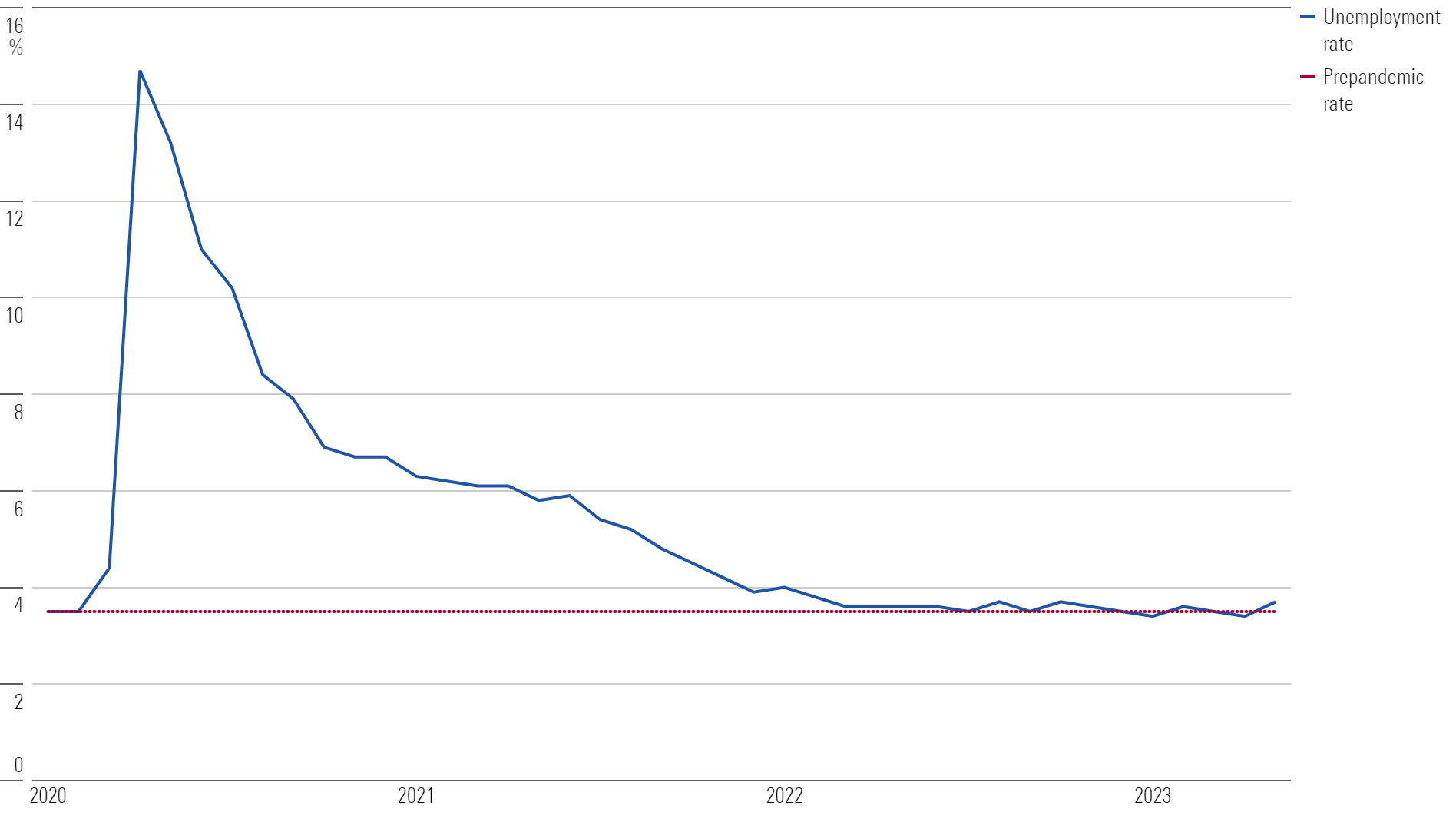
- Unemployment rate to come in at 3.6%, which would be a step down from 3.7% in May.
- Hourly earnings to rise 0.3%, matching the rise they saw in May.
Cummins expects an increase in nonfarm payrolls of around 240,000 for June, above the consensus forecast but still “a step down from where we were in April.”
Hourly earnings are expected to rise 0.3% after increasing by the same amount in May. Forecasts show the unemployment rate ticking down to 3.6%, remaining near historically low levels.
Why Has the Jobs Market Stayed So Strong?
“Over the course of the last year, payrolls have outperformed expectations by close to 100,000 jobs per month on average, and that’s almost unheard of,” Cummins says.
Resilience in the labor market has been driven partly by the economic reopening that took place after the COVID-19 lockdowns, according to Cummins. “During COVID, there was an enormous amount of fiscal stimulus that allowed people to spend a lot more as they started to venture out and take vacations,” he says.
Spending growth on hospitality and other related services accompanied the rise in travel, Cummins says. “The demand for workers has been so strong that it’s sort of self-reinforcing. As businesses hire people and keep them on board, wage growth has picked up because of the tightness in the labor market, and that allows people to continue to spend.”
At some point, Cummins predicts, the excess savings people built up during the height of the pandemic will start to run out. “The process has taken much longer than most have been thinking,” he says. “For a long time now, we’ve been thinking that the economy would slow.”
Unemployment Rate
Jobs Report Seen Keeping the Fed Hawkish
For now, “The Fed is still leaning in a hawkish direction, suggesting that there’s more tightening ahead,” Cummins says. “The likelihood is that the Fed will have to hike rates again in July, assuming we don’t see a jobs number that shocks the markets.”
Cummins notes that Fed chair Jerome Powell has clearly communicated the possibility of raising the federal-funds rate by an additional 0.25 percentage points at the July 25 and 26 Federal Open Market Committee meeting. That would bring the Fed’s target rate to a range of 5.25%-5.50%.
In its fight against inflation, a key metric the Fed is focused on has been core services excluding housing. “The Fed sees this as the big category for understanding future core inflation,” Cummins says. “Because wages make up a big part of determining the prices of those services, the labor market is really key to understanding inflation in this category.” He explains that while the latest numbers have shown some movement in the right direction, “the Fed will want to see more evidence that the labor market is slowing before it will feel comfortable that inflation is really slowing.”
The author or authors do not own shares in any securities mentioned in this article. Find out about Morningstar’s editorial policies.

 United States