
Markets Brief: Back on Recession Watch?
A disappointing jobs report has sparked recession fears, and all eyes are on the Fed’s upcoming move on interest rates.


Jobs Disappoint and Recession Alarm Bells Ring
Friday’s July job report showed that the economy added 114,000 jobs in July, significantly lower than the forecast 175,000. The unemployment rate also rose to 4.3% from 4.1% in June, against the estimate that it would hold steady.
Until Friday, stock investors had taken any news of a softer economy as proof that there would soon be room for the Federal Reserve to cut interest rates. But the jobs report spooked the market, and the Morningstar US Market Index fell 1.98% at the close on Friday.
One reason for worry is that the unemployment rate is now over half a percentage point above the lowest three-month average from the previous year, a condition that the “Sahm Rule” holds has always preceded an economic recession. But as Morningstar chief US economist Preston Caldwell explains, while the rule has some value, it may not be as reliable for predicting the future as some might think.
Fed Tees Up a September Rate Cut, but How Much?
Wednesday’s FOMC meeting ended without a July interest rate cut but with signals pointing toward a likely September cut, although Fed Chair Jerome Powell said that more benign inflation data would be needed first. However, the Jobs report has investors wondering if the central bank will act more aggressively come September. Traders in the bond market now estimate that the Fed will cut rates by half a percentage point in September, rather than the previously anticipated quarter-point cut. While Caldwell doesn’t think that is the base case, he does see an extended period of rate cuts stretching through 2025.
Four Magnificent Seven Stocks Report Earnings
Microsoft MSFT, Meta Platforms META, Amazon AMZN, and Apple AAPL reported their second-quarter earnings in the past week.
Microsoft’s report, released July 30, was in line with analyst expectations, and a projection that Azure revenue would accelerate throughout the rest of the year caused analysts to raise their revenue growth estimates and profitability assumptions. The stock’s fair value estimate rose from $435 per share to $490.
Meta’s revenue increased 22% to $39.1 billion in the quarter, and analysts forecast continued strong cash flows, especially thanks to strong digital advertising demand. Analysts raised their fair value estimate to $450 per share from $400 following the firm’s July 31 earnings call.
Amazon and Apple reported earnings on Aug. 1. Analysts for Amazon raised their fair value estimate from $193 per share to $195 following solid results and enhancements to profitability and efficiency. Apple’s fair value also rose from $170 per share to $185, although the stock remains overvalued. The company forecasts double-digit iPhone revenue growth for fiscal year 2025, driven by consumers upgrading iPhones to stay on top of the latest AI improvements.
Looking ahead, two big pharma companies are reporting their second-quarter earnings this week. Eli Lilly LLY and Novo Nordisk NVO are two of the primary obesity drug manufacturers, and the boom in such drugs is still going strong, which will surely be reflected in their earnings.
Disney DIS is also reporting its earnings for the previous quarter. While analysts don’t expect significant changes in its numbers, they’re keeping an eye on impacts from the company’s recent streaming bundle with Max and its studio’s successes at the box office.
Highlights of This Week’s Market and Investing Events
- Monday, August 5: Earnings from, Palantir Technologies PLTR
- Tuesday, August 6: Earnings from Uber Technologies UBER
- Wednesday, August 7: Earnings from The Walt Disney Company DIS
- Thursday, August 8: Earnings from Eli Lilly LLY
Check out our full weekly calendar of economic reports, consensus forecasts, and corporate earnings.
For The Trading Week Ended August 2
- The Morningstar US Market Index fell 2.38%.
- The best-performing sectors were utilities, up 3.66%, and real estate, up 2.13%.
- The worst-performing sector was technology, down 4.64%.
- Yields on 10-year US Treasury notes fell to 3.8% from 4.2%.
- West Texas Intermediate crude prices fell 4.04% to $74.04 per barrel.
- Of the 702 US-listed companies covered by Morningstar, 220, or 31.3%, were up, 3 were unchanged, and 479, or 68.2%, were down.
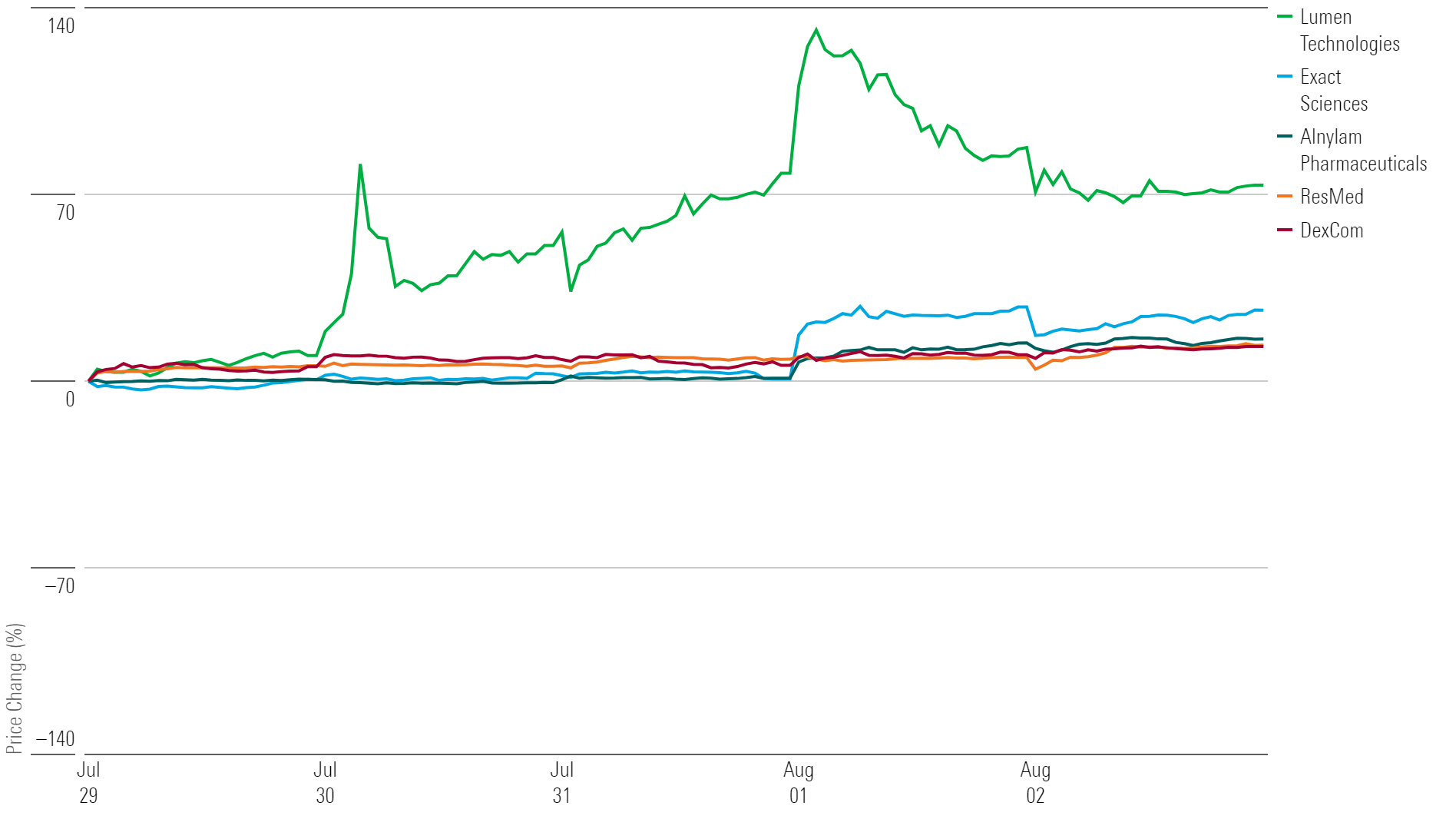
What Stocks Are Up?
Lumen Technologies LUMN, Exact Sciences Corporation EXAS, Alnylam Pharmaceuticals ALNY, ResMed RMD, DexCom DXCM
Best-Performing Stocks of the Week
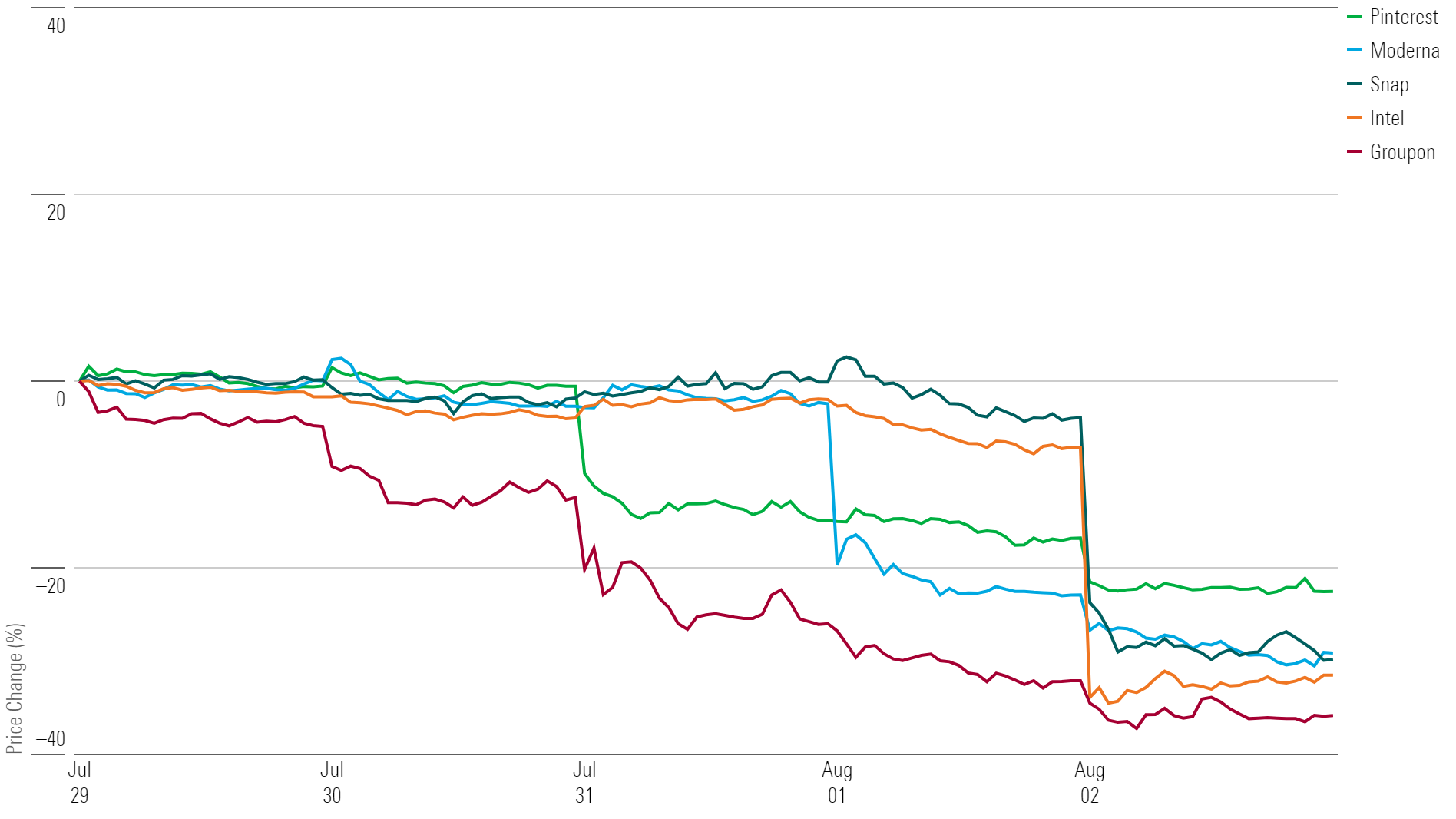
What Stocks Are Down?
Groupon GRPN, Intel INTC, Snap SNAP, Moderna MRNA, Pinterest PINS
Worst-Performing Stocks of the Week
The author or authors do not own shares in any securities mentioned in this article. Find out about Morningstar’s editorial policies.

 United States