
What Caused the Stock Market Selloff?
Investors worry that a recession is back on the table.


Monday was one of the toughest days in years for the stock market.
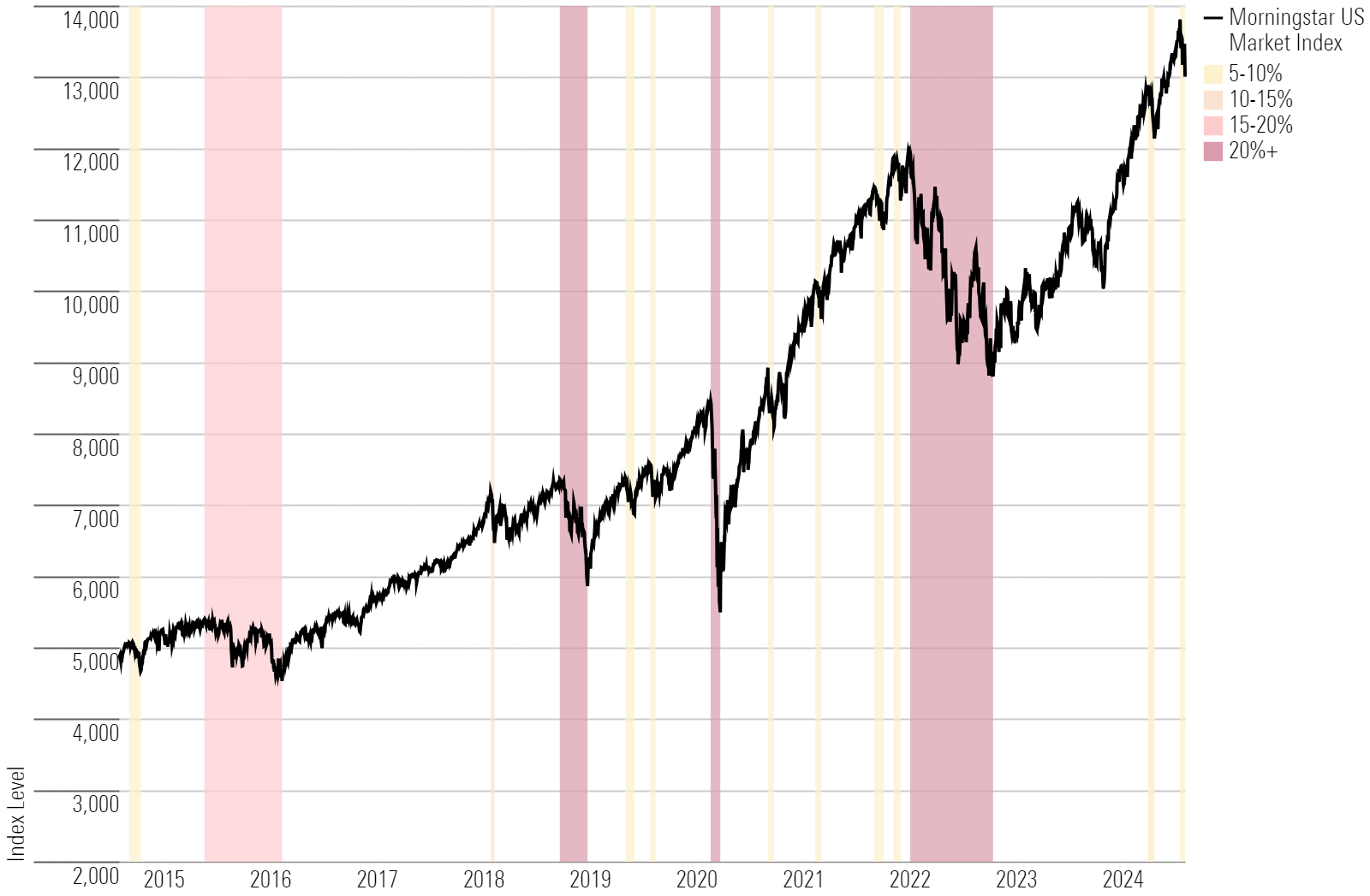
Investors woke up to a painful selloff, with the Morningstar US Market Index down 2.5% in mid-morning trading. Stocks pared some losses over the day but eventually fell even lower, with the index down 2.96% at the close. The worst losses were concentrated in the mega-cap growth stocks that have driven the lion’s share of the stock market’s returns this year.
Japanese stocks fell more than 12% overnight after their worst session in decades. Meanwhile, yields on the 10-year Treasury note slid below 3.8% to their lowest levels since last June.
It was a dramatic turnaround after two years of blockbuster returns driven by enthusiasm over artificial intelligence, resilient corporate profits, and the prospect of a rare soft landing for the economy. The US Market Index has risen more than 14% over the past 12 months and nearly 4% since its most recent bottom in April, when fears of a reacceleration in inflation sent stocks falling. The market hit its latest record high in the middle of last month, when a sudden rotation saw tech stocks stumble while small caps and value stocks rallied.
Stock Market Pullbacks
Why Is the Market Selling Off?
“It’s never just one thing” driving market losses on days like these, according to Steve Sosnick, chief strategist at Interactive Brokers. “When momentum turns, it tends to do so in a really ugly way.” Among the factors at play:
- An overvalued, overly concentrated market
- An ongoing rotation away from mega-cap growth stocks
- A rate hike from the Bank of Japan and the appreciation of the yen
- Weaker-than-expected jobs data, which has renewed fears that the Federal Reserve has left interest rates high for too long and opened the door to a recession
Here’s What Sparked Monday’s Stock Market Madness
Here’s everything investors need to know.
The Stock Market’s Momentum Trade Unwinds
Long-held worries about losses caused by an overvalued, overly concentrated market appeared to materialize on Monday.
Tech stocks stumbled, dragging down the rest of the stock market. Negative headlines surrounding Apple AAPL and Nvidia NVDA—two of the biggest contributors to the market’s gains this year—only worsened the selloff. Many strategists have spent the better part of two years warning that tech stocks could hurt the market as easily as they pulled it higher. “We were going up on narrowing leadership,” Sosnick explains. He likens the past few months to “stock market Jenga, where we were building the tower higher and higher, but on a shaky foundation.”
Morningstar chief US market strategist Dave Sekera adds: “Considering the market valuation was trading above a composite of our fair value estimate, we are not necessarily surprised to see this selloff. However, while selloffs like this are unusual, they’re not uncommon and not a reason to panic.”
Ripple Effects from Japan
Also contributing to Monday’s drama is a recent rate hike from the Bank of Japan, which surprised investors when it tightened policy more than expected last week. For years, leveraged traders like hedge funds had been borrowing the relatively weak yen and using it to buy other assets, like the “Magnificent Seven” mega-cap tech names, Sosnick explains. That helped turbocharge the US market’s momentum, but the trade “started to unravel a few weeks ago” as investors began anticipating a rate hike from the BoJ.
As the yen appreciates, “traders have been forced to close their derivative positions as the dollar has slumped from Y160 to Y140 in a matter of days, a huge move in currency markets,” explains Morningstar UK senior editor James Gard. “This scramble to exit trades has exacerbated the sense of panic.”
A Cooler Jobs Report
The June jobs report came in weaker than economists expected, with the unemployment rate rising to 4.3% and 114,000 jobs added over the month. The cooler-than-expected data lent credence to a question gaining momentum among market watchers: Did the Fed wait too long to cut interest rates?
A rising unemployment rate tends to be a red flag for the economy. “Once the unemployment rate gets moving upward, it’s very likely to continue rising,” Morningstar chief US economist Preston Caldwell explained last week. “People being unemployed leads to less spending, which causes firms to cut back and unemployment to increase more.” The worry among investors is that the Fed waited too long to ease policy, damaging the labor market and putting a recession back on the table.
An Opportune Time to Rebalance
As painful as Monday’s selloff may be, strategists say investors shouldn’t lose sight of the long-term picture.
“First, and foremost, investors should not overreact to market volatility and sell impacted areas,” says Philip Straehl, chief investment officer, Americas, for Morningstar Wealth. “History suggests that down days tend to be followed by recovery rallies that are extremely hard to time.” That’s not to mention that markets are still up roughly 10% since the start of the year, Sosnick adds.
The losses also bring a silver lining, strategists say. “As long-term investors, we view market dislocations as an opportune time to rebalance out of overvalued categories and sectors and rotate into undervalued areas,” says Sekera. He points to value stocks, small-cap stocks, and the real estate, energy, and traditional communications sectors as especially attractive because they are trading at deep discounts.
The author or authors do not own shares in any securities mentioned in this article. Find out about Morningstar’s editorial policies.

 United States