
A Federal Backstop for Long-Term Services and Supports Could Change Retirement Outcomes
Our research shows the WISH Act could boost rates of retirement-income adequacy by over 30% for those who qualify.



Needing long-term services and supports poses a significant risk to retirement-income adequacy. LTSS refers to a broad range of services to assist individuals who have trouble with activities of daily living. Our previous analysis demonstrated that accounting for LTSS costs substantially changes the retirement outlook for many households.
Specifically, we found that the share of households projected to have insufficient resources in retirement went from 26% when we ignored LTSS costs to 41% when we incorporated LTSS costs into the analysis.
One proposed policy solution to mitigate LTSS risk is the Well-Being Insurance for Seniors to be at Home Act, which is a bipartisan proposal from Representatives Thomas Suozzi and John Moolenaar. If enacted, the WISH Act would establish a federal catastrophic insurance program for LTSS.
Using the Morningstar Model of US Retirement Outcomes, we modeled the impact of the WISH Act on retirement-income adequacy. Overall, among households projected to qualify for WISH benefits, we found that the proposal substantially reduced the share of households running short of money in retirement. For example, the shortfall rate fell to 28% from 58% for single women, which is a 30-percentage-point delta. We observed similarly large reductions for many other groups, such as single men and middle-income households.
We expand on our analysis below.
The WISH Act: What It Is and How It Works
The WISH Act would create a federal LTSS insurance program. It would provide benefits to those with a continual LTSS need beginning after a waiting period of one to five years, depending on one’s income history. Lower-income individuals would qualify after a shorter waiting period than those with higher incomes. The Social Security Administration would administer the benefits, beginning at retirement age.
The bill does not specify a fixed benefit amount. Instead, the benefit payment would be based on the median cost of six hours a day of paid personal assistance, indexed to wages in the long-term-care sector. Staff working on the bill estimate that the benefit payment would be approximately $4,000 per month in today’s dollars.
To qualify for benefits, workers must pay into the system for a minimum period. For those who haven’t met the full requirements, benefits would be reduced.
The WISH Act is intended to mitigate the risk of catastrophic LTSS costs and reduce the number of middle-class Americans who spend down their assets to qualify for Medicaid-financed LTSS, which would reduce Medicaid costs. The bill could also help spur a more robust market for private long-term-care insurance, as a more clearly defined public backstop could strengthen the case for obtaining coverage for the earlier years of care that would have to be paid out of pocket.
Conducting Our Study
To conduct our analysis, we built the program’s features into our simulation framework.
We calculated waiting periods based on our estimate of each individual’s average indexed monthly earnings. Per the bill, those with an AIME less than or equal to the 40th percentile were assigned a waiting period of one year. If AIME exceeded the 40th percentile, we added one month to the waiting period for every 1.25% increment above that threshold. The waiting period for someone with an AIME that is equal to the 100th percentile is five years.
We assume the monthly benefit payment is $4,000 in today’s dollars and that the payment amount increases at the same rate as LTSS expenses.
The baseline for this analysis is a model run in which we assume that Medicaid covers LTSS costs for individuals who have spent down their assets.
We compared the percentage of households simulated to run short of money from the Medicaid baseline scenario against results from a scenario in which the WISH Act program is integrated into the long-term-care financing system. In the latter scenario, individuals receive WISH benefits (subject to the waiting period and vesting requirements), which reduces the likelihood that they will need to rely on Medicaid for their LTSS needs.
Below, we focus on households with paid LTSS needs that are simulated to qualify for WISH benefits, as these are the households most directly affected by the proposal. We limited our analysis to Generation Z, millennial, and Gen X households, since these cohorts are likely to qualify for the full benefit.
Results From Our WISH Act Study
Overall, among households projected to qualify for WISH benefits, we found that the proposal substantially reduced the share of households with a retirement shortfall. When reviewing the results by family status, the shortfall rate dropped to 28% from 58% for single women, which is a 30-percentage-point decrease. Single males saw a 29-percentage-point drop, to 19% from 48%. The share of couples with a retirement shortfall went down to 16% from 34%. In aggregate, the shortfall rate decreased to 19% from 42%, a 23-percentage-point drop.
Percentage of Gen Z, Millennials, and Gen X Qualifying for WISH Benefits With a Retirement Shortfall by Family Status With and Without the WISH Act
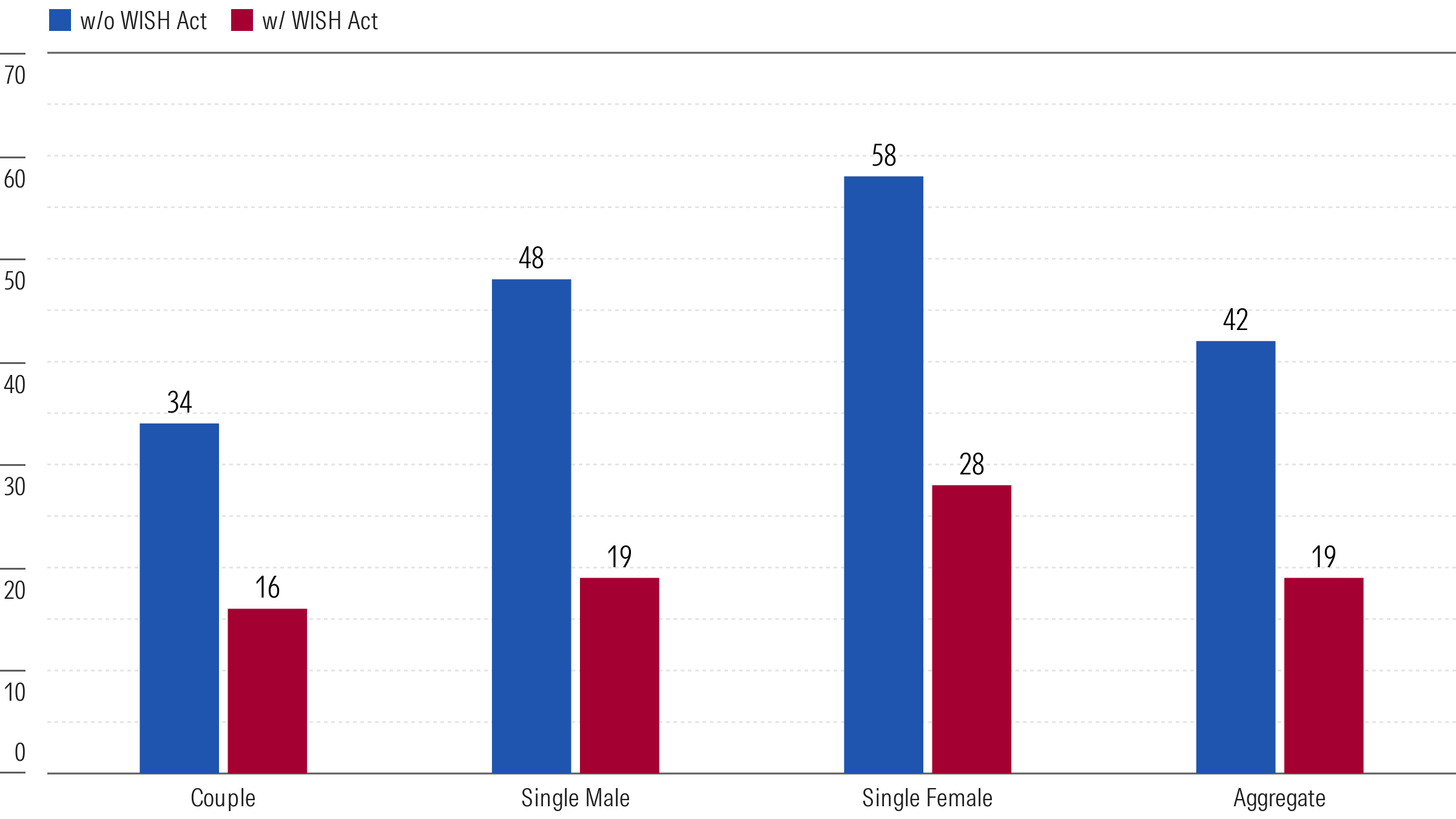
We noted that the reduction in the shortfall rate was similar for single women and single men, despite single women having higher LTSS costs than single men, as we previously documented. This is primarily owing to the lower levels of savings that single women have than single men, which limits how much the WISH benefits can improve retirement-income adequacy.
We also analyzed the results by age cohort. We found that among households qualifying for WISH benefits, the biggest reductions in the shortfall rate occurred for the Gen Z and millennial age cohorts. In particular, the share of Gen Z households with a shortfall went to 24% from 49%, while the shortfall rate for millennials dropped to 19% from 45%.
Percentage of Gen Z, Millennials, and Gen X Qualifying for WISH Benefits With Retirement Shortfall by Age Cohort With and Without the WISH Act
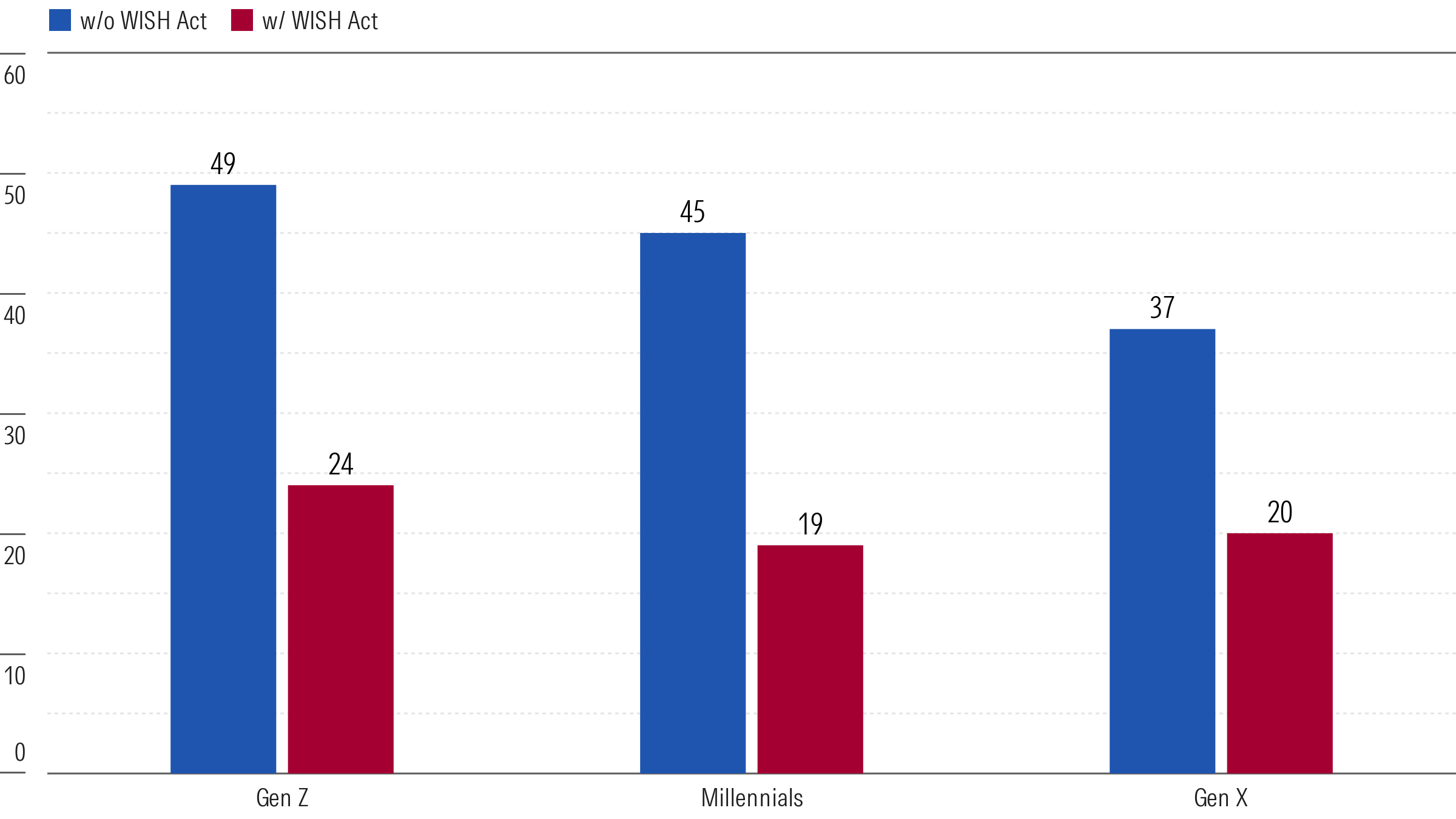
The more substantial impacts to the millennial and Gen Z age cohorts can be largely attributed to the impact of the compounding effects of LTSS inflation. Because LTSS cost inflation is assumed to outpace price inflation, LTSS costs are a relatively larger share of retirement expenses for younger households. And since we assume that WISH benefits grow at the same rate as LTSS costs, the program has a greater impact for younger generations, all else equal.
Middle-income households also saw some of the largest improvements under the WISH Act. For example, for Gen Z households qualifying for WISH benefits in the second income quartile, the shortfall rate dropped to 25% from 61% (a 36-percentage-point drop). This is an intuitive finding given that we previously found that middle-income households have the most exposure to LTSS risk.
We also observed notable improvements in retirement-income adequacy for households with higher projected LTSS costs and across all race and ethnicity groups. Refer to the full report for more detail.
What’s Next
If enacted, the WISH Act could be one of the most significant shifts in retirement risk management in decades, especially for middle-income Americans.
In future research, we will investigate the impact of private long-term-care insurance on retirement-income adequacy.
The author or authors do not own shares in any securities mentioned in this article. Find out about Morningstar’s editorial policies.
Morningstar Investment Management LLC is a Registered Investment Advisor and subsidiary of Morningstar, Inc. The Morningstar name and logo are registered marks of Morningstar, Inc. Opinions expressed are as of the date indicated; such opinions are subject to change without notice. Morningstar Investment Management and its affiliates shall not be responsible for any trading decisions, damages, or other losses resulting from, or related to, the information, data, analyses or opinions or their use. This commentary is for informational purposes only. The information data, analyses, and opinions presented herein do not constitute investment advice, are provided solely for informational purposes and therefore are not an offer to buy or sell a security. Before making any investment decision, please consider consulting a financial or tax professional regarding your unique situation.

 United States