
How to Use Our Retirement Income Research
And how not to!

“The safe withdrawal rate for last year was 4% and this year it’s 3.7%. How can someone plan if a 30-year projection changes yearly?”
I received that query in response to our recently published retirement income research, and I’ve seen variations on it every year since we began publishing the research in late 2021.
I figured that we were overdue to discuss how to use our now-annual research—which Amy Arnott, Tao Guo, Jason Kephart, and I collaborated on in late 2024—as well as how not to use it.
First Things First
Let’s start with what not to do with our retirement spending research: Use it as an impetus to change up your retirement spending as retirement unfolds. While we’ve been revisiting this research annually, we’re not actually suggesting that the retiree who followed our 2021 research would take a 3.3% withdrawal in 2022, 3.8% in 2023, 4.0% in 2024, and 3.7% in 2025 to reflect each edition’s finding. Ratcheting spending up or down in line with Morningstar’s latest recommendations is apt to introduce more volatility into retirees’ cash flows than they’re likely to find acceptable.
Rather, our “base case” assumes that the retiree withdraws a given percentage at the outset of retirement—say, USD 33,000 on a USD 1 million portfolio at the beginning of 2022—and then inflation adjusts that dollar amount or uses some other method to adjust subsequent expenditures thereafter. A USD 33,000 withdrawal at the beginning of 2022, for example, would be USD 35,145 at the beginning of 2023, factoring in 6.5% annualized inflation in 2022, and USD 36,340 at the beginning of 2024, incorporating 2023’s 3.4% inflation rate.
Nor should this research be construed as a market call. While it does embed Morningstar Investment Management’s capital markets assumptions, the team’s forecast is long-term, and we use an even longer, 30-year horizon for our spending simulations. Even though the highest safe spending rate for our base case corresponds with a portfolio with just 20% to 50% in stocks, that’s an outgrowth of the very conservative spending system that underpins the base case.
Instead, the research might be the most valuable to investors and their advisors in the following situations.
Use Case 1: As a Temperature Check
Because our research employs forward-looking inputs for stock and bond market returns and inflation, it can help provide a gauge of how aggressive or conservative retirees might be with their withdrawals in the near future.
When our base case starting withdrawal percentage was just 3.3% in late 2021, for example, that was a signal to retirees to be prepared to tap on the brakes with withdrawals; bond yields were ultralow, and equity valuations were high. And indeed, caution on portfolio withdrawals was valuable in 2022 as both the stock and bond markets sold off. Retirees who could get by on less (and had liquid reserves) benefited by leaving more assets in place to rebound when stocks and bonds recovered in 2023. Our 2023 research, by contrast, pointed to a more normal starting withdrawal percentage of 4% as sustainable over a 30-year period, thanks in large part to higher fixed-income yields/return prospects and moderating inflation. Our 2024 research points to the value of caution once again, as bond yields had dropped a bit last year, and equity valuations looked a bit high, depressing expected returns for fixed-income assets and equities.
As retirees and their advisors consider more cautious or generous withdrawal percentages, it’s also valuable to remember the interplay between actual portfolio values and withdrawal amounts. Balanced stock/bond portfolios dropped by about 17% in 2022, so our 3.8% safe withdrawal recommendation in late 2022, while a higher percentage than the year before, corresponded with a lower portfolio balance, and in turn withdrawal amount, for most investors. By contrast, this year’s 3.7% withdrawal percentage is apt to look better on a dollar basis, given that portfolio values have generally increased for two years running. In other words, it’s not the percentage that matters to retirees; it’s the dollar amount.
Use Case 2: To Depict the Interplay Between Age and Spending
Additionally, the research illustrates how age influences safe spending rates. All else being equal, safe spending rates may increase with age. While our base case simulation assumes a 30-year spending horizon and therefore is best suited to new, traditional-age retirees, the research can also provide a valuable spending check for people who have been retired for several or more years. While many retirees anchor on the “4% rule,” our research shows that older retirees with shorter time horizons can reasonably spend more as they age.
As depicted below, a retiree with a 20-year anticipated time horizon/life expectancy (rather than 30) can reasonably spend more than 5% of a balanced portfolio, with that dollar amount inflation-adjusted thereafter. Meanwhile, the retiree with a 15-year spending horizon could reasonably spend nearly 7% of their portfolio, with that dollar amount inflation-adjusted thereafter. (That suggests that retirees shouldn’t be concerned that their required minimum distributions will prematurely deplete their portfolios; the RMD calculation is even more conservative than our spending research, which itself is pretty conservative.)
30-Year Starting Safe Withdrawal Rate %, by Asset Allocation, 90% Success Rate
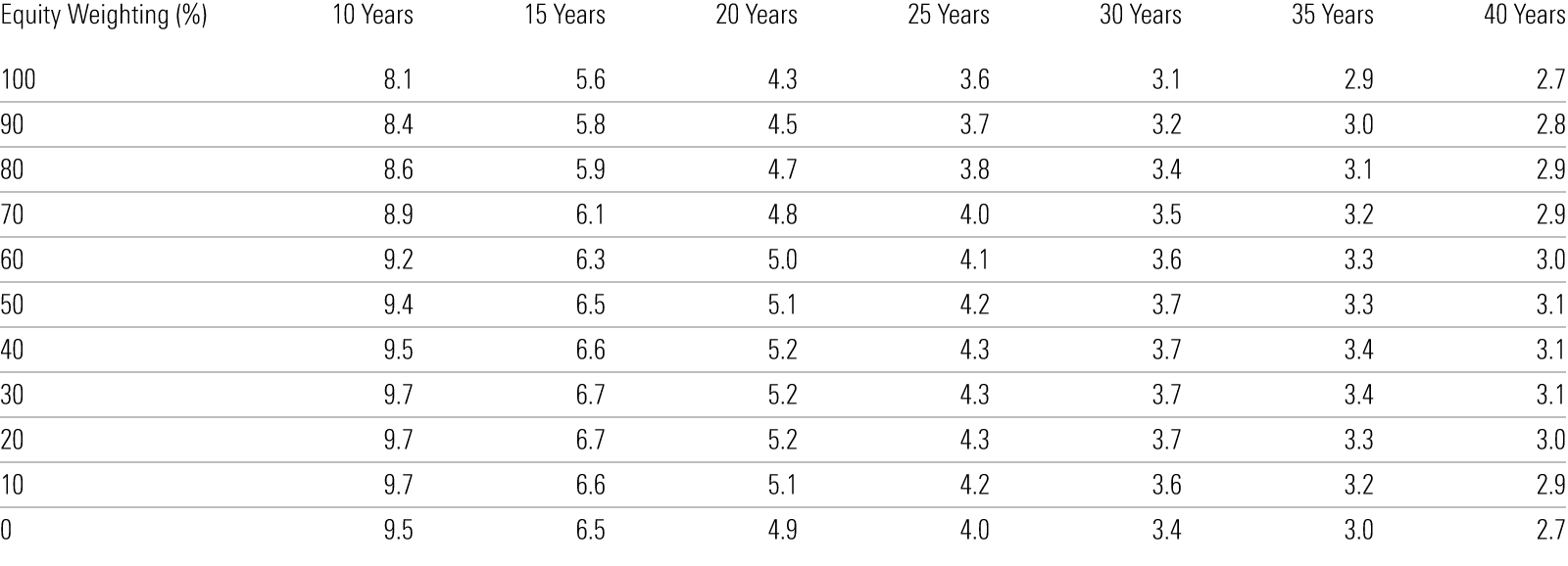
By contrast, early retirees will want to keep caution in mind when calculating a safe starting withdrawal percentage, assuming our “base case” spending system. For example, in our base case, the highest starting safe withdrawal percentage for a 40-year horizon is just 3.1%.
Use Case 3: To Illustrate the Trade-Offs That Accompany Various Spending Strategies and Asset Allocations
Another potential use for this research is to illustrate the trade-offs that accompany various spending strategies, from more rigid, paycheck-equivalent spending strategies like the base case to ones that entail more variability. The findings of this research can help advisors and individual investors home in on the right withdrawal system, given the retiree’s preferences on whether their priority is to front-load retirement spending, maximize lifetime spending, pull a stable, paycheck equivalent from their portfolios, or leave a sizable sum in the form of a bequest. These strategies can provide a significant lift to retirement spending, as Amy Arnott discusses here, but those higher paydays aren’t a free lunch.
Use Case 4: To Arrive at a Holistic Retirement Income Plan
Finally, portfolio spending is just one piece of the retirement income puzzle, and this year’s research considers the role of nonportfolio income sources alongside portfolio income. After all, most retirees will be able to rely on Social Security in addition to their portfolio withdrawals; a smaller subset will be able to rely on a pension. Still, other retirees may wish to generate income from an annuity, working in some fashion, or through real estate rental income. Those types of nonportfolio income sources can go hand-in-hand with portfolio withdrawals.
Delaying Social Security and/or purchasing some type of basic annuity helps enlarge lifetime spending and, importantly, provides predictability in cash flows that portfolio withdrawals cannot. Moreover, that additional income will cover a retiree for life, providing a valuable longevity hedge for the retiree and spouse. Such strategies can work particularly well alongside a flexible approach to portfolio withdrawals, such as the guardrails strategy. They boost lifetime spending appreciably relative to our “base case,” which assumes Social Security filing at age 67, static real portfolio withdrawals, and no annuity purchase.
At the same time, the benefits of these strategies have the potential to shrink the amount of a portfolio that is available for heirs or charity at Year 30. That’s because delaying Social Security may necessitate higher early-retirement withdrawals, for example, while steering a percentage of the portfolio into an annuity takes a chunk out of the portfolio early on. Both decisions reduce the opportunities for portfolio compounding even as they enlarge lifetime cash flows. For that reason, such strategies tend to be most valuable for retirees who wish to maximize their own consumption, which may include lifetime giving, rather than bequests at the end of life. Delaying Social Security will tend to be particularly attractive for retirees who can rely on nonportfolio income (for example, from continuing to work); that way, the decision to delay has no impact on portfolio spending.
Ed Slott: How Roth IRAs Can Help with Estate Planning
The author or authors do not own shares in any securities mentioned in this article. Find out about Morningstar’s editorial policies.

 United States