
3 Generic Drug Stocks to Watch
We think Teva has the best combination of valuation and growth potential.


Generic drug manufacturers are facing increasing pressure from drug distributors, pharmacy benefit managers, and Indian competitors, leading to downward trends in generic drug prices. Which firms are positioned to succeed in this market environment?
To combat the challenges associated with decreased drug prices, generic drug leaders including Sandoz SDZ, Viatris VTRS, and Teva TEVA are diversifying their assets by expanding into branded products, biosimilars, and other nontraditional markets for future growth.
We think Sandoz and Teva have excelled at identifying their areas of expertise and executing on high-potential growth strategies. Viatris needs to catch up in terms of portfolio strength and pipeline depth to win our conviction.
The Generic Drug Market: Its Growth and Challenges
While generic drugs have existed in the US since the early 20th century, two pieces of legislation are largely responsible for their growth: the 1984 Hatch-Waxman Act and the 2012 Generic Drug User Fee Amendments.
The Hatch-Waxman Act facilitated the generic drug application process by providing a safe harbor from patent infringement litigation by branded drug manufacturers. It also allowed the Food and Drug Administration to approve applications for generic drugs with abbreviated new drug applications, or ANDAs. The GDUFA, for its part, allows the FDA to collect fees on ANDAs, which expedites the approval process.
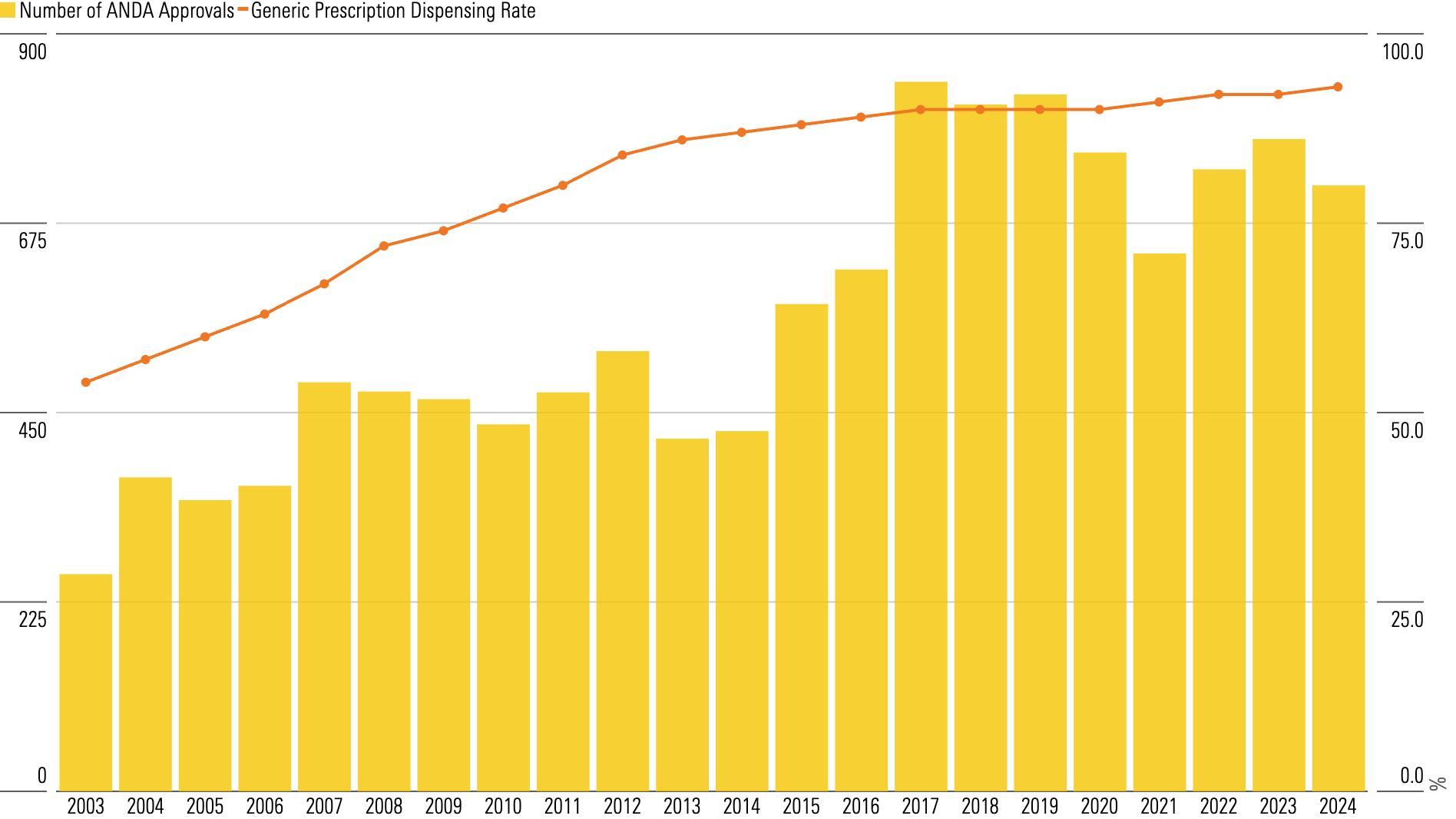
These changes more than doubled the average number of ANDAs that are approved on an annual basis, from fewer than 300 to more than 700. This led to a significant hike in the percentage of prescriptions dispensed with generic drugs (known as the generic dispensing rate), from 54% to 92% between 2002 and 2024.
ANDA Approvals Doubled Since 2003, Leading to Generic Drugs Representing 90% of US Prescriptions
These regulatory pushes have paved the way for the competitiveness and commoditization of the generic drug industry, significantly eroding the pricing power that generic manufacturers once had. According to the Centers for Medicare & Medicaid Services, average spending per claim for Medicare Part D drugs trended downward from 2018 to 2022—a total change of 11% during that window. (This metric includes both branded and generic drugs, but it’s worth noting that more than 90% of dispensed prescriptions are filled with generic drugs.)
Today, generic drug manufacturers face several headwinds as generic sourcing groups (groups that buy generic drugs in bulk) and the establishment of generic formularies by pharmacy benefit managers (lists of generic prescription drugs that are covered by health insurance) have enabled drug distributors and drug buyers to negotiate lower generic prices.
While deflationary headwinds have lessened in recent months, we don’t think these necessarily signal that the industry is improving. Now that FDA activity and the drug supply have normalized after covid, we expect annual price erosion to return to a low- to mid-single-digit level, in line with historical headwinds.
We do believe the industry has gotten more competitive over the past decade thanks to increasing availability of cheaper drugs from Indian manufacturers, exacerbating the challenging market conditions. On average, we see that Indian generic players have delivered a compound annual growth rate of about 11% over the past decade, trumping the 3% global market CAGR over the same period.
Teva: Recovery Underway Thanks to Innovation and Generic Launches
- Morningstar Rating: 4 stars
- Moat Rating: None
- Fair Value Estimate: $23
- Price/Fair Value Estimate (as of Feb. 3, 2025): 0.77
After five years of consecutive sales declines, Teva posted top-line growth in 2023. Although Teva still struggles with declining year-over-year contributions from its patent-expired legacy drugs as well as generic price deflation, new branded therapies and biosimilars have finally started to offset industrywide challenges and help return Teva’s growth.
Teva’s focus and capital allocation have been increasingly shifting away from generics to biosimilars and innovative drugs, a trend that we expect to continue over the medium term.
The firm had been going after about 80% of drugs coming off patent but is now focused on just 60%, since the incremental value driven from the remaining 20% is marginal. We expect an increasing share of those to be complex generics—drugs that have complex formulations or dosage forms, are injected, or have more-complex administration. Complex generics are more difficult to manufacture, which limits competition, so this area paves an opportunistic road for Teva.
Teva currently has three key innovative assets: Ajovy (fremanezumab) for treatment of migraine, Austedo (deutetrabenazine) for treatment of tardive dyskinesia and chorea associated with Huntington’s disease, and Uzedy (risperidone) for treatment of schizophrenia. The three drugs collectively generated over $1.6 billion globally in 2023, or about 10.5% of Teva’s total sales, but we expect this number to continue rising as penetration improves and as Uzedy, which was approved by the FDA in April 2023 and launched a month later, picks up market share.
The main focus in Teva’s innovative portfolio continues to be neuroscience and immunology, with clinical trials for three key assets underway: olanzapine for treatment of schizophrenia, albuterol/fluticasone combination for treatment of asthma, and duvakitug for treatment of ulcerative colitis and Crohn’s disease.
We forecast minimal contribution from these three drugs over the next five years but expect them to collectively generate about $2.5 billion, or over 10% of Teva’s total sales, by the end of 2033.
Sandoz: Biosimilar Powerhouse With Deep Pipeline Should Enjoy Long-Term Growth
- Morningstar Rating: 3 stars
- Moat Rating: None
- Fair Value Estimate: CHF 39
- Price/Fair Value Estimate (as of Feb. 3, 2025): 1.12
Sandoz is one of the largest generic pharmaceutical manufacturers in the world, generating over $9 billion annually from off-patent drugs. Generics, including small molecules and complex injectables, make up 75% of its total sales. The firm has a significant presence in Europe, the US, and other key international markets. Sandoz generates its remaining sales from biosimilars and is among the leaders in the space.
Over the medium term, we believe Sandoz has two main focal points: successful execution in biosimilar launches and margin expansion. While the company has a number of biosimilar launches in the next five years, the rate at which these assets will displace their reference drug prescription volume will depend on the originator’s pricing strategy, formulary changes from pharmacy benefit managers, and the competitive landscape for other biosimilars.
Sandoz’s most notable recent biosimilar achievement came in July 2023 when Hyrimoz, the firm’s biosimilar version of Humira (adalimumab), launched along with six other competing assets. However, because the originator’s selling price dropped significantly and major formularies still covered branded Humira, the biosimilar landscape did not really pick up until April 2024, when CVS Caremark removed branded Humira from its formulary.
Sandoz’s pipeline drugs include Pyzchiva (biosimilar to Stelara), Jubbonti/Wyost (Prolia/Xgeva), and Tyruko (Tysabri), all of which we expect to launch in the US in 2025.
We believe Sandoz’s efforts to build out biosimilar manufacturing infrastructure can significantly improve core EBITDA margins over the next five years. While our 2028 estimate of 23.5% core EBITDA margin is shy of the firm’s goal of 24%-26%, we think continued successful pipeline progression, cost management, and efficiency achievement over the next year could afford us a higher level of conviction in the achievability of the goal.
Viatris: Proven Generic Expert, but Innovative Portfolio Still Underway
- Morningstar Rating: 4 stars
- Moat Rating: None
- Fair Value Estimate: $14.50
- Price/Fair Value Estimate (as of Feb. 3, 2025): 0.78
Viatris is the second-largest generic manufacturer in our coverage in terms of revenue. Management has been selling off noncore assets of its portfolio since 2022, including its over-the-counter business, active pharmaceutical ingredient business, and women’s healthcare business. We believe Viatris is now well positioned to focus on a more simplified operation.
Generic drugs, which make up about 40% of Viatris’ revenue, continue to suffer low- to mid-single-digit price erosion year over year in developed markets like North America and the majority of Europe. This challenging industry dynamic puts pressure on Viatris to launch new products to offset price headwinds and drive top-line growth. The firm has generated significant revenue growth year over year thanks to its expertise and solid execution. It has averaged about $550 million in annual new product revenue over the last five years and has a goal of generating $500 million-plus in new products going forward. We think this is achievable, given Viatris’ history of solid pipeline progression.
Viatris has three core therapeutic areas of innovation: ophthalmology, gastroenterology, and dermatology. Since these are all specialty-driven, a small salesforce can capture a large number of doctors. Ophthalmology and dermatology make up a low-single-digit percentage and gastroenterology a high-single-digit percentage of the US pharmaceuticals market. Since a lot of innovations come from smaller players, there is not one big leader that Viatris has to displace to gain share.
Given the timing of the potential launches of its main pipeline drugs (cenerimod, selatogrel, and sotagliflozin), the drugs’ contribution remains minor in our five-year model, and we expect them to contribute an insignificant portion of sales in 2028. Beyond the next five years, we think they could enjoy higher uptake, but we still do not expect them to collectively make up a double-digit percentage of Viatris’ total sales.
The author or authors do not own shares in any securities mentioned in this article. Find out about Morningstar’s editorial policies.

 United States