
Amid New Curbs on ESG Shareholder Resolutions, Companies May Lose Useful Signals From Investors
The number of proxy-voting proposals with near-zero support continues to increase.


The largest surprise of the 2025 proxy season was the Securities and Exchange Commission’s new restrictions on permissible shareholder resolutions in the middle of an ongoing proxy season. This permitted companies to throw out many proposals that had already been submitted under the prior rules. It also heralded a sharp fall in the number of environmental and social proposals that made it to the corporate ballot box this year.
You might think that this would increase support for the remaining proposals that made it to the ballot. But, in another surprise, the proportion of failed proposals with near-zero shareholder support has continued to increase. Meanwhile, the number of proposals with significant shareholder support is down over 70% this year.
Shareholder dialogue and proposals give companies useful indicators of what actions and disclosures investors find valuable on sustainability and governance matters. This year, there are significantly fewer proposals, with only very few achieving meaningful shareholder support.
And that’s worrying, because it indicates a risk that the signal is being lost on what was once a clear channel for investors to communicate their preferences to the companies they invest in.
A Greater Proportion of Poorly Supported Proposals
The graphic below, based on Morningstar data, shows the distribution of independent shareholder support for environmental and social shareholder resolutions in the US for the last four proxy years: 2022 to 2025. The most successful resolutions appear at the bottom, with poorly supported ones toward the top.
Support for Environmental and Social Resolutions
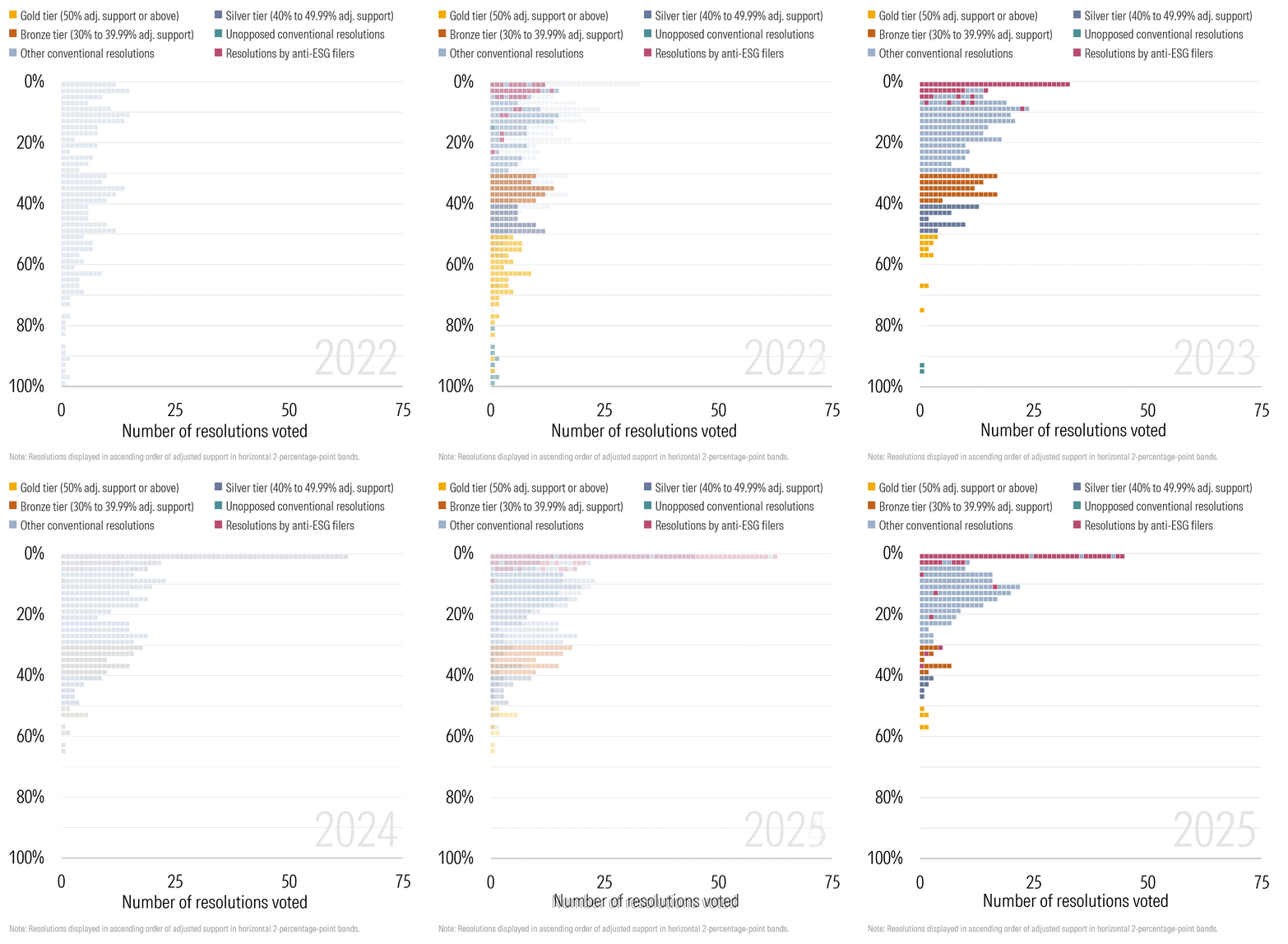
We can see the effect of the SEC’s Staff Legal Bulletin 14L in 2021, which expanded the scope of permissible shareholder resolutions and prompted steep growth in the number of proposals in subsequent years.
We saw a growing cohort of failed resolutions with close to zero shareholder support. That’s the long string of resolutions you can see at the top of the graphic from 2023 onward. I call this the “fail tail.”
Behind the Failed Shareholder Proxy-Voting Proposals
The overwhelming majority of these resolutions are “anti-ESG” proposals. Anti-ESG proposals are filed by investors who oppose the emphasis on ESG risk and ESG factors by companies. There were also a handful of pro-ESG proposals that failed to resonate with even some of the most sustainability-focused institutional shareholders.
Late last year, I argued that the fast-growing fail tail was a sign that things had gone too far with regard to how many low-quality resolutions were making it onto the corporate proxy ballot. A reduction in the sheer number of resolutions with no demonstrable relevance to investors would be, in my opinion, a healthy outcome for the market.
The SEC made its move in February by issuing SLB 14M. Its guidance largely reversed the 2021 expansion of permissible resolutions. It also drew criticism from some resolution filers owing to its timing and immediate effective date, in the middle of an ongoing proxy season.
Looking at the graphic for the 2025 proxy year, there has certainly been a reduction in the overall population of voted shareholder resolutions following SLB 14M. As we discussed recently, the population of voted ESG resolutions is 22% smaller this year. And the population of environmental and social resolutions is down a huge 40%.
Number of Environmental and Social Shareholder Resolutions
Average Support for Environmental and Social Shareholder Resolutions
But it looks like the fail tail survived the cut. The proportion of poorly supported environmental and social proposals as a percentage of the whole population stands higher than at any point in the past 10 years.
As the chart below shows, only 7% of environmental and social shareholder resolutions in the 2021 proxy year achieved less than 5% shareholder support. That figure steadily increased to 25% in the 2024 proxy year. This was primarily driven by the proliferation of anti-ESG proposals, mostly net-zero-skeptic and anti-DEI resolutions that institutional shareholders almost unanimously opposed.
Poorly Supported Environmental and Social Shareholder Resolutions
The percentage of poorly supported proposals increased further in the 2025 proxy year, to 27%. And the absolute number of poorly supported resolutions (64) in 2025 was still the second highest in the past 10 proxy years, bested only by the 100 such resolutions in 2024, according to Morningstar data.
Shrinking Number of Proposals With 30% Support
Looking at the other end of the spectrum, there’s been a sharp drop in the number of significant environmental and social shareholder proposals—those that achieve at least 30% support from the company’s independent shareholders. (We call this “adjusted support”; it excludes votes by company insiders like founders, company executives, and board members with large shares of the vote.)
Those proposals are shown as the gold-, silver-, and bronze-colored squares in the first graphic. You can see the sharp reduction in their population from 2024 to 2025. As shown on the chart below, there were at least 100 such resolutions in each of the five proxy years to 2024, with over 150 in the 2022 proxy year.
Number of Significant Environmental and Social Shareholder Resolutions
However, in 2025, there are only 30 such resolutions. Only five of these proposals gained majority support, and all five addressed a single topic: political spending transparency.
Trends Indicate Serious Communication Challenges for Investors and Companies
Why does that matter? A few important trends are combining here:
- New regulatory obstacles: Changes to SEC guidance this year have had the effect of creating barriers (both real and perceived) to open engagement dialogue between companies and their shareholders on financially material ESG themes.
- Smaller population of voted resolutions: There are considerably fewer shareholder resolutions going to a vote. And there are many fewer significant resolutions to provide companies with high-quality feedback on the market’s view of financially material sustainability matters.
- Average resolution quality continues to fall: The decline in the average quality of sustainability-focused shareholder resolutions, according to the market’s perception, has continued. This is evidenced by the greater proportion of poorly supported resolutions, the much smaller cohort of resolutions with significant shareholder support, and lower average support for proposals overall.
All this means that the quality of signal being sent by shareholders to companies on material sustainability and governance issues via the shareholder resolution process is worsening.
The author or authors do not own shares in any securities mentioned in this article. Find out about Morningstar’s editorial policies.

 United States