
Explore These 30 Leading Water Funds and Water Stocks in the US and Europe
Blue economy and glacier preservation are key water investment themes on World Water Day.


The theme for World Water Day in 2025 (on March 22) is “Glacier Preservation,” focusing on the critical role glaciers play in global water systems and the urgent need to address their rapid decline due to climate change.
Glaciers are critical to life—their meltwater is essential for drinking water, agriculture, industry, clean energy production, and healthy ecosystems. But rapidly melting glaciers are causing uncertainty to water flows, with profound impacts on people and the planet. For example, flooding and rising sea levels can contaminate land and water resources and cause damage to water and sanitation infrastructure. According to the 2023 State of Global Water Resources Report by the World Meteorological Organization, glaciers lost 600 gigatons of water in 2023, the largest measurement in 50 years.
Against this backdrop, the supply/demand dynamics of water create opportunities for thematic investments in utilities, infrastructure, and technology that increase the supply and reliability of safe freshwater. These investment opportunities can come in the form of open-end and exchange-traded funds focused on companies involved in water-related activities and a range of publicly traded water-related stocks.
How to Invest in Water in the US and Europe
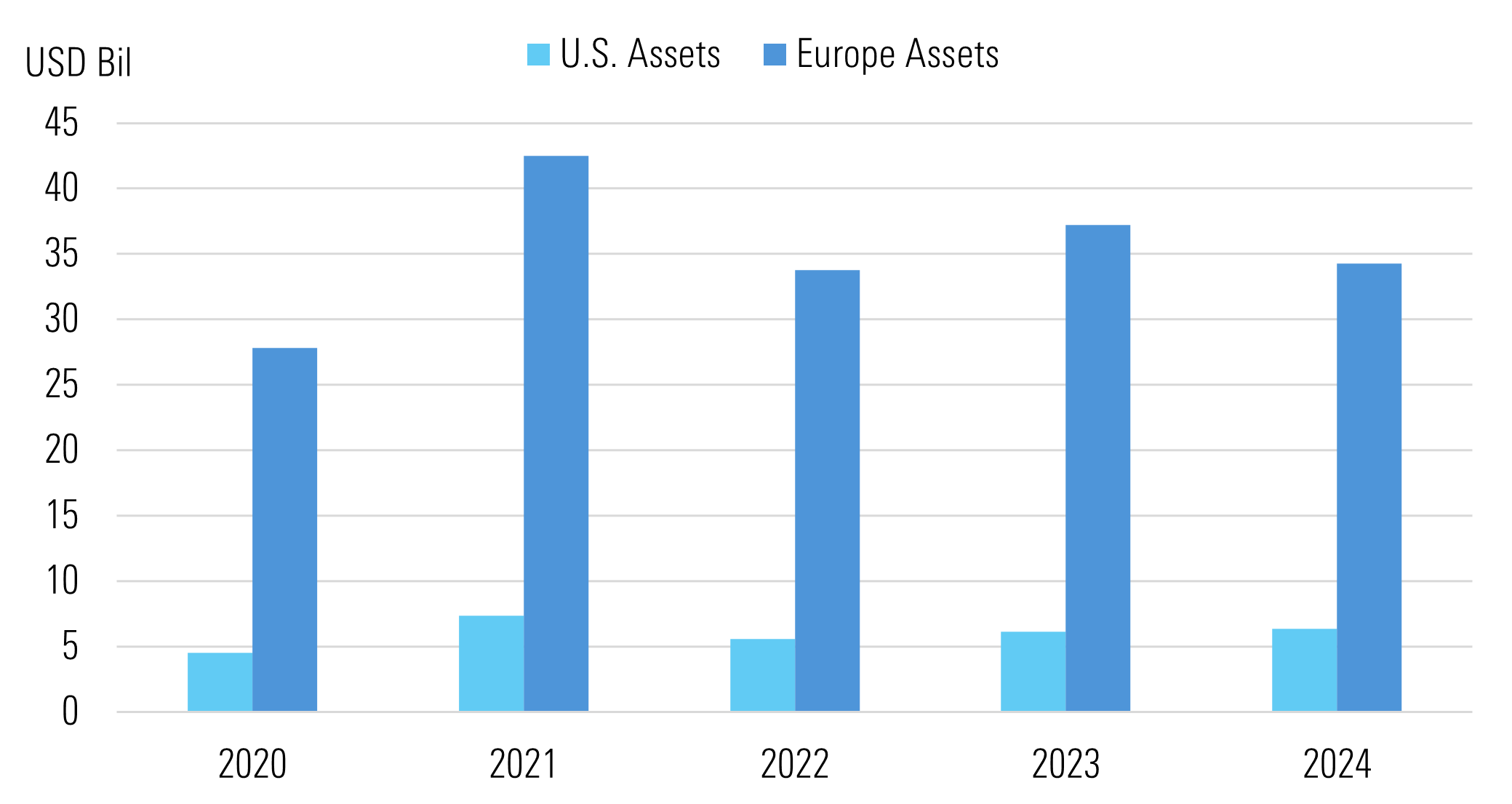
As of February 2025, we identified 73 open-end funds and ETFs focused on the water theme, including 13 in the US and 60 in Europe, representing a total of $41 billion in assets under management. This universe has grown by almost 70% in the past five years.
Assets peaked at $50 billion in 2021 before declining to today’s level due to outflows and mixed performance.
Exhibit 1 Annual Assets in U.S. and European Water Funds
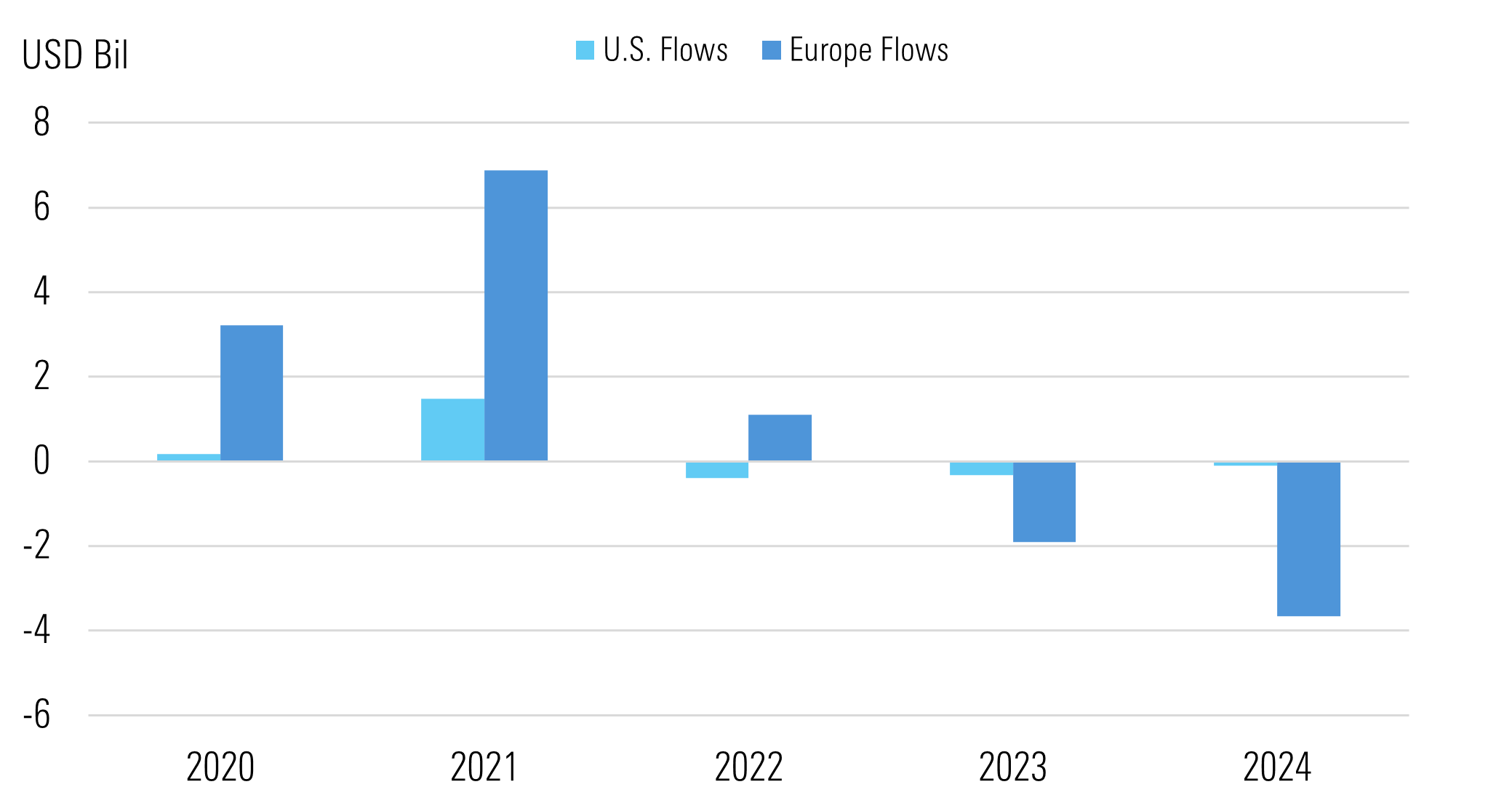
US water funds have registered net withdrawals in each of the past three years, totaling $820 million. Meanwhile, European water funds have bled an aggregated $5.6 billion over the past two years, contrasting with the subscriptions of nearly $7 billion in 2021.
Exhibit 2 Annual Flows of U.S. and European Water Funds
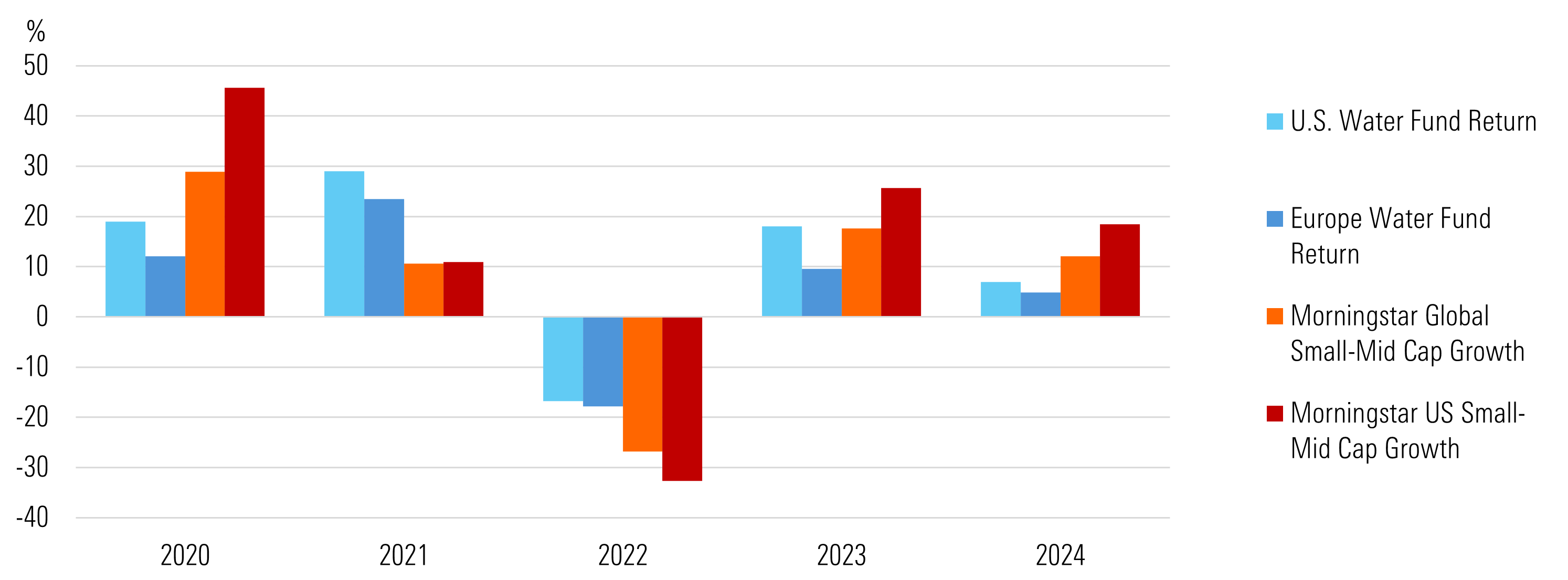
The recent outflows on both sides of the Atlantic can be partly explained by the underperformance of the strategies against a backdrop of subdued industrial activity and high interest rates. After outperforming the Morningstar Global Markets Small-Mid Cap Index by 4 and 12 percentage points in 2021 and 2022, respectively, US water funds paced the index in 2023 and lagged by 3.5% in 2024. European water funds trailed the benchmark by an annual average of 5.4% over the past two years.
Though municipal and broader water and wastewater infrastructure spending remained healthy last year in the US and Europe, broader industrial activity was subdued, resulting in slower-than-anticipated capital and operating expenditures in the water sector. Meanwhile, higher interest rates continued to hold back residential and nonresidential construction activities, affecting water spending in multiple markets around the world. Moreover, low agricultural commodity prices pressured profitability in key growing regions such as the US and Brazil, limiting investment in irrigation equipment and technology.
Exhibit 3 Annual Performance of U.S. and European Water Funds
US Water Investment Funds Focus on Mid-Cap Growth Companies
The exhibit below lists the 13 water funds available to US investors. Investors interested in water funds can choose US-focused or global portfolios. Nine are passively managed ETFs, concentrated (with an average number of 43 holdings), and focused on midsize growth companies. Fees average 0.7% on an asset-weighted basis, roughly in line with the average (0.6%) thematic peers in the US.
For investors seeking impact, one benchmark is U.N. Sustainable Development Goal 6 (Clean Water and Sanitization). Based on revenues of investee companies, US water funds are all over the map, with revenues contributing to the theme ranging from 7% to 65%, averaging 38%.
At 65%, Global X Clean Water ETF AQWA boasts the highest percentage of revenue contribution to the theme. The fund invests in companies advancing the provision of clean water through industrial water treatment, storage and distribution infrastructure, and purification and efficiency strategies. In comparison, NYLI Clean Oceans ETF OCEN focuses on companies that help to achieve a cleaner ocean through reduced pollution and increased resource efficiency. The low revenue percentage (7%) associated with SDG 6 can be partly explained by the multiple SDGs the strategy targets, including Life Below Water (SDG 14) and Responsible Consumption and Production (SDG 12).
US funds appear to be biased toward US companies, with revenue exposure to the US averaging above 50% compared with 12% to Europe.
Exhibit 4 US-Domiciled Water Funds
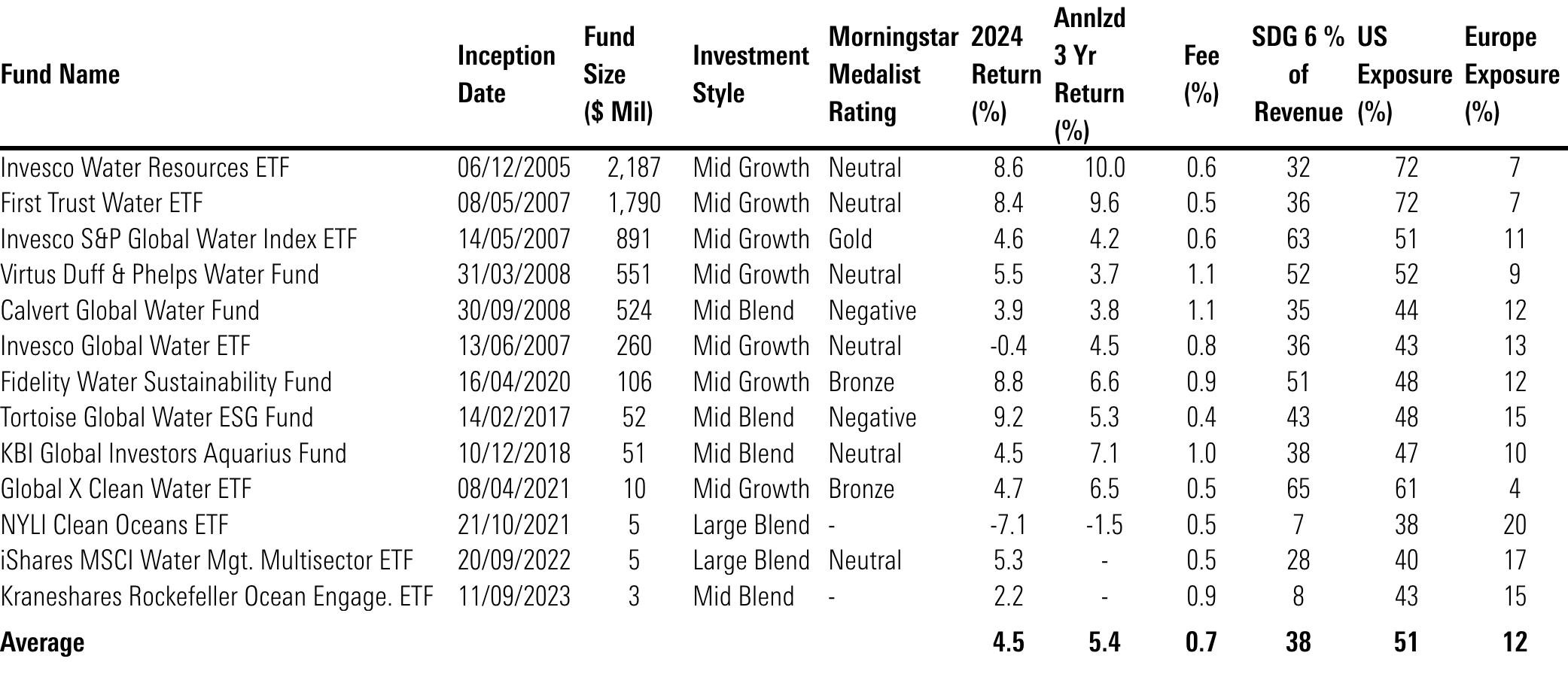
Invesco offers three US-domiciled passive water strategies, including the country’s largest, Invesco Water Resources ETF PHO, which invests in US companies that offer products and services designed to conserve and purify water for homes, businesses, and industries. Invesco S&P Global Water Index ETF CGW looks at a broader universe of companies in water utilities, infrastructure, equipment, instruments, and materials. Invesco Global Water ETF PIO features the same strategy as the first ETF but applied to global companies. The first offering has delivered the strongest returns of all water funds over three years.
As one of the few active strategies in the list, Virtus Duff & Phelps Water Fund AWTIX invests in companies that specialize in leading water technologies that look to improve water supply, efficiency, and quality.
Performance has varied. In 2024, returns of US water funds ranged from negative 7% to over 9%. As of February 2025, US water funds posted an average three-year annualized return of 5.5% compared with 9.3% of Morningstar Global Markets Large-Mid Cap Index.
In Europe, Investing in Water Can Be More Expensive
Compared with the US, Europe houses a larger and more diverse range of water-themed funds, 60 in total, of which the top 15 are listed below. European water funds are also larger in size: The top nine products hold more than $1 billion in assets.
European water funds tend to be actively managed. Twelve of the 15 largest products are active strategies. They also tend to be biased toward US companies, with exposure to European companies not exceeding 12%. Mid-cap companies with a growth style remain their focus, too.
Exhibit 5 Top 15 European Water Funds
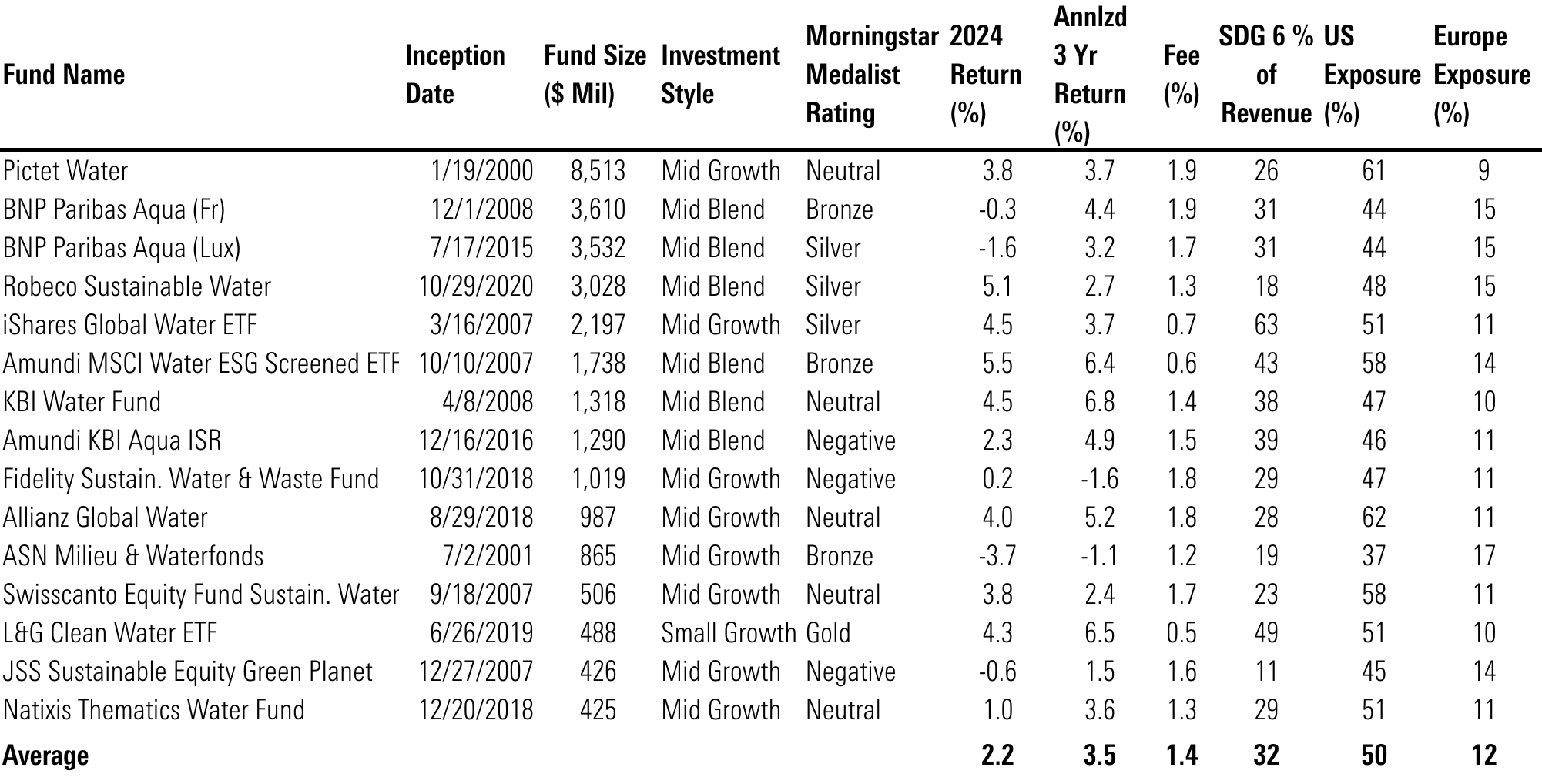
Pictet Water PBFQ, an Article 9 fund, is the largest European water strategy, with $8.6 billion in assets. The fund focuses on companies globally that provide water supply or processing services, water technology, or environmental services. The distant second and third are versions of BNP Paribas Aqua BNPAQUP, also Article 9 funds. They invest in companies that generate at least 20% of their income, profits, or capital from the entire water sector chain, which includes activities in the construction and/or renovation of infrastructure for water supply, water treatment, and utilities.
Most European water funds incorporate environmental, social, and governance factors and consider issues relating to drinking water, sanitation, and hygiene, as well as water use efficiency and waste disposal, as core elements of securities selection. This gives rise to a wider range of environmental or water-related investment focuses, which translates into a slightly lower average revenue exposure to SDG 6 (Clean Water and Sanitation). For the top 15 European water funds, this average revenue exposure is 32%, versus 38% for US water funds.
In addition to SDG 6, some funds target other SDGs. This is the case for Robeco Sustainable Water ROSWEDU, which, by investing in companies across the water value chain, also targets SDG 3 (Good Health and Well-Being) and SDG 11 (Sustainable Cities and Communities).
Performance of European water funds has been disappointing in the past three years. The year 2024 saw the largest 15 European water funds return 2.2% on average, versus 12.1% for the Morningstar Global Small-Mid Cap Growth Target Market Exposure Index. For the three years, the funds returned 3.5% annualized, mostly on par with the global benchmark. European fund returns have also lagged their US counterparts. This can be attributed, in part, to the higher management fees of European water funds (1.4% versus 0.7% in the US). Yet, the fees charged by European waters are similar to those charged by their thematic peers in Europe.
The Blue Economy—an Emerging Focus for Water Investors
Of the 60 water funds available to European investors, eight focus on the emerging “blue economy” theme. “Blue economy” is a term in economics that relates to the exploitation, preservation, and regeneration of the marine environment. The lower percentages of revenue related to SDG 6 are perhaps unsurprising, as the revenue sources of the blue economy funds often revolve around a wide range of SDGs including SDG 7 (Affordable and Clean Energy), SDG 8.4 (Improve Resource Efficiency in Consumption and Production), and SDG 14 (Life Below Water).
Exhibit 6 Europe-Domiciled Blue Economy Funds
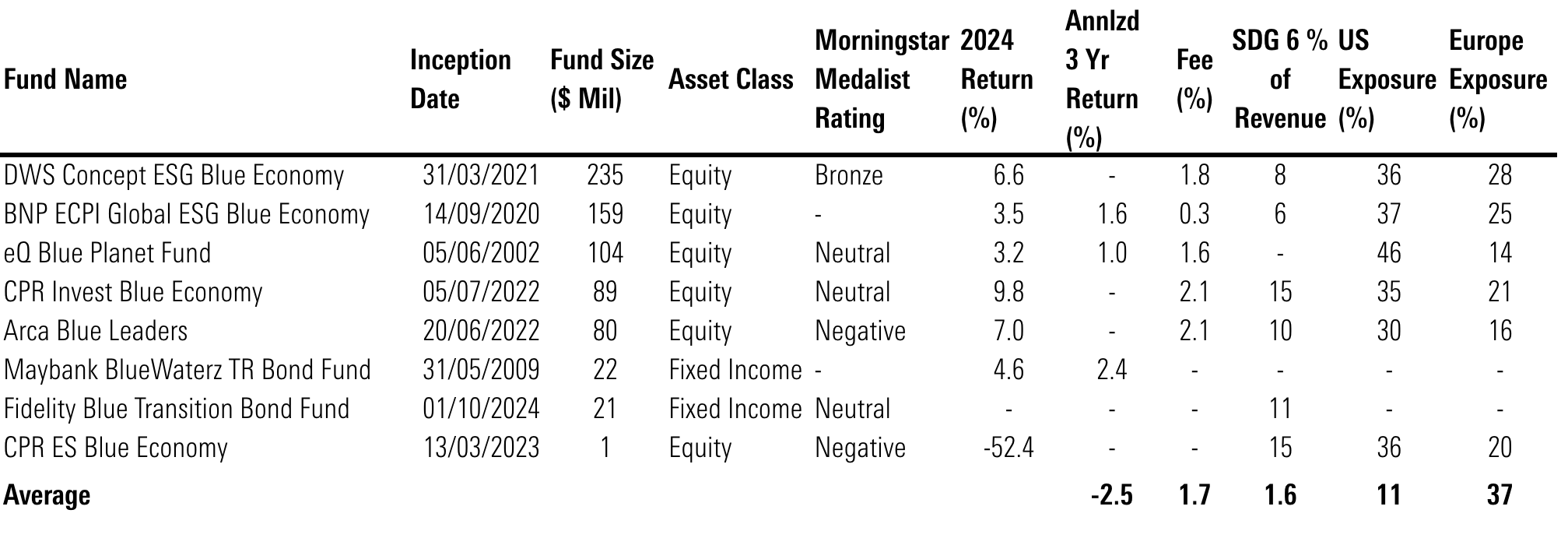
DWS Concept ESG Blue Economy DWEBEDR, the largest of the group, invests in two types of companies: transitioning companies that seek to mitigate their impacts on ocean resources and companies that provide solutions for the conservation of ocean ecosystems, such as emission reduction technologies in shipping, biodegradable packaging materials, and sustainable fish feed procedures.
Fidelity Blue Transition Bond Fund F2BTAAE focuses on issuers that use bond proceeds to finance projects that benefit ocean- and freshwater-related sustainability (including blue bonds and nonlabeled bonds) as well as companies that aim to improve the management of water-related risks and opportunities and reduce the negative impact of climate change on the ocean or freshwater. Fund managers also invest in green bonds with a significant allocation to the blue economy.
The Top Water Stocks
Looking closer at the 73 water funds in our US and European universe, we find four broad categories of companies.
- Water utilities. Regulated companies that provide clean drinking water and/or wastewater management.
- Water machinery. Companies that provide special equipment and machinery for water extraction, transportation, and distribution.
- Water technologies. Products that apply smart technologies to improve treatment, purification, and measurement of water.
- Miscellaneous. Companies that may be considered leaders in water efficiency although they have little to no exposure to the water industry.
The table below lists the most popular holdings among US water funds, ranked by the number of funds investing in the stocks. As expected, the majority of the companies are US-based and contribute a large portion of their revenues to SDG 6 (Clean Water and Sanitation). Five operate in the utilities sector, while eight are industrial companies.
Exhibit 7 Top 15 Common Holdings by US Water Funds
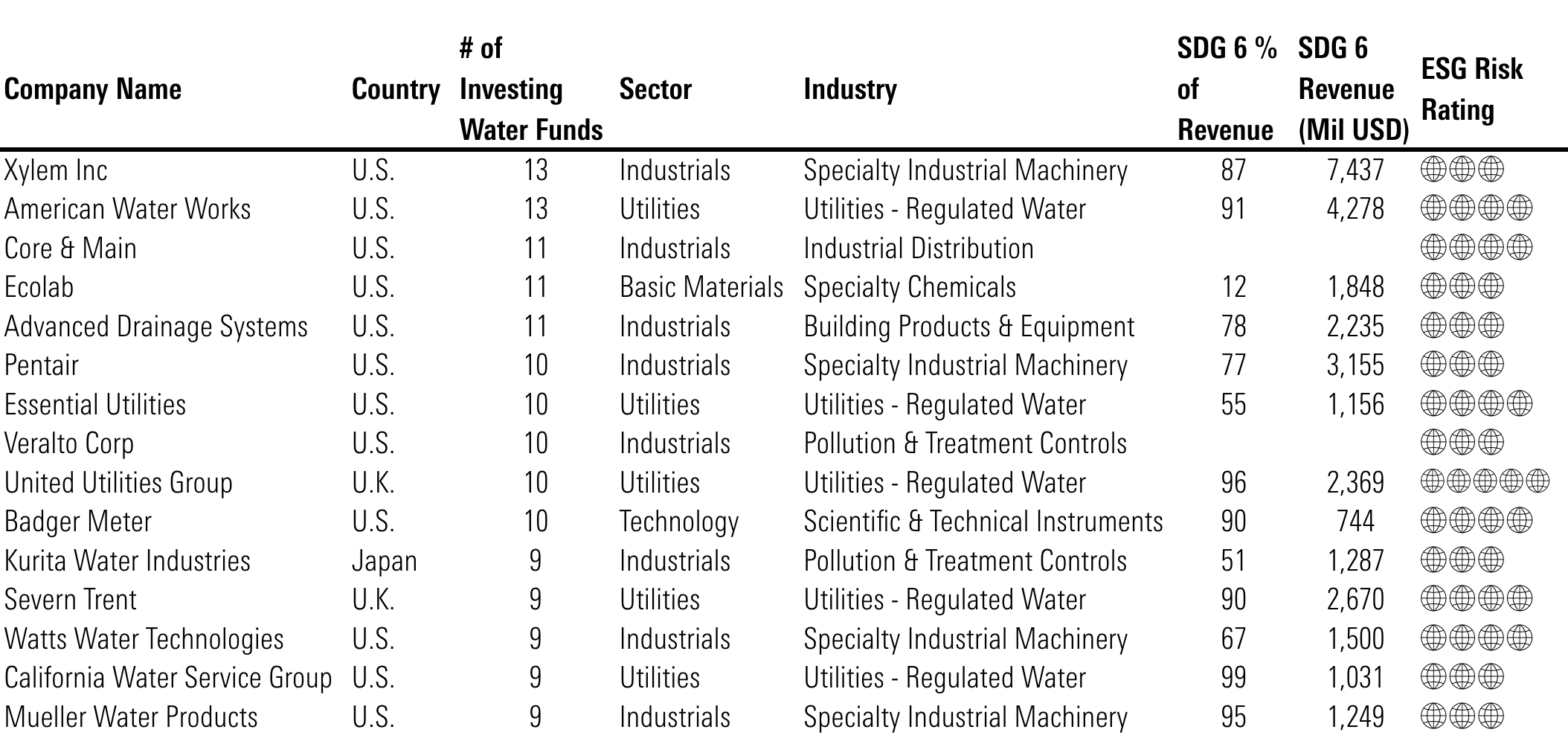
Several of these stocks are pure plays, including California Water Service Group CWT (99% of revenue related to SDG 6), UK United Utilities Group UU (96%), Mueller Water Products MWA (95%), and American Water Works AWK (91%).
Xylem XYL stands out as the top favorite by US water funds. The company has grown from a pump manufacturer to a leading global provider of water-related solutions, including the transport, treatment, testing, and efficient use of water in the utility, industrial, commercial, and residential sectors. Meanwhile, American Water Works operates as regulated utilities providing water and wastewater services in 14 states.
Ecolab ECL, on the other hand, has the lowest share of revenue related to SDG 6 (only 12%). The company produces cleaning and sanitation products for the hospitality, healthcare, and industrial markets. Badger Meter BMI, the only tech company in the list, is renowned for its smart water solutions for flow measurement, water quality, and control products that enable customers to optimize the delivery and use of water and reduce waste.
Looking at the common holdings by European water funds in the table below, we find greater variation of geographical exposure, though there are significant overlaps with the previous table.
Exhibit 8 Top 15 Common Holdings by European Water Funds
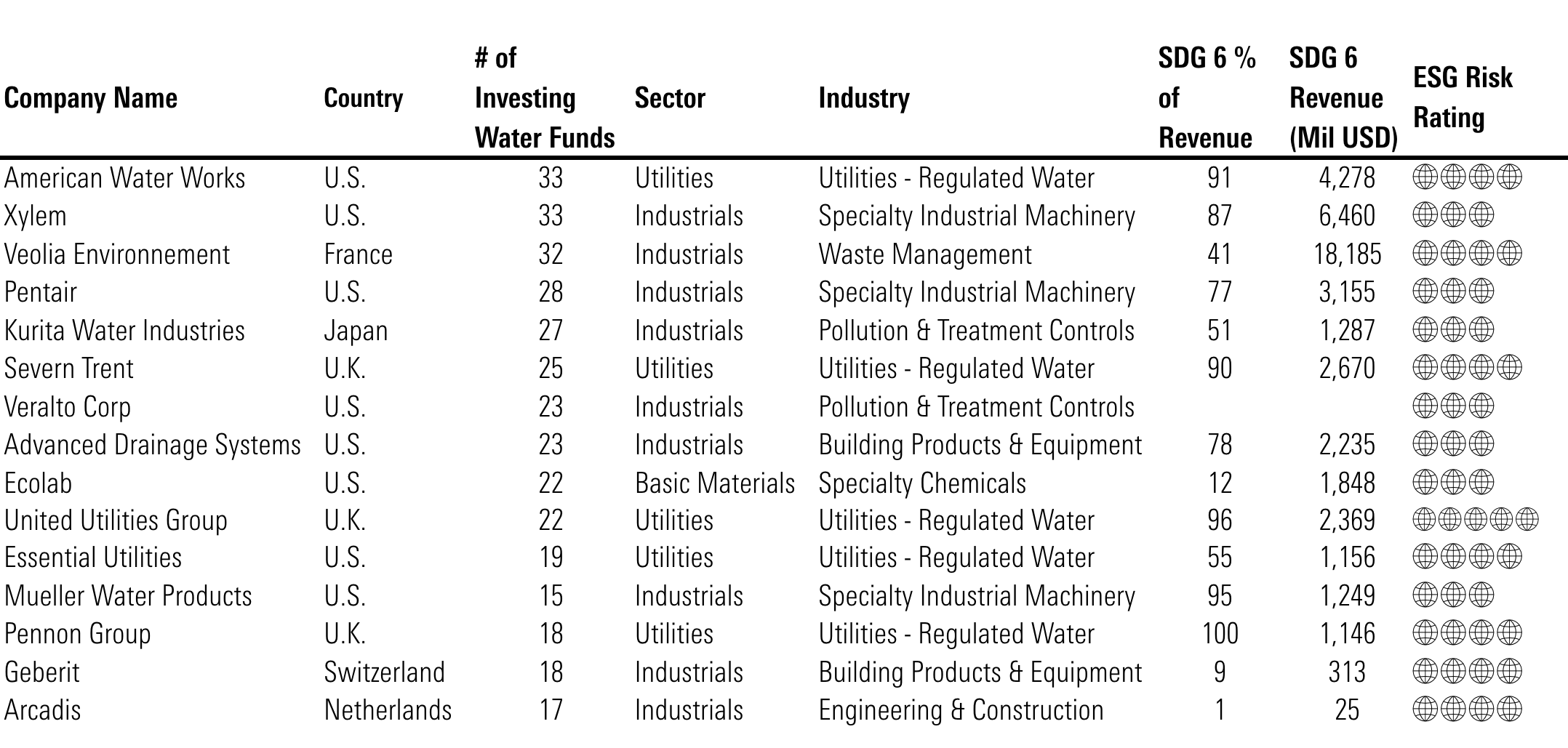
France’s Veolia Environnement VIE provides drinking water and wastewater services to residential, commercial, and industrial sectors that cover all stages of the water cycle, including production and delivery of drinking water and industrial process water; collection, treatment and recycling of wastewater; as well as the design and construction of treatment and network infrastructure. Water is one of Veolia’s three key businesses, which explains the lower percentage (41%) of revenue contribution to SDG 6.
Swiss Geberit GEBN (9% of revenue related to SDG 6) specializes in the design and production of sanitary products. In addition to integrating water-saving technologies to final sanitary appliances, the company has been consistently striving to reduce water consumption and improve wastewater treatment during the ceramics production phase.
Meanwhile, Arcadis ARCAD has the lowest revenue alignment with water (0.6%). The Dutch engineering & construction firm is exposed to the water theme through its projects focused on implementing green infrastructure and low impact development strategies that promote water conservation and explore alternative water sources.
The Future of Water Investment
While water funds have faced performance challenges in recent years, the fundamental drivers behind them remain intact. The growing global population and rising living standards in developing countries are increasing the demand for clean drinking water and water for agriculture and manufacturing. At the same time, climate change threatens freshwater supplies, making efficient water management more critical than ever.
For investors seeking long-term growth, water funds may offer a strategic way to tap into this essential and increasingly valuable resource. But they are not the only way to get exposure to water. Investors can also take a look at sustainable infrastructure funds, environmental services funds, or diversified sustainable funds in the mid-cap blend or mid-cap growth categories or the global small/mid-stock category.
The author or authors do not own shares in any securities mentioned in this article. Find out about Morningstar’s editorial policies.

 United States