
Investors Continue to Focus on ESG and Impact Investing, PitchBook Survey Says
72% of respondents incorporate sustainable investing factors into their investing process, although survey response rate falls.


Much of the once enthusiastic chatter around environmental, social, and governance-based investing from just a few years ago has died down in 2025, replaced in some areas by hostile commentary and policy antagonistic to the strategies associated with it. While many believe this to be a US-specific phenomenon, negative feelings about sustainable investing come from individuals in other parts of the world, as well. All of this led some to theorize that the topic will fade into obscurity, with the investment world content to leave this controversial subject behind and move on to the next set of topics du jour.
Data from our sixth annual Sustainable Investment Survey tells us that this is not likely to be the case. Instead, it shows that discourse and messaging around ESG and sustainability are changing. Yet the majority of respondents have continued to maintain or even increase their focus on ESG, impact investing, and DEI. Respondents included fund managers, asset owners, funds of funds, private wealth advisors, family offices, investment consultants, and others.
The number of responses to this year’s Sustainable Investment Survey was way down, with 267 people answering at least one question and 127 completing the survey—less than half the responses and completions we had in 2024. There are a few possible explanations for this, including general survey fatigue, the politicization of the topic making it taboo to discuss in some circles, and the fact that fewer investors are still seeking information on the topic, having now settled into the heads-down execution phase of their sustainable investment journey.
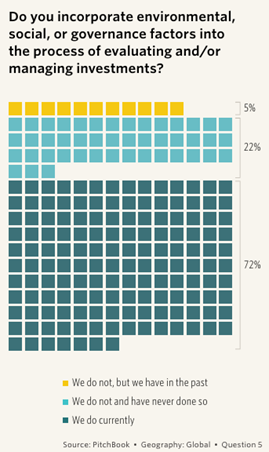
Even so, a larger share of respondents this year are active practitioners of both ESG and impact investing. Among respondents, 72% say they currently incorporate ESG factors into their investment evaluation and management process. Just 5% indicated that they used to, but no longer do.
How Investors Use ESG
Communication Around Sustainable Investing Is Changing
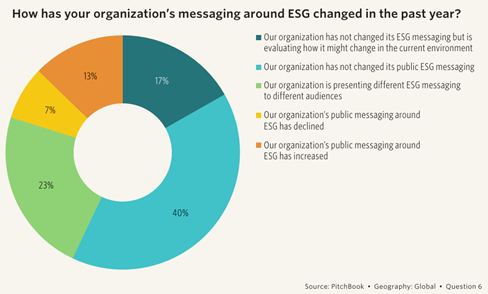
They are, however, changing how they communicate. Asked about how messaging around ESG has shifted for their organization in the past year, 43% of respondents stated that they have modified their messaging by either increasing or decreasing it overall or by offering different information to different audiences. Another 17% are evaluating how they might change their messaging.
How has your organization's messaging around ESG changed in the past year?
In part, this shift is happening because industry participants are hearing anti-ESG sentiment from their clients: 35% of those with clients have some in the anti-ESG camp. To complicate matters, many of those with clients arguing against the use of ESG also have some advocating for its use, with 21% of respondents to the question in this predicament. Many of those with this experience are adapting their language, swapping sustainability buzzwords for more neutral terms like “risk,” “resilience,” and “efficiency” without abandoning the underlying work.
So, while language is shifting, it appears that the economic and geopolitical events of the past year—from the enactment of anti-ESG and anti-DEI policies and retraction of support for renewables in the US to the continuation of the challenging dealmaking and exit environment and escalation of global trade tensions—have not deterred many from their sustainable investment strategies. Of those that have at some point in time engaged in ESG, 87% have either maintained or increased their focus over the past year. For impact investing, this number is 89%. And for DEI, it’s 90%.
Top Concerns for Sustainable Investors
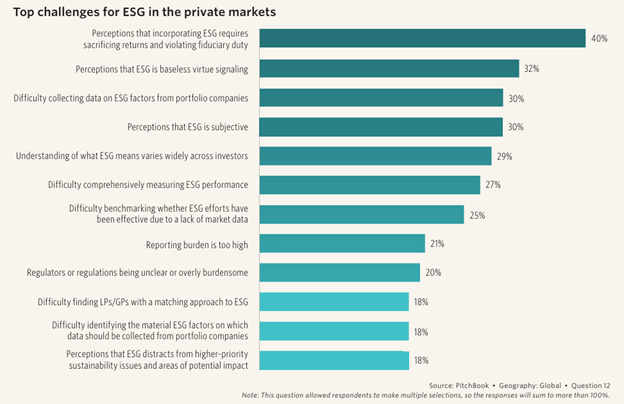
The greatest challenge for ESG is the belief of some that it requires sacrificing returns and violating fiduciary duty, selected as a top challenge by 40% of respondents. For impact, the leading concern is the perception that impact investing equates to concessionary returns, selected by 41%. Lack of shared understanding around definitions ranked highly for both ESG and impact investing, emphasizing just how much misconceptions and inability to achieve agreement on what exactly these strategies involve continue to create friction.
Top challenges for ESG in the private markets
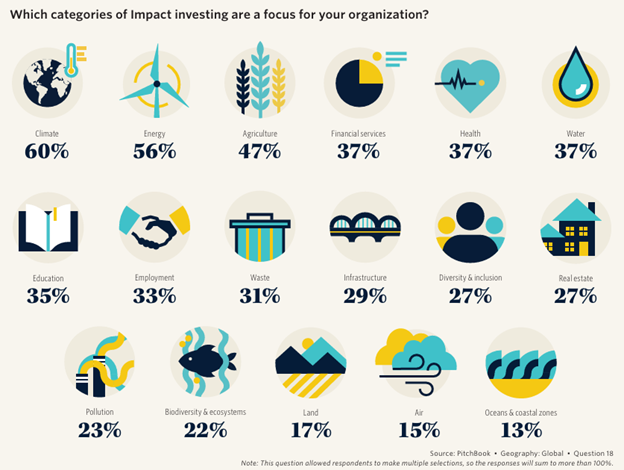
Which categories of Impact Investing are a focus for your organization?
Which Sustainable Investments Are Attracting Capital?
So, if the capital is continuing to flow, where is it going? In the private markets, ESG and impact mandates are most frequently offered, awarded, or recommended in private equity and venture capital strategies, but they are also common in private debt and infrastructure. On the impact side, respondents’ focus areas are generally clustering around durable, real-economy needs, with climate, energy, and agriculture in the lead, followed by financial services, health, and water. The drivers of interest in these areas are inextricably linked to dynamics that will influence economic and societal outcomes for decades to come, from decarbonization and digitalization to natural resource scarcity and food security concerns.
For more on how industry participants are navigating the sustainable investment landscape globally, please read our recently released report here.
The author or authors do not own shares in any securities mentioned in this article. Find out about Morningstar’s editorial policies.

 United States