
Warsh Pounds the Table on Inflation Fight, but We See Rate Cuts in 2027
The Federal Reserve raised interest rates for the first time in three years.

Kevin Warsh took the plunge and hiked rates for the first time as Federal Reserve chair.
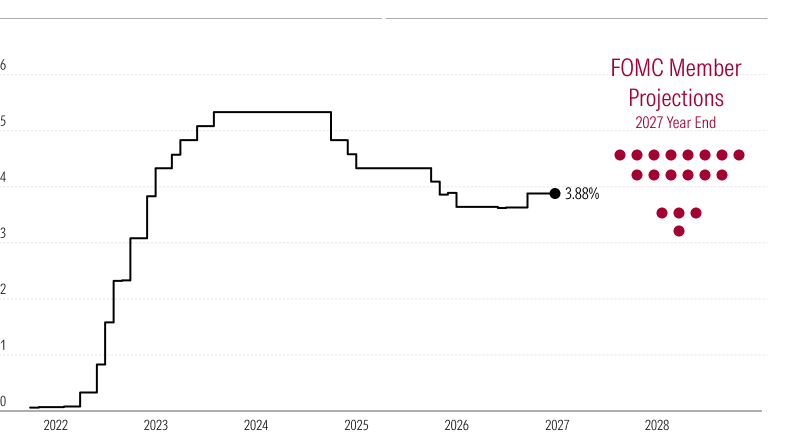
The federal-funds rate moved up by a quarter-point to a target range of 3.75%-4.00% on Wednesday, Sept. 16. That’s after being held in the 3.50%-3.75% range since December 2025. Before that, rates had been progressively lowered by 1.75 percentage points after a plateau of 5.25%-5.50% from July 2023 to September 2024.
The Fed’s decision had been widely expected, with around a 90% probability of a hike. Warsh had signaled the likelihood of a hike during his speech at the Fed’s economic conference in Jackson Hole, Wyoming, in August. Oil prices have soared again as resolution of the US-Iran war has proved elusive. The decision was unanimous.
In the months before the meeting, bond yields climbed higher, with the five-year Treasury yield rising over half a percentage point from mid-July levels. Commensurately, expectations for the federal-funds rate path rose. Markets are expecting four rate hikes (a full percentage point) by mid-2027.
In that light, the Federal Open Market Committee’s latest economic projections would seem to be dovish news, that is, they call for a lower rate path than market expectations. The median FOMC participant expects two rate hikes in 2026 but no further hikes. On the other hand, Warsh did not participate in those projections. And Warsh’s tough talk around inflation during the press conference after the meeting suggested that he may be pushing for higher rates in meetings to come.
Federal Funds Rate: Historical Data and FOMC Projections
Warsh really pounded the table on the need to tame high inflation. He stated that, after five years of inflation running above the Fed’s 2% target, “our predominant focus is on the price stability side of our dual mandate.” He added that “inflation is too high and has been too long.”
Commenting on the recent rise in bond yields, Warsh argued that it reflected in great part “economic strength” and artificial intelligence’s “competition for capital,” echoing our recent analysis. But we expect the demand side of the economy to weaken in years ahead, as the AI boost and other factors subside. As a result, we expect the unemployment rate to average 4.6% by 2028, significantly above the Fed’s projection of 4.1%.
Weakening economic demand, in conjunction with normalizing inflation, will call for a return to monetary policy loosening. We expect the Fed to cut twice in 2027 (undoing the two hikes in 2026) and a further four times in 2028. That will bring the federal-funds rate down by 1 percentage point compared with current levels.
The author or authors do not own shares in any securities mentioned in this article. Find out about Morningstar’s editorial policies.

 United States