
We Expect GDP Growth to Weaken Until Fed’s Rate Cuts Kick In
Our economic forecast is optimistic in the long run thanks to labor supply and productivity expansion.

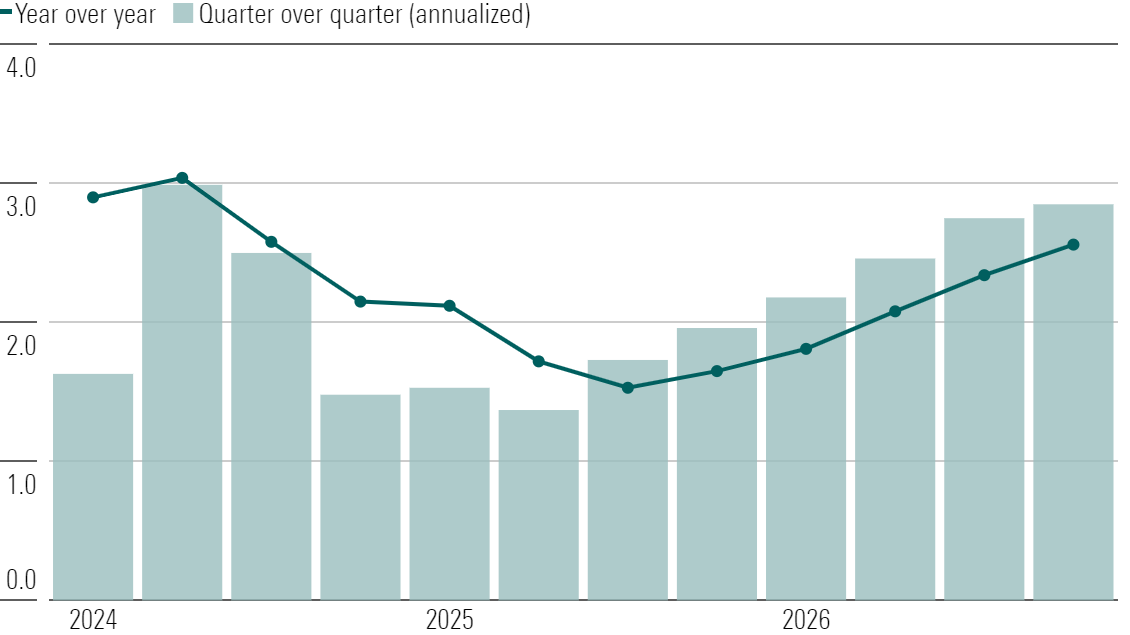
We expect gross domestic product growth to weaken over the next year before beginning to reaccelerate as the effects of Federal Reserve rate cuts start to kick in. We still expect growth to remain positive, thus avoiding a recession. This period of weaker growth should cool off the economy and ensure that inflation returns to the Fed’s 2% target.
GDP measures the size of an economy, specifically the total value of goods and services produced in a given period. The GDP growth rate indicates how fast the country’s economic output is growing.
US real GDP growth accelerated in 2023 despite facing the largest federal-funds rate hikes in four decades. But the contractionary effects of Fed rate hikes have yet to fully play out, and this and other headwinds should cause growth to slow in 2024 and 2025. In terms of annual average numbers, we expect growth to trough in 2025.
US Real GDP Growth (%)
Over 2026-28, we expect GDP growth to rebound to a brisk pace. But this shouldn’t generate renewed inflationary pressures thanks to strong supply-side expansion.
Growth Has Remained Strong in Recent Quarters, but We Expect It to Slow Soon
After posting 3% growth (quarter over quarter, annualized) in second-quarter 2024, real GDP growth is projected to grow a solid 2.5% in third-quarter 2024, according to the Atlanta Fed’s GDPNow. Our forecast is the same. The data is indicating that consumption will account for the lion’s share of third-quarter growth, while the contribution from private investment and government spending continues to fade. The Beige Book survey presents anecdotal evidence of sharply decelerating business activity, but we don’t put much weight on anecdotal evidence that flies in the face of aggregate data.
Real GDP by Expenditure, % Quarter-Over-Quarter Growth (Annualized)
While it’s too early to say a genuine slowdown has already begun, we do believe a GDP growth deceleration is coming. We expect growth to slow until late 2025.
Key factors to drive slower growth include:
- The delayed effect of tight monetary policy, which includes the ongoing slowdown in credit growth, affecting commercial real estate and other areas.
- Government spending growth should slow as state and local surpluses have been spent down. Also, federal spending growth is limited by budget agreements.
- The boom in the building of manufacturing structures that was spurred by federal subsidies, especially semiconductors and electric vehicles, should level off.
- The depletion in household excess savings should constrain consumption.
GDP Growth, Quarterly Forecast
The depletion of household excess savings is one key factor. The personal saving rate currently stands at 5.0% (last three-month average), below the prepandemic (2019) average of 7.3%. Households have been dipping into excess savings accumulated during the pandemic. But with excess savings becoming depleted, we expect saving rates to drift upward over the next couple of years, dragging on consumption growth.
Contingent on our expectation of aggressive Fed rate cuts playing out, economic growth should rebound strongly over 2026-28. With the Fed moving ahead with its first rate cut in September and projecting a year-end 2025 federal-funds rate of 3.25%-3.50%, it looks like it’s going to deliver enough monetary easing to ensure the economy thrives.
Our Supply-Side View Drives Our Bullish Long-Run GDP Forecast
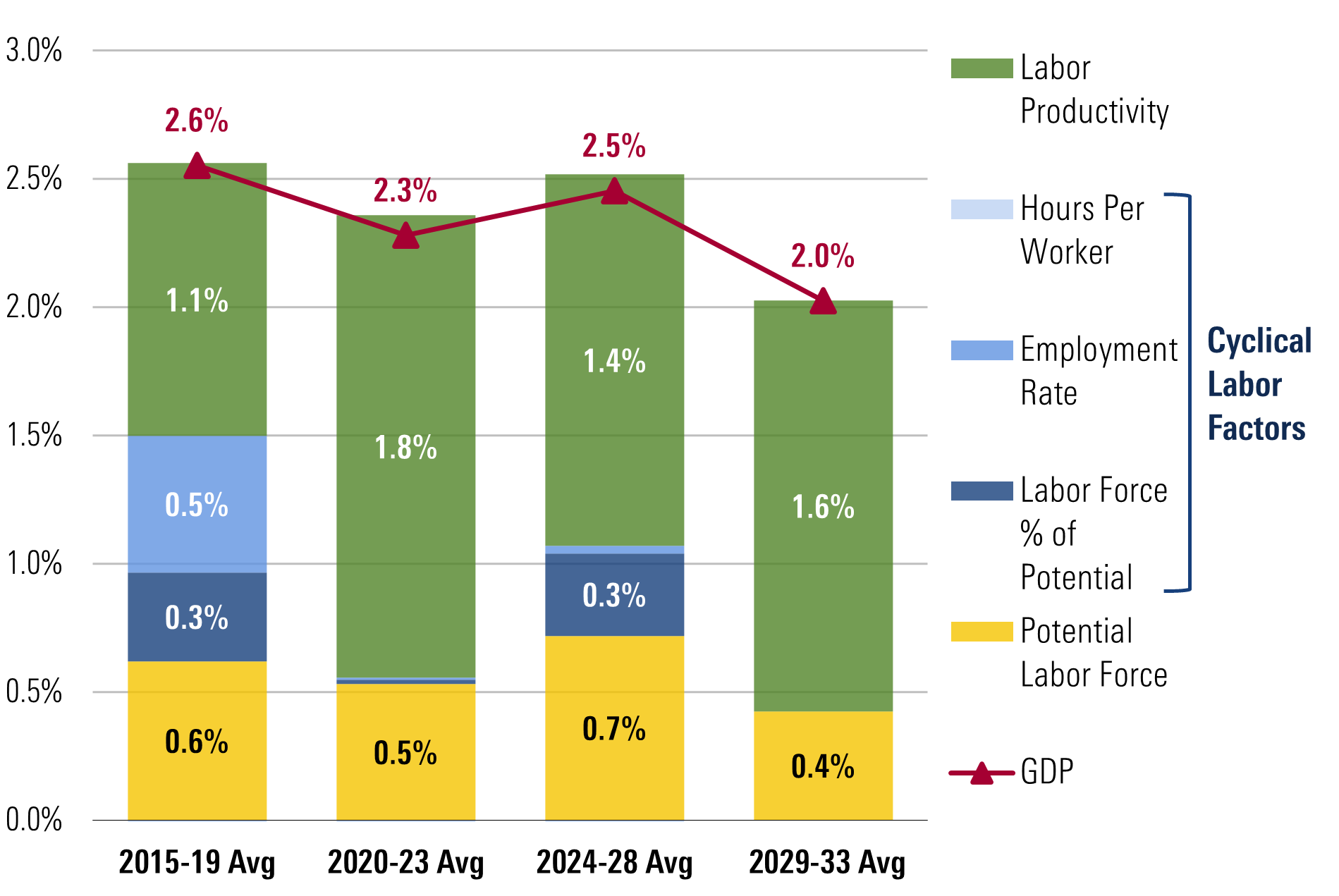
Despite our somewhat bearish near-term views, over 2024-28 as a whole, we’re bullish on GDP growth, expecting a cumulative 2 percentage points of more growth than consensus estimates, owing to our optimism on labor supply and productivity.
On a five-year time horizon, our GDP forecasts are driven by our views on the supply side of the economy. This is because we assume the Fed will fulfill its goals of hitting its 2% inflation target and achieving full employment, which entails that the economy operates at full capacity (but no higher).
In terms of labor supply, we expect labor force participation (adjusted for demographics) to recover ahead of prepandemic rates as widespread job availability pulls in formerly discouraged workers.
We also expect solid productivity growth of 1.4% on average from 2024 to 2028.
US Real GDP Growth: Supply-Side Decomposition
This article was compiled by Emelia Fredlick.
The author or authors do not own shares in any securities mentioned in this article. Find out about Morningstar’s editorial policies.

 United States