
Here’s Fidelity Contrafund’s Will Danoff’s Secret Sauce
Fidelity Contrafund’s retiring manager showed how long-term stock-picking success is still possible.
One man, one fund, 35 years. That kind of consistency is rare in money management, where hands go cold and careers flame out. But Will Danoff, the legendary steward of Fidelity Contrafund, has done what few could: built wealth steadily, massively, and without ever switching seats. He will retire from public money management at the end of 2026. The Morningstar Medalist Ratings for Fidelity Contrafund and Fidelity Advisor New Insights, another strategy that Danoff has long led, are Under Review.
What, exactly, made Danoff different? That’s the question this article tries to answer—not by glorifying a few lucky stock picks, but by dissecting the repeatable habits that turned one manager’s career into a three-decade anomaly.
The Long Arc Beats the Highlight Reel
Most fund managers don’t last three decades on a single strategy. Many who do ride a single hot streak—often during market manias like the dot-com boom or housing bubble—and spend the rest of their careers coasting on reputation alone.
Consistency You Can See
Danoff’s track record didn’t need a tentpole year. His success spanned regimes. He routinely outperformed during market pullbacks, yes—but also often in the long, grinding bull markets in between. Measured against broad benchmarks like the S&P 500 or the Morningstar US Market Extended Index, Fidelity Contrafund beat the market and peers in the large-growth Morningstar Category over every standard horizon: one year, three years, five, 10.
Will Danoff’s Advantage Shows Up in Every Time Frame
That achievement is even more remarkable when you consider the fund’s sheer bulk. By the time Danoff announced his exit, he oversaw more than $300 billion across accounts. Fidelity Contrafund alone held $176 billion in early 2026, placing it among the world’s largest actively managed mutual funds. Such heft is the enemy of agility. You can’t dance around earnings misses or nimbly pivot into momentum. And it narrows the menu of stocks where high-conviction bets are possible.
To be fair, market conditions have been friendly to Danoff’s investment style over much of the past two decades. Mega-cap growth stocks trounced smaller firms and value stocks. Still, plenty of other portfolio managers enjoyed the same weather and did not build the same fortune. What turned a favorable regime into enduring peer-beating results was Danoff’s craft: how he picked, sized, held, and sold.
How Fidelity’s Will Danoff Proved Active Management Can Still Succeed
The Art of Betting Big
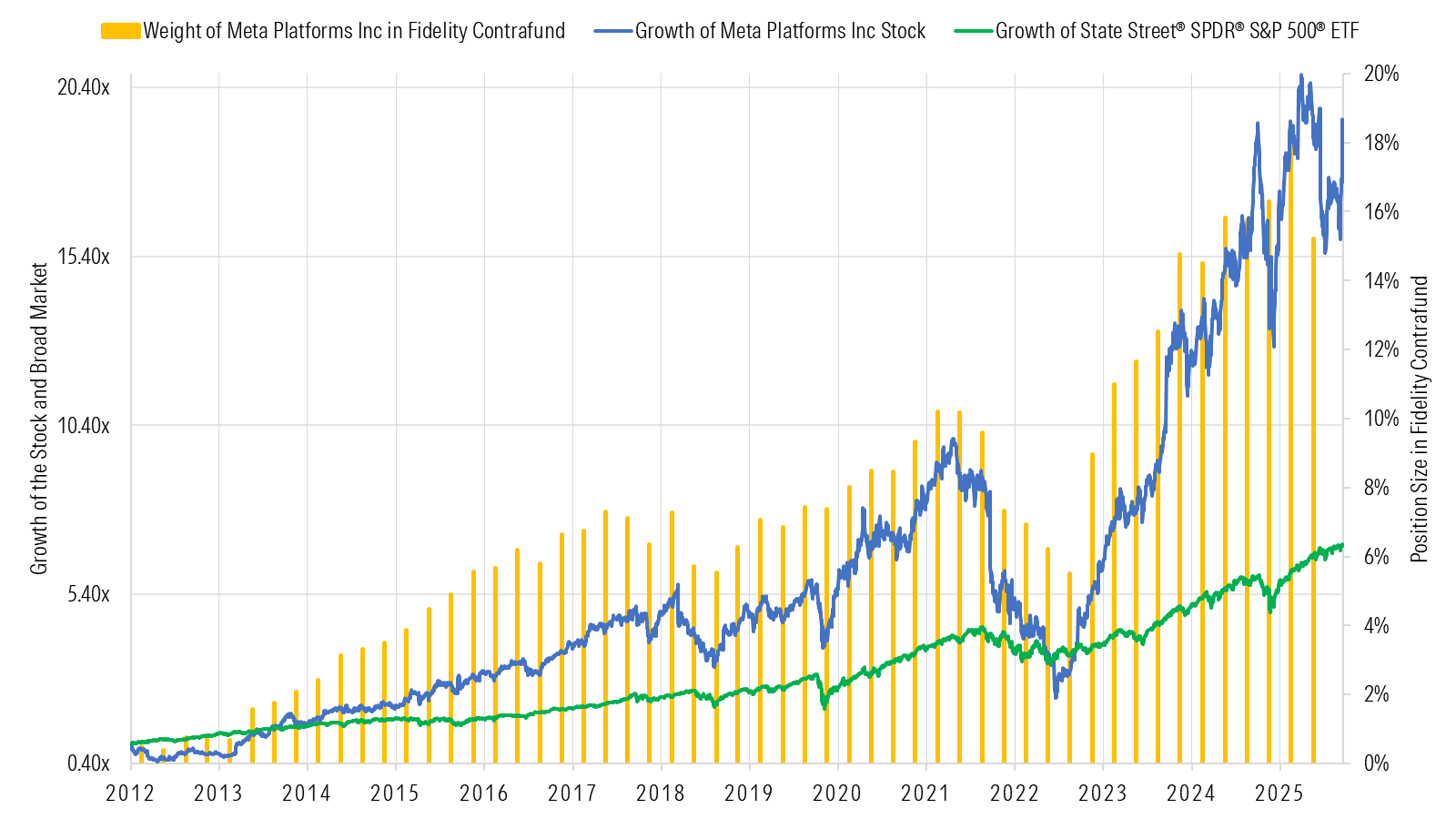
Within Fidelity Contrafund’s sprawling portfolio of between 300 and 400 stocks, perhaps no holding better captures Danoff’s approach than Meta Platforms META (previously called Facebook). Danoff owned it before it was public, nursed it as a small holding, then turned it into a defining one. For long stretches, Meta sat between roughly 8% and 15% of assets—at times even higher—far above what most mutual funds would dare. He held it through controversy, regulatory noise, a collapsing share price, and the sort of headlines that tempt managers to “derisk” for the sake of their careers.
Contrafund did not always look like this. Before 2010, its top holding typically ran 3% to 6% of assets, similar to the S&P 500’s concentration at the time. Then Danoff changed. The trigger, by his telling, came in Omaha. In 2012, he asked Warren Buffett’s advice on managing a massive fund, to which Buffett replied, “When you have a good idea, bet big.”
Still Sprawling—Just Less Than It Used to Be
The Biggest Bet Got Bigger
Danoff would bet big—but not naively. When Meta, then his largest position, began to unravel in late 2021 following Mark Zuckerberg’s costly metaverse pivot, the risks of such concentration came sharply into focus. From September to year-end, Meta tumbled 12%, while the broader market climbed nearly 6%—a brutal mismatch for any fund with a 10% stake. Yet Contrafund outperformed the average large-growth peer over the same stretch. The reason? Positions like Berkshire Hathaway BRK and UnitedHealth Group UNH—together comprising nearly 9% of assets and largely uncorrelated with Meta—helped cushion the blow. This wasn’t luck. It was skillful portfolio design: conviction balanced by counterweights.
Over the past 10 bear markets, Fidelity Contrafund beat the S&P 500 in eight. The difference was not just what Danoff bought, but how he built.
Poker, Not Prophecy
“Bet big” did not mean “bet fast.” Danoff applied the metaphor of a poker game. He started with a small stake when he thought he had a good hand. A new product gained traction? A successful market expansion? Weakening competition? Time to raise. The best bets, in his view, revealed themselves over time. And when they did, he knew how to push the chips forward.
That is where the portfolio’s long tail of holdings mattered. Danoff kept a “farm team” of tiny positions—often 0.1% to 0.5%—that acted like living research files. They told Fidelity’s analysts, “keep watching this,” and gave him a toehold if the story improved.
That discipline sat atop a vast machinery for idea flow. Danoff cast his net wide, using Fidelity’s sprawling analyst team as both radar and filter. With experts covering nearly every industry and geography, he could afford to be both curious and cautious—probing private companies, Chinese internet platforms, and unloved US sectors without flying blind. The long tail of the portfolio reflected this scale: a testing ground for dozens of promising-but-unproven names. But reach alone wasn’t the edge. What mattered was what got through.
Danoff favored best-of-breed firms with strong leadership, durable earnings growth, and clear competitive edges. He leaned toward founder-linked companies or firms with meaningful insider ownership. That preference showed up in his long-running conviction list—Meta, Amazon.com AMZN, Netflix NFLX, Berkshire Hathaway—and unusual for a mutual-fund manager, to own pieces of private companies, including SpaceX.
Where Will Danoff Chose to Be Different
‘You Haven’t Missed It’
Danoff stayed open-minded not just by chasing what was new, but by refusing to close the door to what was still working. He rejected the idea that a stock was “done” just because it had doubled or tripled. “You have not missed it,” he often said, pointing to founders who didn’t sell after their companies’ first surge. What mattered was not the chart but the compounding beneath it. If the business kept executing—growing earnings, expanding moats—the stock could stay expensive for years and still reward patient holders. To Danoff, high price multiples were not a red flag if the growth engine was durable. Drawing on advice from Peter Lynch, Fidelity’s Magellan’s successful portfolio manager from 1970 to 1990, Danoff believed that “the big money is made not in year one, but in year four or five.”
‘Be Patient, But Be Vigilant’
The story of Danoff’s Meta posture is so far vindicated. While many investors fled during its 77% collapse from 2021 to 2022, Danoff held firm. From that low in November of that year through January 2026, the stock surged over 700%, becoming the S&P 500’s second-best performer behind Nvidia NVDA.
A Decade of Letting It Run
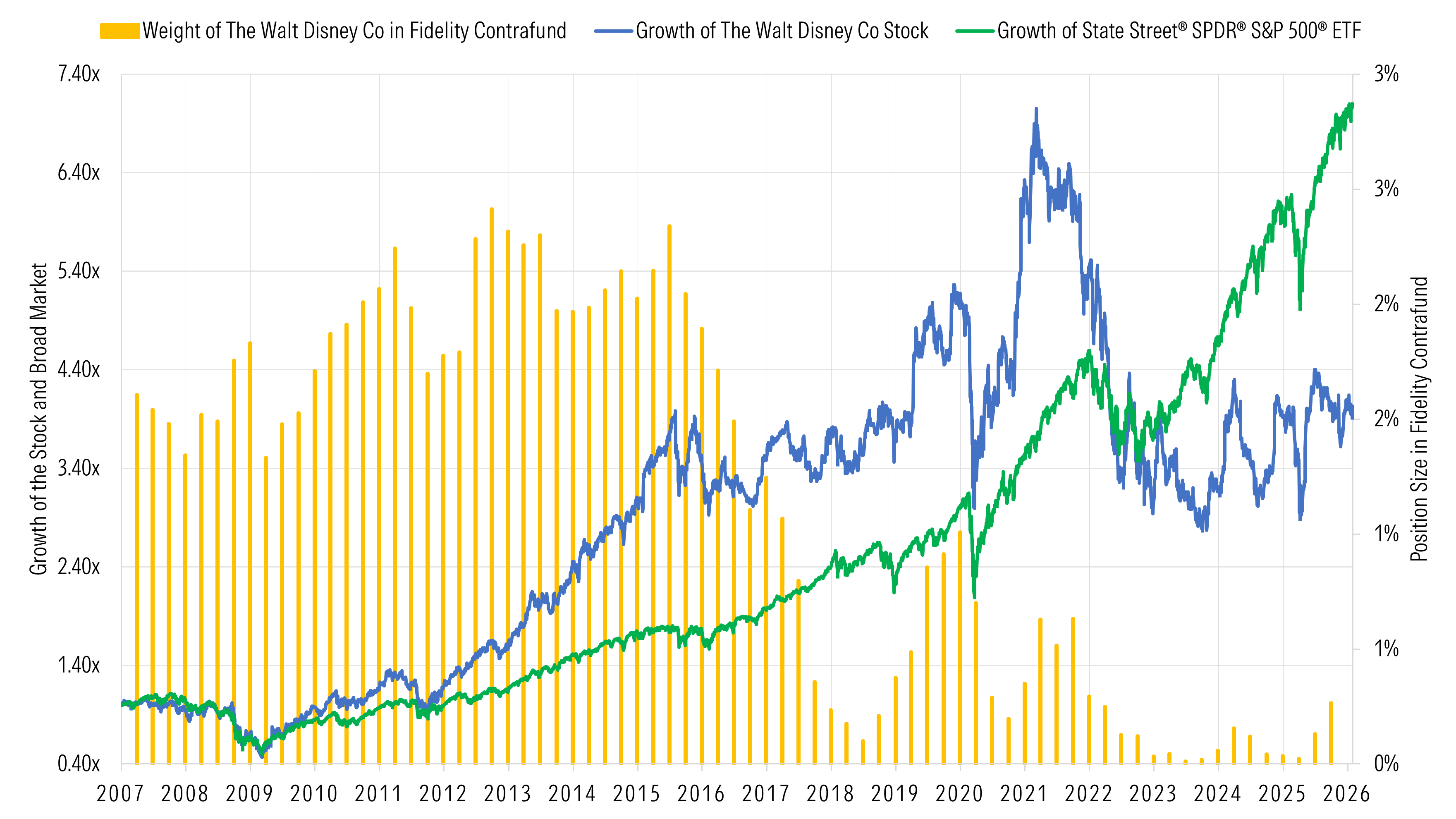
Danoff has been patient, but not passive. Danoff let his winners run, but when a company’s moat eroded, its growth prospects dimmed, or leadership faltered, he moved on. Fidelity Contrafund once held the likes of Walt Disney DIS, Nike NKE, and Starbucks SBUX in size. He didn’t let nostalgia or hope that they could repeat their former glory days keep him from trimming or selling, mostly to the fund’s benefit. In past cycles, Danoff fled WorldCom, Lehman Brothers, Wachovia, and Circuit City Stores well before their demise. Some exits were about decline; others about displacement. More recently, he pivoted away from former the top 10 positions, UnitedHealth Group and Adobe. UnitedHealth’s outlook has dimmed under the weight of rising costs and regulatory pressure, while Adobe faces the disruptive threat of generative artificial intelligence encroaching on its core creative software business.
The Fund Moved On
Vigilance meant staying close to the facts. Each quarter offered a fresh checkpoint. Earnings reports weren’t just numbers; they were scorecards on whether management was executing, whether growth plans were advancing, whether competitive threats were being held at bay.
‘What Do I Know From Tinder and Match.com?’
Danoff credits much of his longevity to something rarely celebrated in finance: intellectual humility. He’s frank about his limitations, especially in fast-moving fields like biotech or dating apps, where he leans on younger analysts and domain experts to clarify what matters.
“The first time I heard of Lyft LYFT, I thought, I’m never going to go into somebody else’s car with a driver I don’t know. So, keep an open mind, and try to stay around young people, because young people are more open to new ideas. They’re smarter, they’re working harder, and they can help you see the future.”—Will Danoff, quoted in Leslie P. Norton, “Fidelity’s Will Danoff Looks Back on 30 Years at Contrafund,” Barron’s, Oct. 2, 2020.
He often likened Fidelity to a big city hospital, staffed with specialists across every field, and saw his role as listening closely and adjusting accordingly. It also means holding onto a beginner’s mindset: open, curious, and never too proud to ask a basic question.
The Long Game, Played Well
Danoff will retire having done what active managers promise and rarely deliver: he beat the market, over and over, without turning his fund into a reckless stunt or a closet index fund. He built big positions carefully, scaled them as proof arrived, and held them long enough for compounding to show its power. He sold when the story broke, not when the price merely wobbled. Investors who stuck with Contrafund did not just “do fine.” They built real wealth—over short windows and long ones—because Danoff made good judgment into a habit.
Danoff exits as one of the last of the true star mutual fund managers—a breed becoming less common as index funds and team-managed strategies take greater share. His successor duo, Asher Anolic and Jason Weiner, bring years of shared experience, having comanaged large-cap strategies at Fidelity since 2017. They will take full control of Contrafund by year-end 2026, with a gradual transition already well underway. A new chapter is beginning. The last one set a high bar.
Further Listening, Reading, and Watching
- “Will Danoff: Succeeding at Scale”—The Long View (podcast transcript), Jan. 29, 2020. https://the-long-view.simplecast.com/episodes/will-danoff/transcript
- “Transcript: Will Danoff”—Masters in Business (podcast transcript), by Barry Ritholtz, Sept. 13, 2020. https://ritholtz.com/2020/09/transcript-will-danoff/
- “Fidelity’s Danoff Makes Stock-Picking Case in ETF Era”—Bloomberg Television (video). https://www.youtube.com/watch?v=yp9mEwBaO54
- “Fidelity’s Will Danoff Looks Back on 30 Years at Contrafund”—Barron’s, by Leslie P. Norton, Oct. 2, 2020. https://www.barrons.com/articles/fidelitys-will-danoff-looks-back-on-30-years-at-contrafund-51601679688
The author or authors own shares in one or more securities mentioned in this article. Find out about Morningstar’s editorial policies.

 United States