
These Growth Funds Were Ahead of Their Indexes on the AI-Buildout Trade
Micron and Western Digital were value stocks until the AI buildout. Morningstar’s Active Score reveals which growth managers had the leeway to scoop them up before their growth accelerated—and which didn’t.


To the biggest index providers, some of the best-performing US growth stocks of the past two years were value stocks, including a memory chipmaker, a couple of disk-drive companies, and a semiconductor giant the market had written off. Some growth funds saw through that, though, and owned the stocks anyway, to their and their shareholders’ benefit. Active score, a measure of how far a portfolio strays from its benchmark, can point out strategies that are more likely to make such bold moves better than the usual gauges of portfolio activity.
The Cost of Style Purity
Many fund companies tell portfolio managers to fish almost exclusively in their benchmark’s waters, for defensible reasons: A large-growth fund that discreetly owns value stocks can cause unwanted overlap across an investor’s multifund portfolio. A more cynical rationale is that taking such chances risks losing to the benchmark and triggering an exodus of fee-generating assets.
Trouble starts when an index doesn’t keep pace with changes in the investment universe it tries to represent. When a poky company suddenly becomes an earnings juggernaut in one month, it keeps its old value label until the benchmark reconstitutes or updates its membership, usually quarterly, annually, or semiannually.
Micron Technology MU shows how long a stock’s style label can lag its reality in some indexes. The stock was a negligible holding in the Russell 1000 Growth Index until it dropped out in the widely followed benchmark’s June 2023 annual reconstitution. But when it rejoined the growth index in June 2026 after three years in the Russell 1000 Value Index, it returned as the growth bogy’s seventh-largest position. For those 36 months, owning Micron meant accepting some drift from the growth benchmark’s characteristics and performance.
Missing the Boom
Value Stocks, Growth Returns
Artificial intelligence obsoleted the style labels, and fast. AI models’ appetite for computer memory, storage, and networking hardware has been insatiable since ChatGPT’s release in late 2022. The subsequent feeding frenzy sharply boosted suppliers’ earnings and the market repriced their shares faster than the index could keep up.
Off the Menu, On a Tear
Up and to the Right
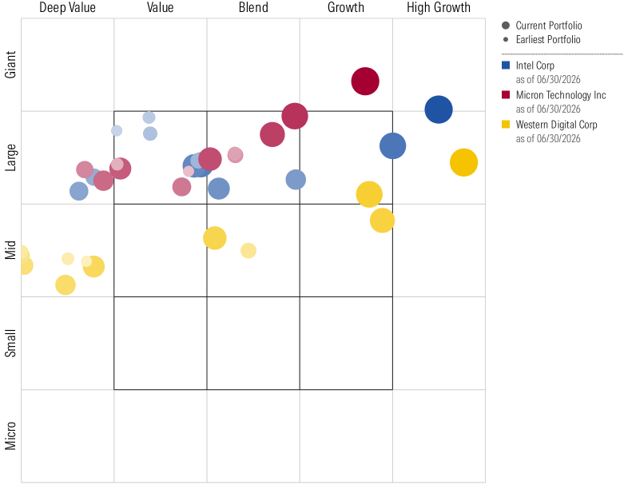
From Jan. 1, 2025, through Sept. 7, 2026, Micron alone contributed 1.9 percentage points to the Morningstar US Market Index’s 34% cumulative return, and Intel another 0.6 percentage points. Intel’s path shows how short-lived the labels can be. It sat in the Morningstar Style Box’s deep-value column in 2024, but has since darted to high growth and remains outside the Russell 1000 Growth. A growth fund without these stocks missed a big part of the AI trade.
Months Ahead of the Index
Which growth funds owned these stocks while the index still called them value? Micron and Western Digital joined the Russell 1000 Growth in June 2026. From January 2023 to December 2024—the period after ChatGPT’s launch alerted anyone paying any attention to AI’s investment potential, but before the index acted—half the 21 Fidelity, MFS, JPMorgan, and T. Rowe Price funds benchmarking themselves to large-growth indexes bought Micron or Western Digital; the rest waited.
Months Ahead of the Index
The funds at the top bought both names early. Fidelity Blue Chip Growth was ahead of the index by more than two years. The funds at the bottom bought near when the index reconstituted: Four purchased Micron in May 2026, a month before it rejoined the index, and three T. Rowe Price funds—Blue Chip Growth, Growth Stock, and Large Cap Growth—bought the same month index-trackers did.
Clustered by Firm
Patterns arise by fund family: Eight of Fidelity’s nine funds bought one of the two stocks, while three of the other three firms’ 12 did. Averaged across each firm’s lineup, Fidelity had a nearly 16-month lead; JPMorgan had a six-month lead, MFS four, and T. Rowe Price two.
A Family, Not Just Fund, Trait
Active share, a standard gauge of how much a portfolio differs from its benchmark, would not have tipped anyone off about Fidelity’s apparent prescience. The correlation with how early each of the families’ funds bought the AI-related stocks is essentially zero. MFS had the highest average active share of the four firms and was the second-latest buyer; the fund with the highest active share bought neither stock early.
That’s because active share says nothing about which stocks (either public or privately held) a fund owns outside its benchmark. Instead, we can use a simple companion score—call it the Morningstar Active Score—which focuses more on portfolios out-of-benchmark and private holdings. Active score correlates to funds that buy before the index far better than active share.
Blue Chip in Name Only
Two funds illustrate the case. Fidelity Blue Chip Growth Fund FBGRX and T. Rowe Price Blue Chip Growth Fund TRBCX share a name, benchmark, and Morningstar Category (large-growth), and their trailing 3-year median active shares are within 5 percentage points of each other.
Blue Chip in Name Only
Despite these similarities, they are quite different. Fidelity keeps roughly twice as much of its assets in stocks outside the index, and several times as much in private companies. Fidelity Blue Chip Growth bought Micron and Western Digital more than two years before the index; T. Rowe Price’s Blue Chip Growth fund bought Micron the same month the index did and has avoided Western Digital. It’s not just Micron and Western Digital at Fidelity. It also owns Seagate Technology STX, Kioxia Holdings, and SK Hynix SKHY—none of which are in the benchmark.
Worth the Risk?
There are caveats to giving managers a long leash, though. Private company stakes are riskier and harder to buy and sell than Russell 1000 constituents, so funds that buy early often do so in small increments. Most of these purchases started as less than one percentage point of assets.
Fidelity is not the only firm that gives its managers some latitude. MFS Growth, which has no private holdings, had the largest out-of-index Seagate stake at 2% of assets. Finally, this article focuses on one period and a small sample of funds, and a wide-ranging shop eventually will range into something that flops.
Style Purity and Its Discontents
For anyone picking a fund, the practical move is to consider what the firm permits before asking what the fund holds. A fund at a 40% active share that owns its index’s constituents at different weights is different from one with the same active share, but holds one-fifth of its assets in companies the index excludes or nonpublic holdings.
Style-pure funds give investors clean building blocks for their portfolios, but at a cost. In recent years, that has meant that style-pure, benchmark-conscious growth funds missed some of the market’s best-performing growth stocks. That can happen again the next time the benchmark fails to keep up with abrupt changes in the investment universe—but managers with the freedom to look beyond their benchmarks have a shot at taking advantage of those changes before the benchmarks do. Looking at a fund and family’s active score might help you find funds and fund families with track records of doing so.
Special thanks to Don Phillips, whose original idea inspired this research.
The author or authors do not own shares in any securities mentioned in this article. Find out about Morningstar’s editorial policies.

 United States