
Markets Brief: Stocks Are Getting Expensive. Should You Sell?
Plus: Fed decision looms, more inflation data, and market timing.



Mixed Valuation for Consumer Stocks
US equities fell 0.8% last week, with mid- and small-cap stocks leading the decline, while large companies declined the least. At a sector level, only communications services and consumer cyclicals rose, with each dominated by a single stock. Alphabet GOOGL/GOOG, which accounts for 38% of the communication services sector, was up 8.4%, and Tesla TSLA, the second-largest consumer cyclical stock, rose 12.1%. Tesla’s stock price is now more than double Morningstar’s estimate of its fair value, while Alphabet remains undervalued. This demonstrates the considerable variation in opportunities at a company level despite the sharp rise in the index over 2024. You can dig into these disparities with the Morningstar Markets valuation view.
Is the Stock Market Overvalued?
Following the sharp rise in stock prices since the election, more commentators are warning about high valuations. This prompts the question of how investors should respond. Although high valuations can indicate lower future returns, they are poor portents for timing. Investor sentiment can drive market prices to more extreme levels than most think possible. Significantly reducing equity exposure in your portfolio may lead to regret, and in the worst cases, you may repurchase securities at a higher price. At the same time, ignoring valuations can lead to permanent capital losses, which could prevent you from reaching your financial goals.
Your Time Horizon Makes a Huge Difference
Any response should be considered in the context of the purpose of your portfolio. The right move for someone with 20 years of work left may differ from the one for someone already in retirement. Because of this, we treat these situations separately in our 2025 outlook.
For most, the first response to a concentrated rise in prices should be rebalancing one’s portfolio to its original target weights, as this will reduce excess exposure to assets that have risen strongly and add to those that have lagged. For those who want to go further, seeking underpriced parts of the market can be a good alternative to selling stocks. This lets you remain engaged with stocks that drive long-term returns while marginally increasing those expected returns and reducing the probability of a sharp fall.
Selling Stocks Slowly
If you want to reduce your equity exposure, do so gradually rather than making a precipitous adjustment, as the catalyst for a change in market direction is typically only discernible with hindsight. But bear in mind that most investors find it difficult to purchase stocks when the prospects are bleak and the valuations attractive. Selling to avoid a near-term decline may therefore impair returns over the long term.
How Many Fed Rate Cuts in 2025?
The latest CPI data was in line with expectations, increasing the probability of a 0.25-percentage-point interest rate cut when the Federal Reserve Open Market Committee concludes its meeting on Wednesday. While that decision will make the headlines, market commentators will be more interested in the “dot plots,” which indicate what individual members of the FOMC expect for interest rates, as they may challenge current thinking. Two further rate cuts are currently priced into market expectations for 2025. If the FOMC signals a different potential outcome, asset prices will likely see some volatility. Bella Albrecht has more details on last week’s inflation data.
Up Next: PCE Data
Alongside the FOMC meeting, there is a deluge of economic data this week, including retail sales, the second revision to third-quarter GDP, and more inflation data in the form of the Personal Consumption Expenditures Index on Friday. While such announcements could cause price volatility at any time of year, the holidays increase the probability of this happening, as there are fewer active participants in the market. You can keep up to date with all of the economic data releases with our calendar.
Highlights of This Week’s Market and Investing Events
- Monday, Dec. 16: Purchasing Managers Index Composite
- Tuesday, Dec. 17: Retail Sales, Capacity Utilization, Industrial Production, Business Inventories
- Wednesday, Dec. 18: New Residential Construction, Federal Open Market Committee decision on interest rates
- Thursday, Dec. 19: Initial Unemployment Insurance Claims, Federal Reserve Bank of Philadelphia Index, Existing Home Sales, Leading Indicators, earnings from Nike NKE
- Friday, Dec. 20: Personal Income and Outlays report
Market Performance - Trading Week Ended Dec. 13
- The Morningstar US Market Index fell 0.9%.
- The best-performing sectors were consumer cyclicals, up 1.1%, and communication services, up 0.6%.
- The worst-performing sector was basic materials, down 3.2%.
- Yields on 10-year US Treasury notes rose to 4.40% from 4.15%.
- West Texas Intermediate crude prices fell 0.1% to $71.06 per barrel.
- Of the 877 US-listed companies covered by Morningstar, 245, or 28%, were up, one was unchanged, and 631, or 72%, were down.
Best-Performing Stocks
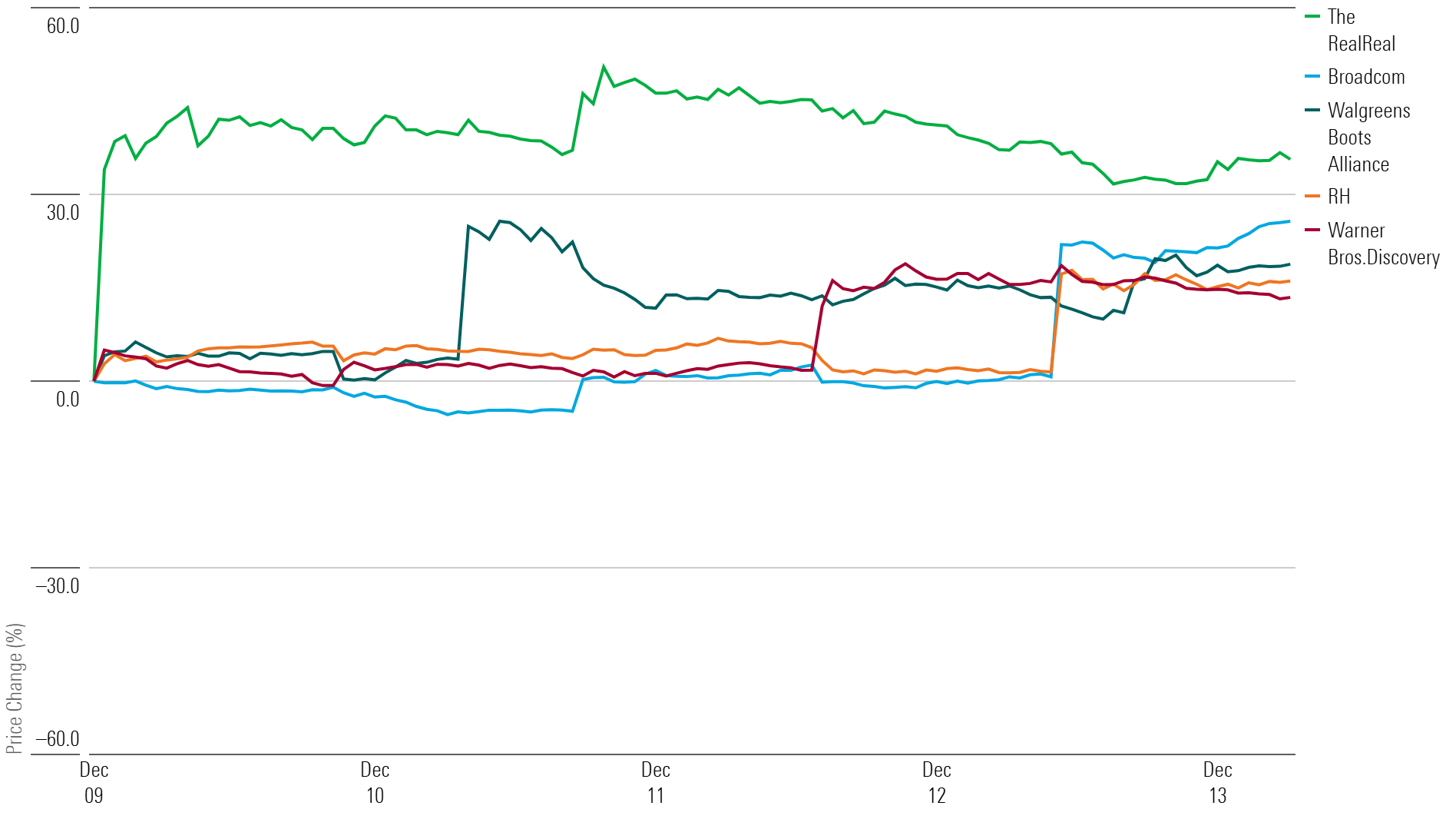
The RealReal REAL, Broadcom AVGO, Walgreens Boots Alliance WBA, Restoration Hardware RH, and Warner Bros. Discovery WBD were the top performers among US-listed stocks covered by Morningstar analysts.
- The RealReal performed best, gaining 36.5%, and it’s up 254.4% over the last three months. The no-moat company, which carries a 1-star rating, is up 292.0% over the last 12 months. The stock finished the week at $8.80, trading at a 290.7% premium to its fair value estimate of $2.25 per share.
- Broadcom was the second-best-performing stock, with a 25.2% return. The 2-star stock has gained 10.1% over the last three months. Shares in the wide-moat company are up 70.4% over the last 12 months. Broadcom stock finished the week at $224.8, trading at an 18.3% premium to its fair value estimate of $190 per share.
- Ranking third was no-moat Walgreens Boots Alliance. The 5-star stock rose 21.4%, gained 12.9% over the last three months, and lost 53.2% over the past year. At the end of the week, Walgreens stock was trading at $10.40, a 48% discount to its fair value estimate of $20 per share.
- Restoration Hardware stock rose 18.6%. The no-moat company has gained 48.7% over the past three months and is up 50.7% over the past 12 months. The 2-star stock finished the week at $446 per share, a 48.7% premium to its fair value estimate of $300 per share.
- The fifth-best-performing stock for the week was Warner Bros. Discovery, with a gain of 13.2%. The 4-star stock has risen 63.1% and it’s up 11.2% over the last 12 months. Warner Bros. Discovery closed the week at $12.10, a 39.6% discount to its fair value estimate of $20 per share.
Best-Performing Stocks of the Week
Worst-Performing Stocks
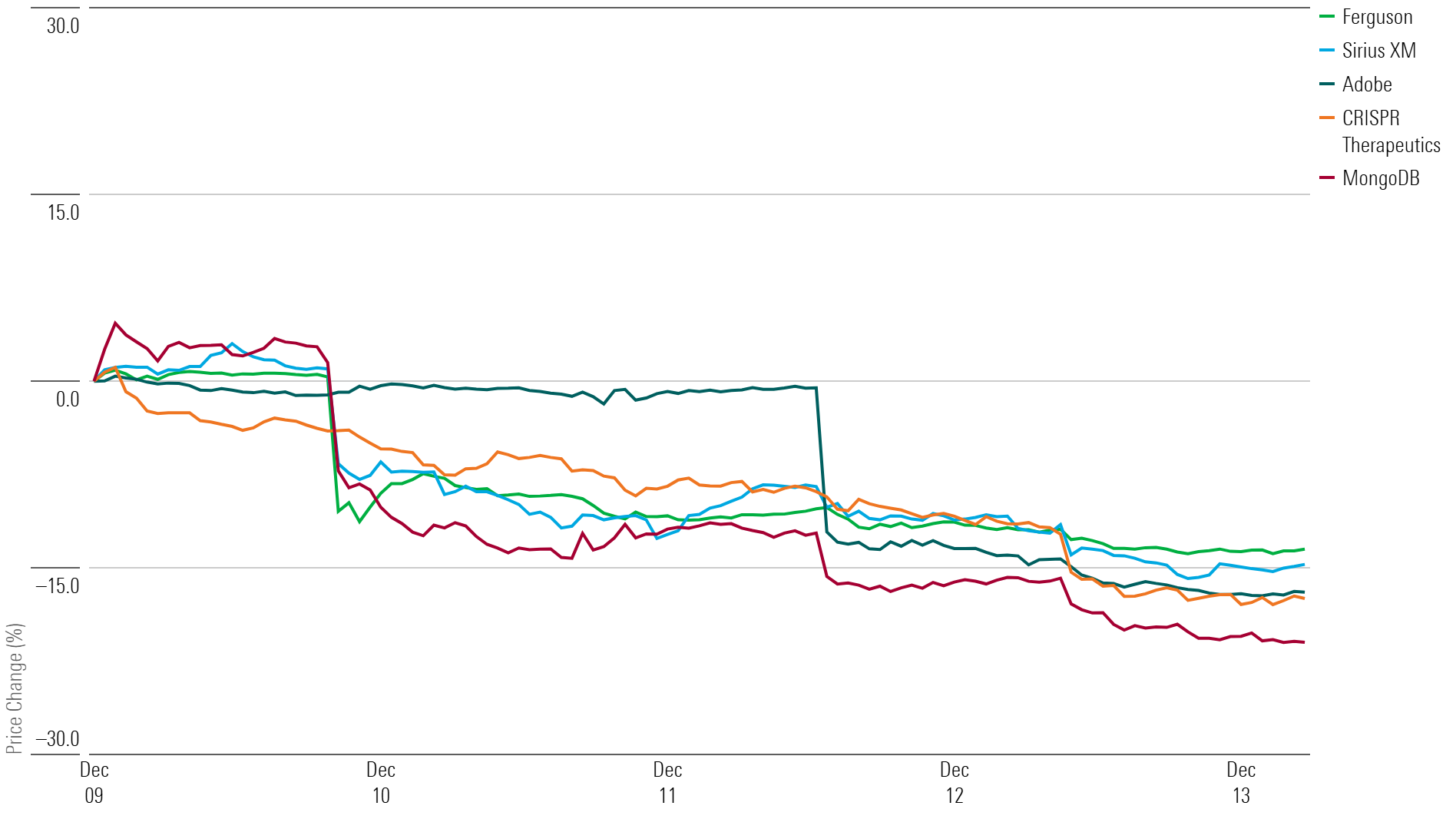
MongoDB MDB, CRISPR Therapeutics CRSP, Adobe ADBE, Sirius XM Holdings SIRI, and Ferguson Enterprises FERG performed worst among US-listed stocks covered by Morningstar analysts.
- MongoDB was the worst-performing stock of the week, falling 22.2%. This 3-star, no-moat company has increased 2.2% over the last three months and 26.6% over the past 12 months. The stock ended the week at $267.20, trading at a 7.9% discount to its fair value estimate of $290 per share.
- CRISPR Therapeutics took the second spot, with a 16.3% price decline this week. The no-moat company, rated 5 stars, has fallen 1.1% in the past three months and increased by 21.9% over the last year. Closing at $43.80, the stock trades at a 58.7% discount to its fair value estimate of $106 per share.
- Adobe came in third, experiencing a 15.8% drop this week. This 4-star, wide-moat company is up 19.1% in the last three months and 25.1% over the past year. The stock finished the week at $465.70, trading at a 21.1% discount to its fair value estimate of $590 per share.
- Next up is Sirius XM Holdings, which saw its stock price fall by 14.8% this week. The no-moat company, which has a 3-star rating, has dropped 1.7% over the past three months and is up 51.2% over the last year. At $24.10, the stock trades at a 19.6% discount to its fair value estimate of $30 per share.
- Ferguson Enterprises rounds out the list, with its stock declining by 13.6% this week. Rated 2 stars, this narrow-moat company has increased 0.5% over the past three months and 5.8% over the last 12. The stock closed the week at $187.50, trading at an 11.6% premium to its fair value estimate of $168 per share.
Worst-Performing Stocks of the Week
The author or authors do not own shares in any securities mentioned in this article. Find out about Morningstar’s editorial policies.

 United States