
Did Your Thrift Savings Plan TSP L Fund Keep Up in 2025?
Some target-date L Funds surged, others stumbled for the Federal workers they serve.


Like other target-date funds, the Federal Thrift Savings Plan’s TSP L Funds are among the retirement plan’s most popular options. The funds, also known as the TSP Lifecycle Funds, accounted for more than $270 billion, a quarter of TSP assets in October 2025. The L Funds would rank as one of the world’s top 10 target-date providers.
The L Funds saw a few updates in 2025: TSP L 2025 closed as it hit its retirement year, and its investors rolled into TSP L Income. TSP also launched L 2075 for investors who have about 50 years until retirement, a vintage year no other US-based target-date vehicle tracked by Morningstar offers, but, according to TSP’s modeling, suits teenaged workers who will retire around age 62.
This is the second article intended to supplement Tsp.gov information and provide more context on these massive investment offerings’ processes and performance. Your input has shaped these articles. Thanks to those who provided feedback. You can still provide input via our TSP feedback survey.
Asset Allocation Glide Path Drive Results
The TSP L Funds invest in the TSP plan’s five individual, mostly index-based funds. The L Funds become less equity-heavy over time, moving into bonds and TSP G Fund as workers approach their retirements. While the funds have been less equity-heavy than most target-date funds, they’ve been transitioning for more than a decade to a more aggressive glide path. Such a lengthy transition, which will be complete in 2032, is unheard of. Other target-date providers measure transitions in months rather than years. The TSP’s Federal Retirement Thrift Investment Board said it wanted to minimize disruption, take time communicating the changes, and reduce the odds of mistiming the equity increase.
TSP L Funds Continue Decade-Plus Move to Heavier Equity Allocation
Currently, the longer-dated L Funds for early career workers—L 2055 through L 2075—have 99% of their assets in stocks, much more than their typical peer’s roughly 90%. Midcareer workers (L 2050 through L 2030) have more average equity allocations. TSP L Income’s 27% equity allocation is much lower than the industry’s 42% average.
In 2025, when stocks beat bonds, those big equity stakes, shown in the exhibit above, drove the L Funds results: The bigger the stock allocation, the stronger the relative results. Below, we cover each TSP L Fund’s 2025 and longer-term results. Use the page menu on the left to find specific funds’ results.
TSP L Income Fund
- Intended Investor: Retired and/or 63 or older
- Morningstar Index: Morningstar Lifetime Moderate Income Index
- Morningstar Category: US Fund Target-Date Retirement
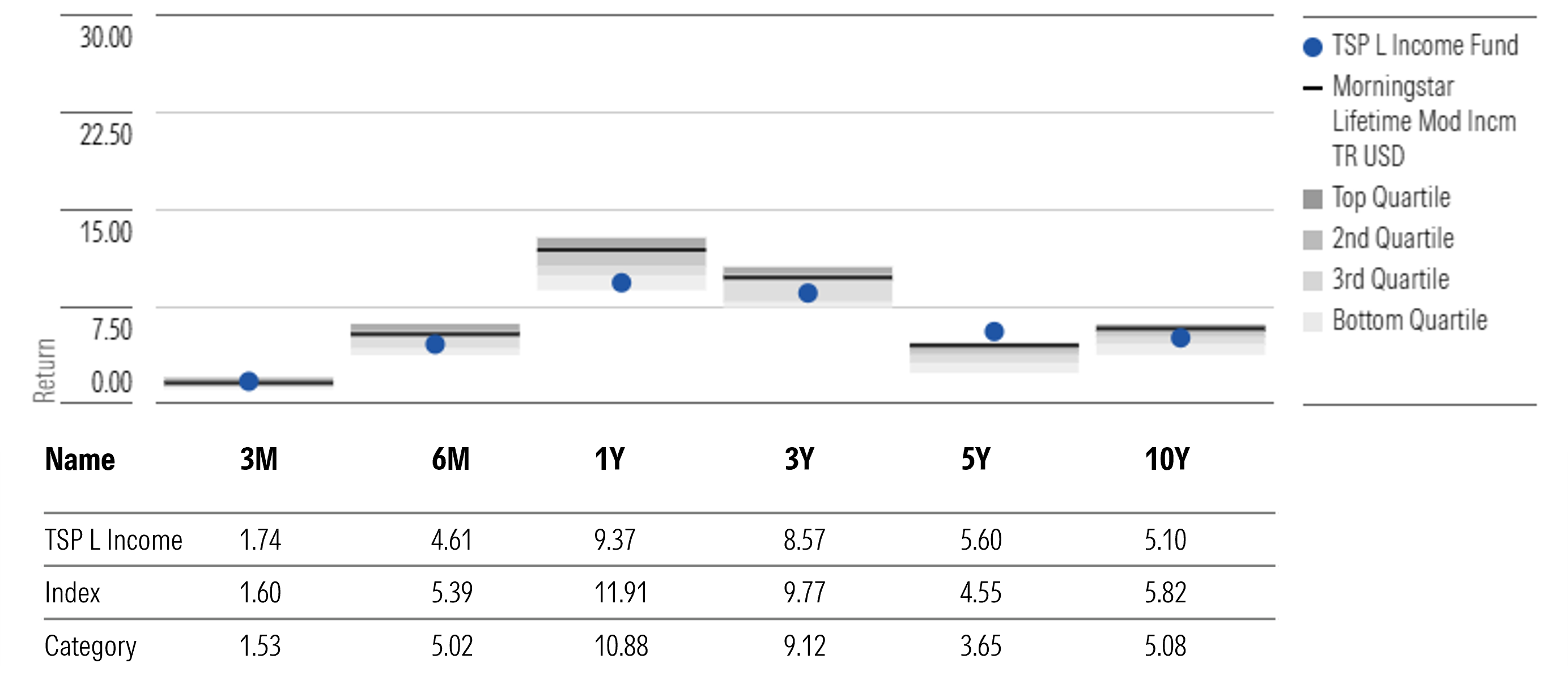
TSP L Income’s low equity allocation and big TSP G Fund allocation have shaped the fund’s short- and longer-term results. In recent periods, TSP L Income has lagged its target-date retirement Morningstar Category peers due to strong equity markets; the fund’s 9.4% 2025 gain trailed the category average’s 10.9% by 1.5 percentage points.
The fund‘s hefty TSP G Fund stake, two-thirds of the portfolio at the end of 2025, helped when interest rates rose in 2022. That year, TSP F, which tracks the Bloomberg US Aggregate Bond Index, lost 12.8% while TSP G gained 3.0%. Most target-date funds’ fixed-income allocations more closely resemble TSP F. As a result, in 2022, the typical category peer lost 12.7%, while TSP L Income lost just 2.7%. Over the decade through December 2025, TSP L Income’s 5.1% annualized gain matches the category average return.
TSP L Income Fund Annualized Returns Through Dec. 31, 2025
TSP L 2030 Fund
- Intended Investor: About 56 to 60 years old
- Morningstar Index: Morningstar Lifetime Moderate 2030 Index
- Morningstar Category: US Fund Target-Date 2030
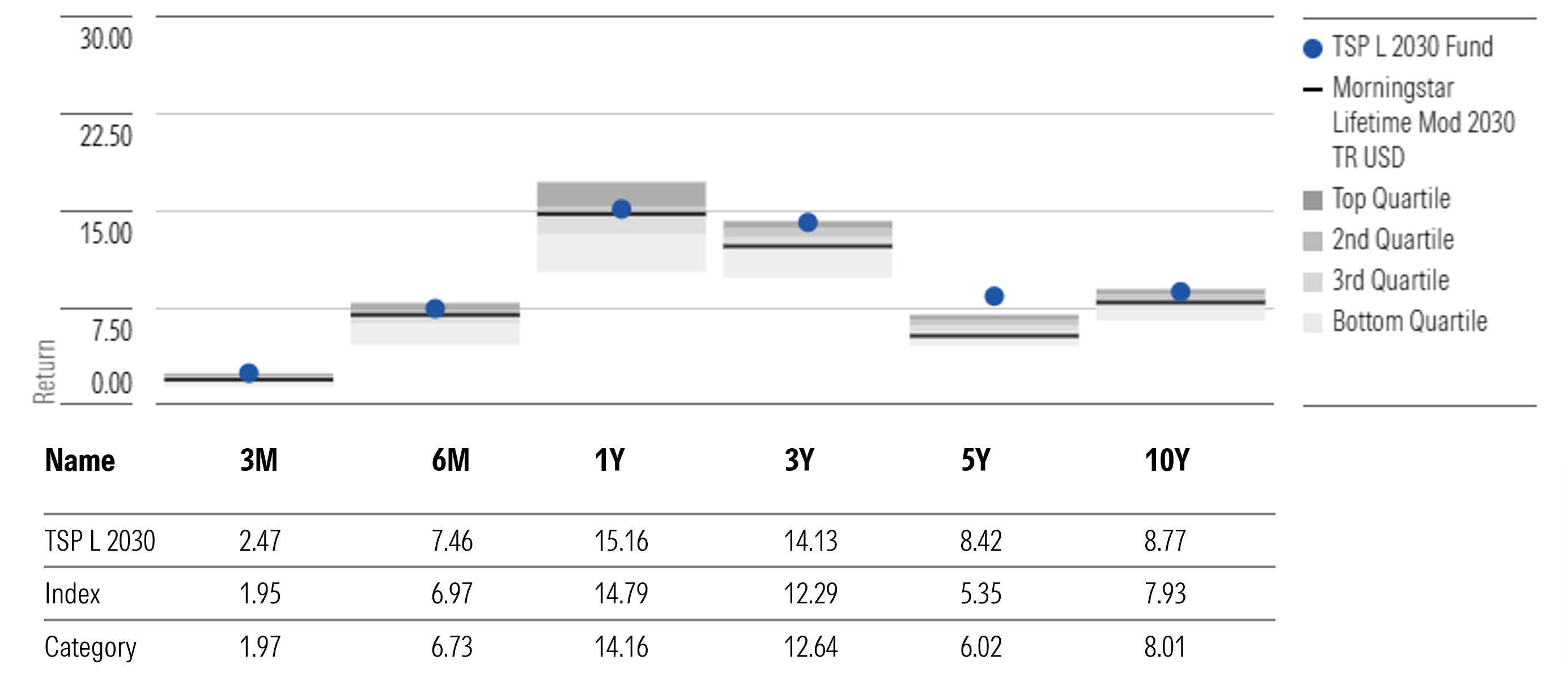
TSP L 2030 is the “kink” in the TSP L Funds’ equity asset-allocation glide path, the point where their stock helpings begin a steep decline. As of December 2025, TSP L 2030’s 57% equity stake was almost 30 percentage points greater than TSP L Income’s 28%. Such a rapid move courts the risk of selling stocks when they are down and when account balances are at or near their highs.
The “kink,” though, has also given TSP L 2030 more stocks than its target-date 2030 category peers’ 52% average stake. This helped the fund’s 8.8% 10-year annualized gain rank in the top half of target-date 2030.
TSP L 2030 Fund Annualized Returns Through Dec. 31, 2025
TSP L 2035 Fund
- Intended Investor: About 51 to 55 years old
- Morningstar Index: Morningstar Lifetime Moderate 2035 Index
- Morningstar Category: US Fund Target-Date 2035
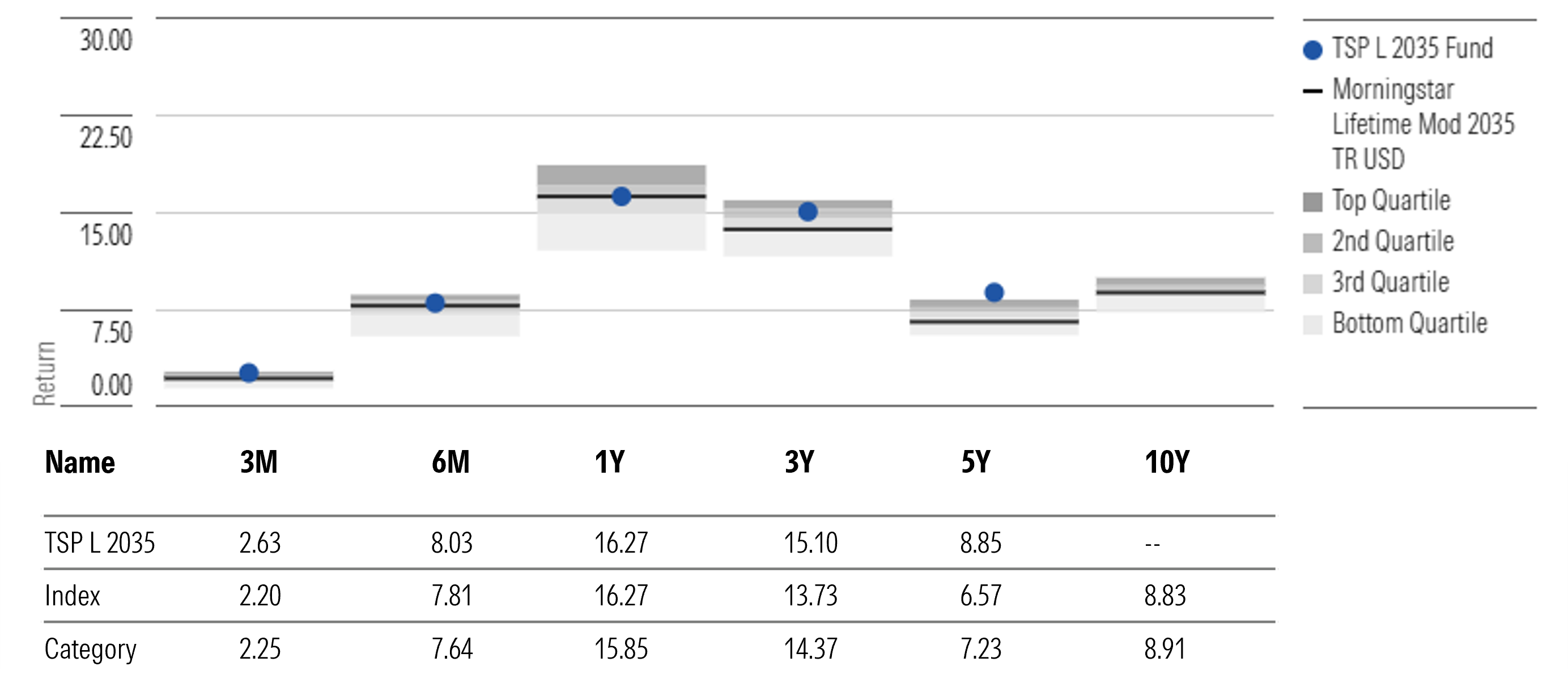
Since TSP L 2035’s July 2020 inception through December 2025, its 10.9% annualized gain beat the target-date 2035 category average by 1.2 percentage points. A larger-than-category-average equity allocation and big TSP G stake aided results since inception. TSP L 2035’s equity heft helped it offset headwinds from its G Fund allocation; the fund’s 16.3% gain in 2025 beat the category average.
TSP L 2035 Fund Annualized Returns Through Dec. 31, 2025
TSP L 2040 Fund
- Intended Investor: About 46 to 50 years old
- Morningstar Index: Morningstar Lifetime Moderate 2040 Index
- Morningstar Category: US Fund Target-Date 2040
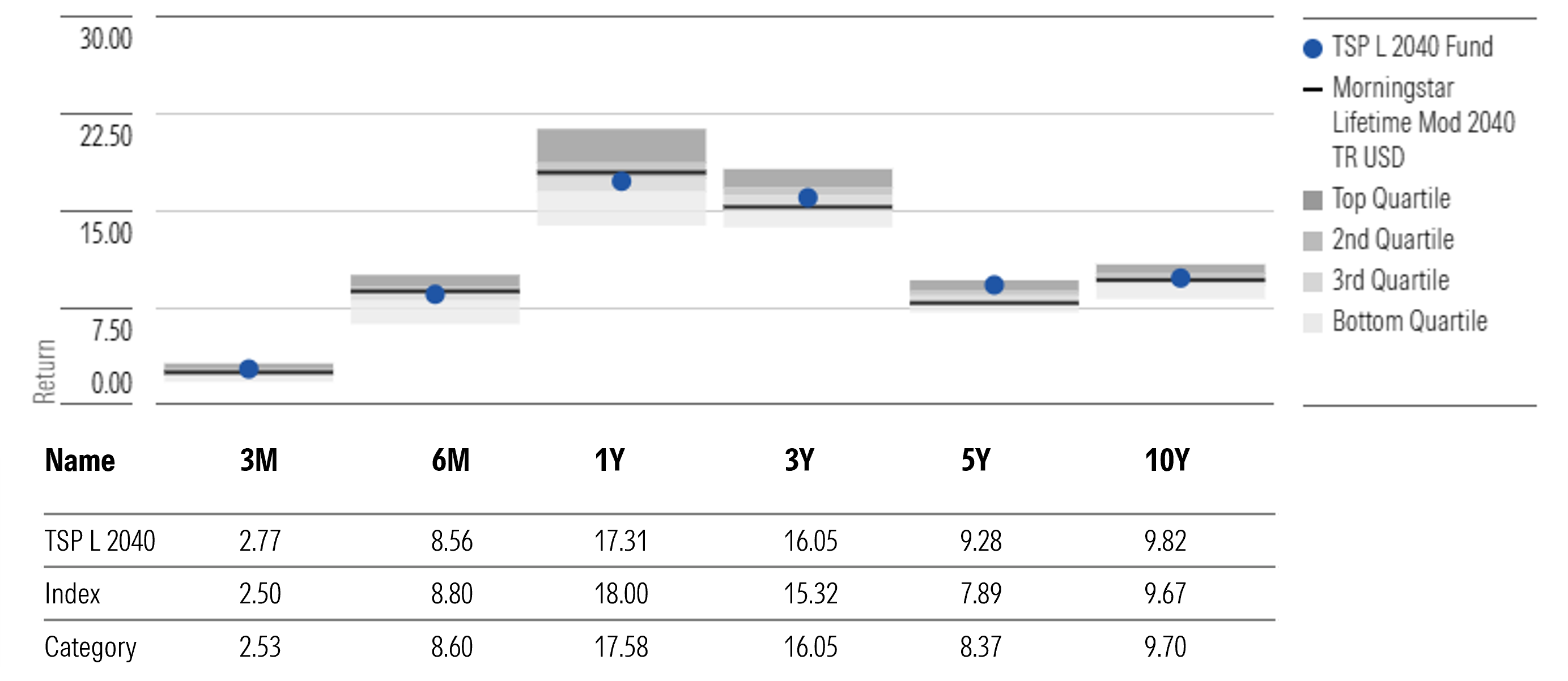
TSP L 2040’s 72% stock allocation as of December 2025 is about even with the target-date 2040 category average of 73%. Its distinctive 21% allocation to TSP G Fund has delivered reliable annual gains, including in 2022 and 2021, when TSP G posted modest gains while TSP F fell.
That’s helped TSP L 2040’s 9.8% annualized gain over the last decade stay 12 basis points ahead of its typical target-date 2040 peer. In 2025, however, the fund’s 17.3% gain somewhat lagged the category’s 17.6% average.
TSP L 2040 Fund Annualized Returns Through Dec. 31, 2025
TSP L 2045 Fund
- Intended Investor: About 41 to 45 years old
- Morningstar Index: Morningstar Lifetime Moderate 2045 Index
- Morningstar Category: US Fund Target-Date 2045
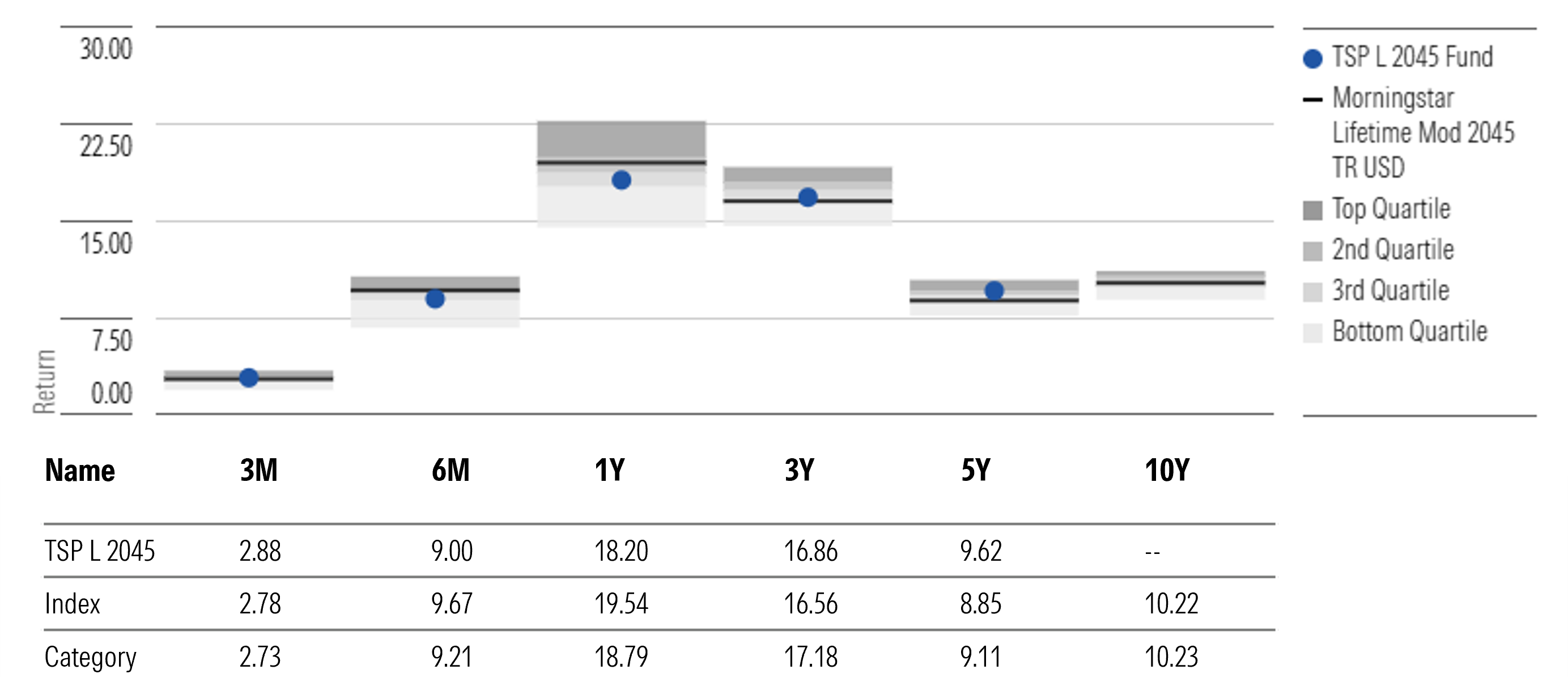
TSP L 2045’s 12.1% annualized gain from its July 2020 inception through December 2025 edged the target-date 2045 category’s 12.0% average. The fund’s 77% stock sleeve as of December 2025 is somewhat lower than the category average’s 81%. That was a headwind in 2025, when its 18.2% gain lagged the category’s 18.8% average. Over the fund’s lifetime, its lower non-US stock allocations and the fund’s 16% TSP G Fund allocation, as of December 2025, helped the fund keep up with the competition.
TSP L 2045 Fund Annualized Returns Through Dec. 31, 2025
TSP L 2050 Fund
- Intended Investor: About 36 to 40 years old
- Morningstar Index: Morningstar Lifetime Moderate 2050 Index
- Morningstar Category: US Fund Target-Date 2050
TSP L 2050’s December 2025 82% stock allocation fell below the target-date 2050 category’s 86% average. Its 11% allocation to the TSP G fund in its bond sleeve, however, has been reliable. In 2022 and 2021, for example, TSP G posted modest gains, while TSP F fell.
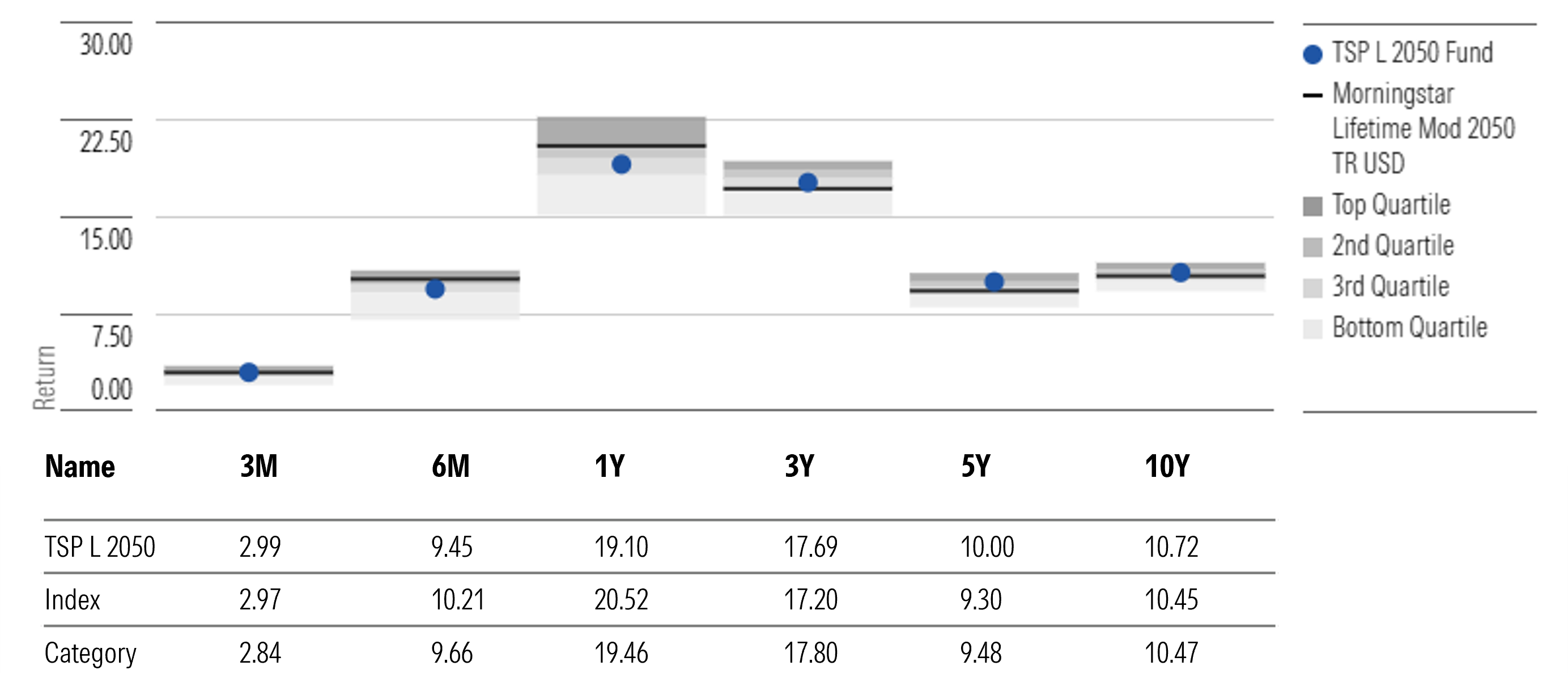
That’s helped TSP L 2050’s 10.7% annualized gain keep 25 basis points ahead of its typical target-date 2050 peer over the decade through December 2025. In 2025, the fund’s 19.1% gain lagged its average peer by 36 basis points due to its lower equity and more conservative fixed-income allocations.
TSP L 2050 Fund Annualized Returns Through Dec. 31, 2025
TSP L 2055 Fund
- Intended Investor: About 31 to 35 years old
- Morningstar Index: Morningstar Lifetime Moderate 2055 Index
- Morningstar Category: US Fund Target-Date 2055
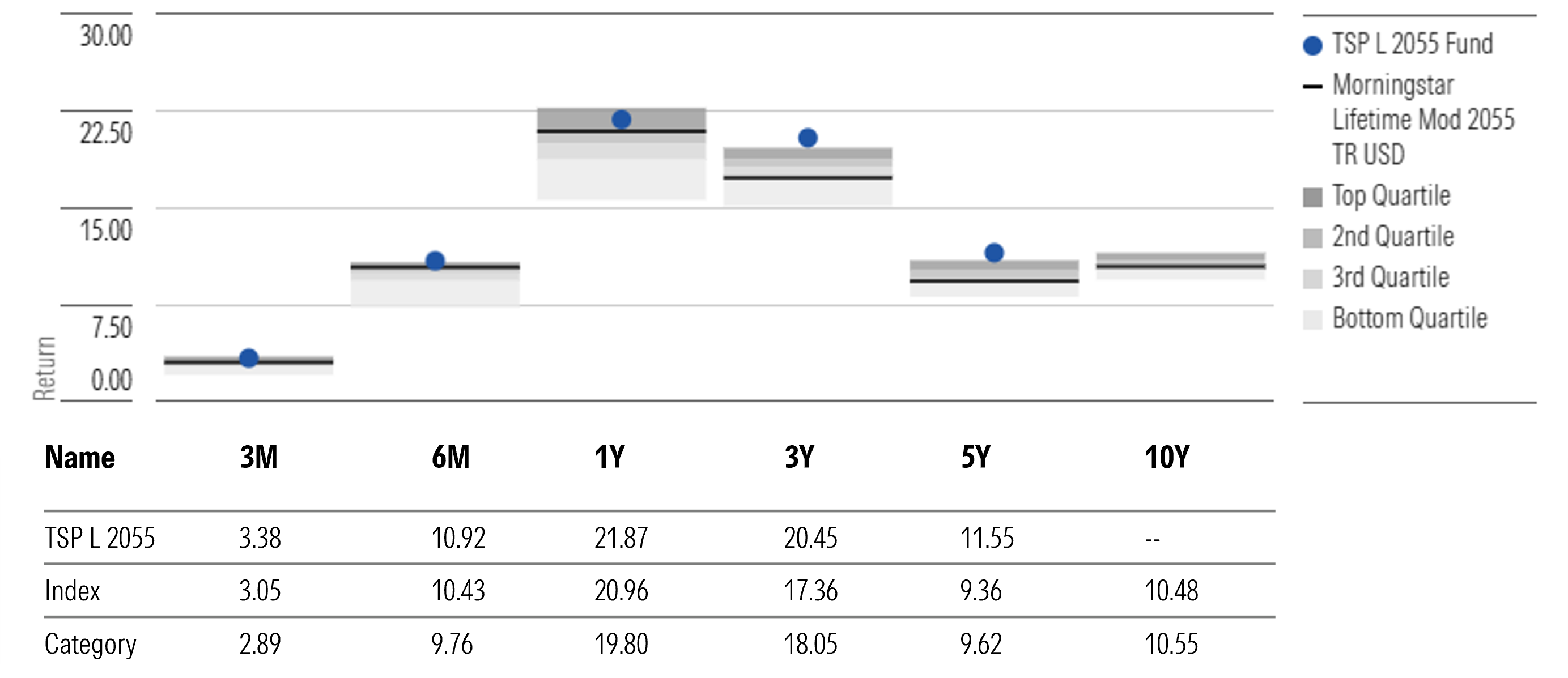
The TSP L 2055’s 14.9% annualized gain from its July 2020 inception through December 2025 beat the target-date 2055 category’s 12.7% average by 2.2 percentage points. The fund’s 99% stock sleeve, which as of December 2025 was 11 percentage points greater than the category average’s 88%, drove those returns. The fund’s big equity stake supercharged its 2025 results, too; its 21.9% gain beat the category average by more than 2 percentage points and ranked in the group’s top quartile.
TSP L 2055 Fund Annualized Returns Through Dec. 31, 2025
TSP L 2060 Fund
- Intended Investor: About 26 to 30 years old
- Morningstar Index: Morningstar Lifetime Moderate 2060 Index
- Morningstar Category: US Fund Target-Date 2060
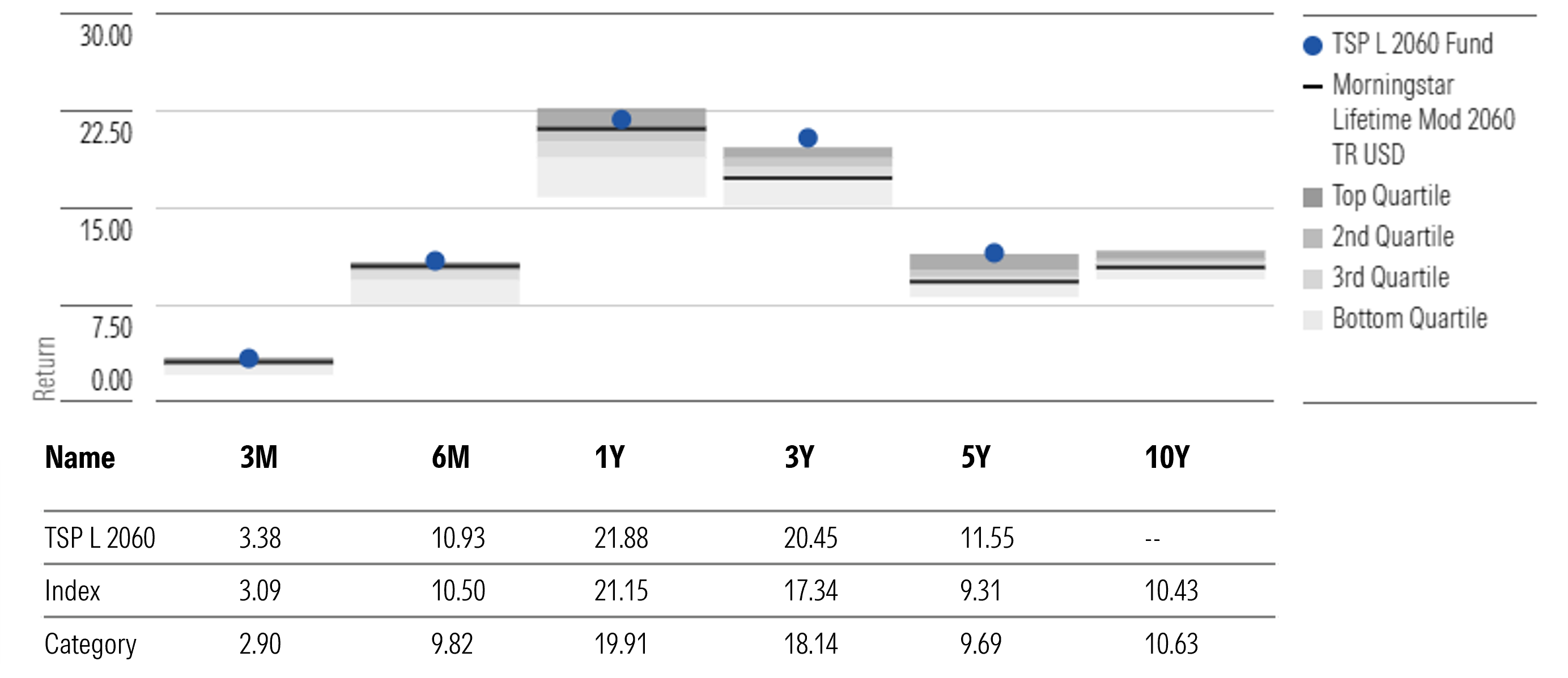
TSP L 2060 Fund launched in July 2020 for younger investors, so its track record is short. Its 14.9% annualized gain from its inception through the end of 2025 beat the target-date 2060 category average’s 12.8% return. The fund’s 99% stock allocation as of December 2025 is among the largest in the peer group, which averages 89% in stocks. The heavy stock allocation bolstered since inception and 2025 results, when the fund gained 21.9% while its typical peer rose 19.9%.
TSP L 2060 Fund Annualized Returns Through Dec. 31, 2025
TSP L 2065 Fund
- Intended Investor: About 21 to 25 years old
- Morningstar Index: Morningstar Lifetime Moderate 2065 Index
- Morningstar Category: US Fund Target-Date 2065+
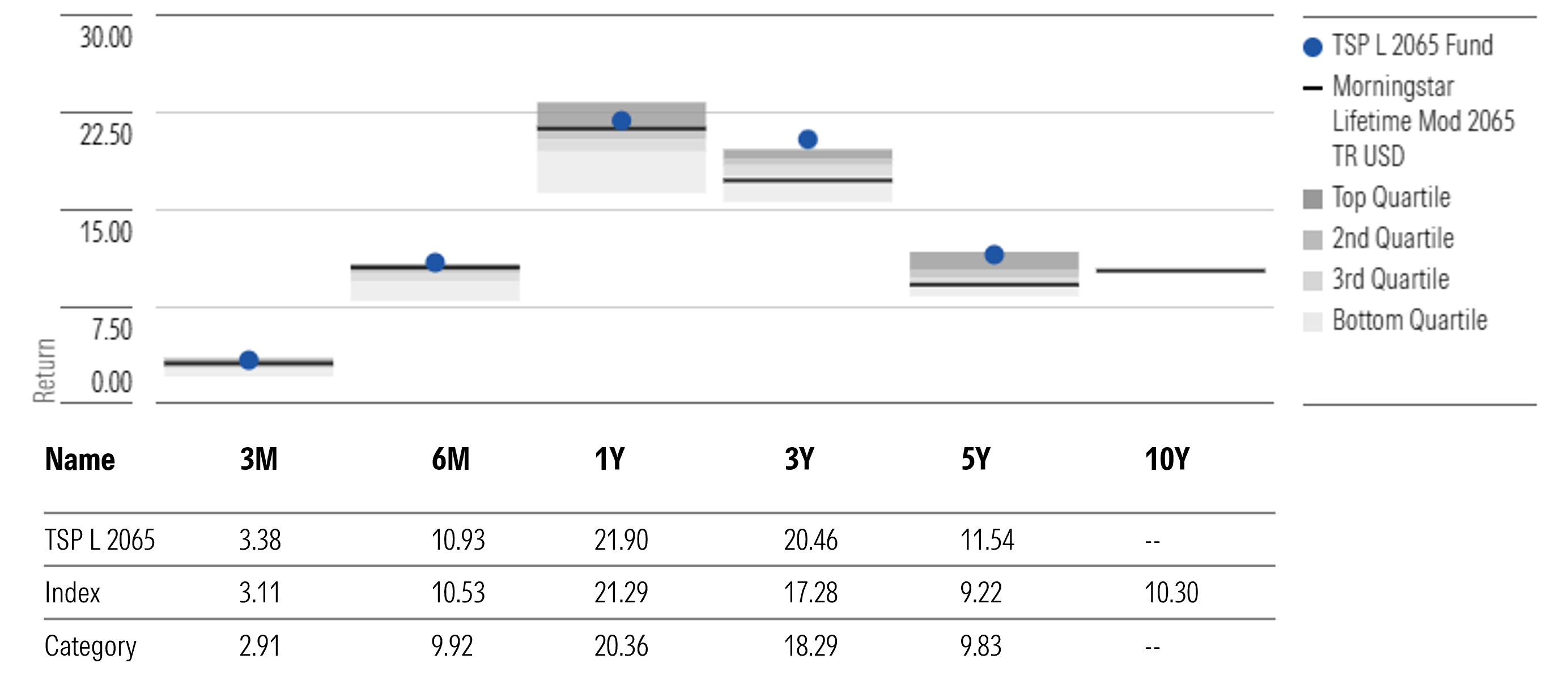
TSP L 2065 Fund launched in July 2020 for younger investors, so its track record is short. Its 14.9% annualized since inception gain through December 2025 beat the target-date 2065+ category average’s 13.0% by 1.9 percentage points. The fund’s heavy 99% stock sleeve, which is 9 percentage points greater than the category average’s 90%, drove performance. It also helped boost the fund’s 2025 showing; it gained 21.9%, while the category average rose 20.4%.
TSP L 2065 Fund Annualized Returns Through Dec. 31, 2025
TSP L 2070 Fund
- Intended Investor: About 16 to 20 years old
- Morningstar Index: Morningstar Lifetime Moderate 2065 Index
- Morningstar Category: US Fund Target-Date 2065+
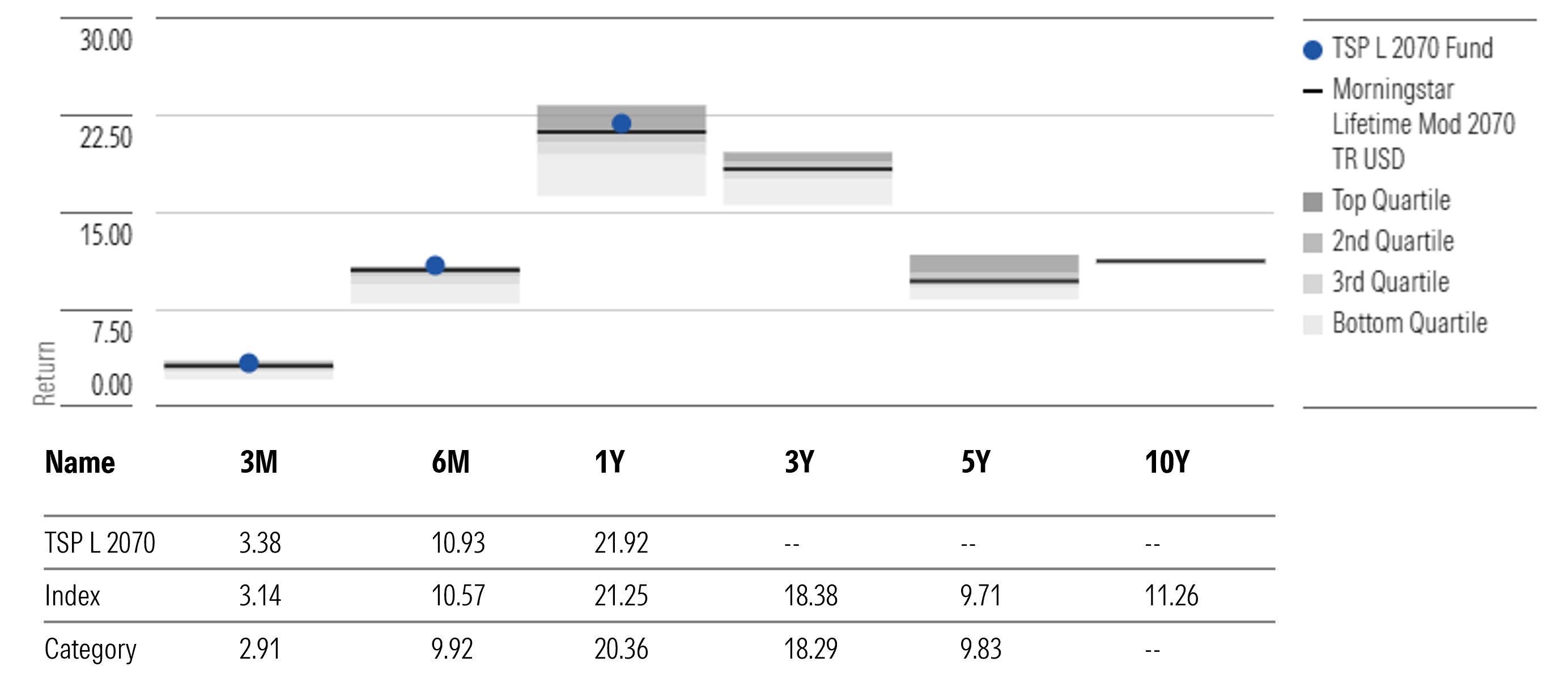
TSP L 2070 launched in late July 2024, so its performance history is limited. From August 2024 to December 2025, its 17.4% annualized gain beat the target-date 2065+ category average’s 15.6%. The fund’s 99% stock sleeve is 9 percentage points greater than the category average’s 90% and boosted the fund’s strong 2025 showing. It gained 21.9%, while the category average rose 20.4%.
As TSP increases the L Funds’ equity allocation across their glide path, their stock helpings will likely be greater than the target-date industry glide path average, increasing potential long-term returns, but also volatility.
TSP L 2070 Fund Annualized Returns Through Dec. 31, 2025
TSP L 2075 Fund
- Intended Investor: About 15 years old or younger
- Morningstar Index: Morningstar Lifetime Moderate 2065 Index
- Morningstar Category: US Fund Target-Date 2065+
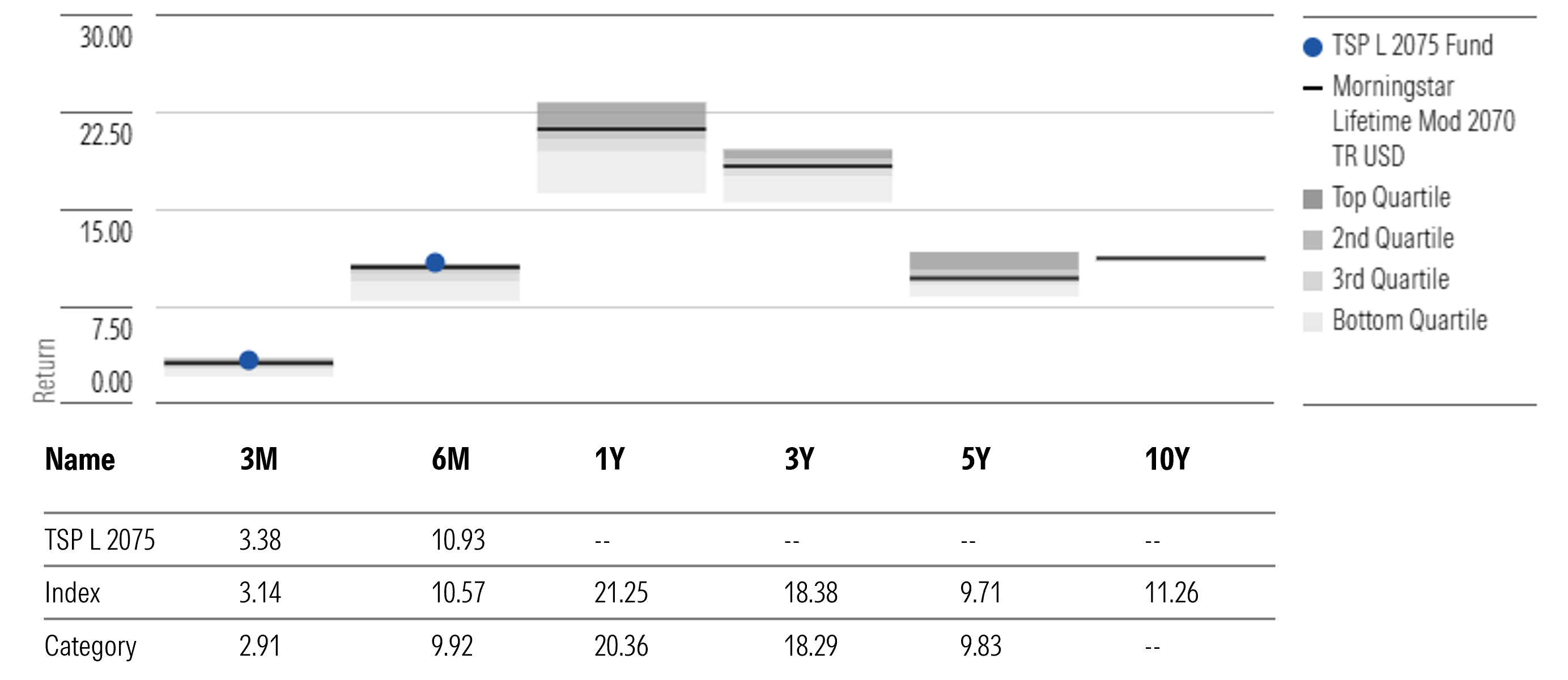
TSP L 2075 launched in mid-2025, so its performance history is limited. From July to December 2025, its 10.9% gain beat the target-date 2065+ category average’s 9.9%. Its high equity allocation drove relative results: At the end of 2025, its 99% equity weight was 9 percentage points higher than the category average of 90%.
As TSP increases the L Funds’ equity allocation across their glide path, their stock helpings will likely be greater than the target-date industry glide path average, increasing potential long-term returns, but also volatility.
TSP L 2075 Fund Annualized Returns Through Dec. 31, 2025
The author or authors do not own shares in any securities mentioned in this article. Find out about Morningstar’s editorial policies.

 United States