
5 High-Yielding Stocks Addressing the U.N. Sustainable Development Goals
Drug, biotech companies dominate high-yielders owned by SDG funds.


If you want some signals of where the world is moving, check out the United Nation’s Sustainable Development Goals. In 2015, the U.N. adopted these global goals, which are designed to achieve a sustainable future and aim to address social, economic, and environmental challenges by 2030. For example, specific goals include ending hunger, ensuring good health, achieving gender equality, taking climate action, and ensuring affordable and clean energy. You can read all 17 SDGs here. The SDGs, according to the U.N., address the “indispensable transitions needed for sustainability, peace, and prosperity.”
For the world to achieve these goals, investors must back climate change solutions such as renewable energy and solutions to hunger and other problems, the U.N. says.
So far, the goal of achieving the SDGs by 2030 has fallen short. Only 17% of SDG targets are on track, and the Human Development Index has fallen globally for two years in a row, for the first time in over three decades, according to the UN. That’s because the covid-19 pandemic, escalating conflicts, geopolitical tensions, and growing climate effects have placed SDGs out of reach. “With more than six years left, we must not let up on our 2030 promise to end poverty, protect the planet, and leave no one behind,” António Guterres, U.N. secretary-general, said recently.
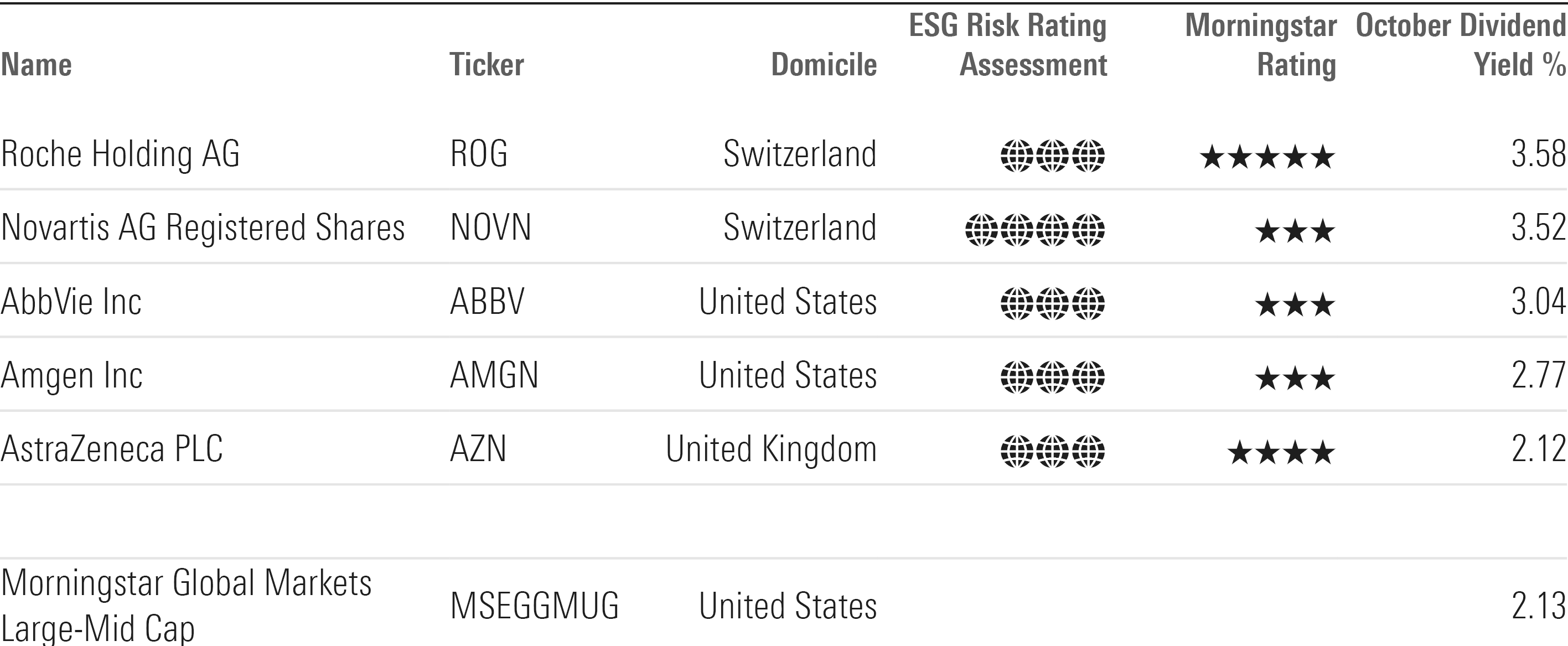
Much depends on the financial markets, which, in theory, can deliver investments that can support these goals. A few dozen funds invest according to the SDGs. We found five high-yielding stocks that are widely owned by the largest SDG funds. All are drug and biotech names.
Methodology
To compile a list of SDG funds for this article, we ran a screen on open-end and exchange-traded equity funds in the Morningstar universe that mentioned “Sustainable Development,” “SDG,” or a related term in their name. We included funds from all domiciles but only used the oldest share class, and we removed funds of funds, as well as funds whose holdings weren’t available. That left us with a list of 44 funds. From this list, we analyzed the top 25 holdings of the aggregated group. Next, we ranked them by their dividend yield, a popular measure with investors. We show the highest-yielding stocks in the following table, as well as the current yield for the Morningstar Global Markets Large-Mid Cap Index for comparison purposes.
Top 5 Stocks
5 Sustainable Development Goal Stocks with a High Yield
- Roche Holding AG
Roche is a Swiss biopharmaceutical and diagnostic company. The firm’s bestselling pharmaceutical products include a variety of oncology therapies from acquired partner Genentech, and its diagnostics group was bolstered by the acquisition of Ventana in 2008. Oncology products account for 50% of pharmaceutical sales, and centralized and point-of-care diagnostics account for more than half of diagnostic-related sales.
Roche addresses SDG 3: Ensure healthy lives and promote well-being for all at all ages. This is seen in its contribution to a better society by enabling the right treatment for the right patient at the right time for the right value. Additionally, it incorporates SDG 12, responsible consumption and production, with a focus commitment to halving the environmental impact of its operations and products from 2019 to 2029. More information can be seen in its company’s sustainability report.
2. Novartis AG Registered Shares
Novartis develops and manufactures innovative drugs. The firm’s key areas of drug development include oncology, rare diseases, neuroscience, immunology, respiratory, cardio-metabolic, and established medicines. The company sells its products globally, with the United States comprising close to one third of total revenue.
Novartis addresses SDG 3: ensure healthy lives and promote well-being with its goal to implement a global access strategy for all new medicines launched. SDG 5, gender equality, is addressed with Novartis’ goals of achieving gender balance in management and closing the gender pay gap by 2023. SDG 6, clean water and sanitation, is incorporated in its goal to reduce water consumption in its operations by half by 2025. The company’s incorporation of SDGs 1, 4, and 8-15 can be seen in the sustainability report.
3. AbbVie
AbbVie is a pharmaceutical firm with a strong exposure to immunology (with Humira, Skyrizi, and Rinvoq) and oncology (with Imbruvica and Venclexta). The company was spun off from Abbott in early 2013. The 2020 acquisition of Allergan added several new products and drugs in aesthetics (including Botox).
Abbvie addresses SDG 3, good health and well-being, as it provided comprehensive HIV care, treatment, prevention, testing, and psychosocial support for more than 25,000 children and adults in Romania and Malawi, as well as supporting its network in Botswana, Lesotho, Eswatini, Tanzania, and Uganda. It also addresses SDG 5, gender equality, as it focuses on the proportion of women in managerial positions. AbbVie also addresses SDG’s 6, 9, 11, 12, and 13 in an ESG Action Report.
4. Amgen
Amgen is a leader in biotechnology-based human therapeutics. Flagship drugs include red blood cell boosters Epogen and Aranesp, immune system boosters Neupogen and Neulasta, and Enbrel and Otezla for inflammatory diseases. Amgen introduced its first cancer therapeutic, Vectibix, in 2006 and markets bone-strengthening drug Prolia/Xgeva (approved 2010) and Evenity (2019). The acquisition of Onyx bolstered the firm’s therapeutic oncology portfolio with Kyprolis. Recent launches include Repatha (cholesterol-lowering), Aimovig (migraine), Lumakras (lung cancer), and Tezspire (asthma). The 2023 Horizon acquisition brings several rare-disease drugs, including thyroid eye disease drug Tepezza. Amgen also has a growing biosimilar portfolio.
Amgen addressed the UN’s SDG 17, partnerships, by developing a free online education platform at Harvard University that reached over 14 million new users in 2023, of which more than 86% were in low- and lower-middle-income countries. SDG 6, clean water and sanitation, is seen in its efforts to decrease water usage to achieve 34% of its 2027 targeted reduction from a 2019 baseline. The company’s efforts toward SDG’s 3, 4, 5, 7, 8, 9, and 12 can be seen in its ESG Report.
5. AstraZeneca PLC
A merger between Astra of Sweden and Zeneca Group of the United Kingdom formed AstraZeneca in 1999. The firm sells branded drugs across a number of major therapeutic areas, including gastrointestinal, diabetes, cardiovascular, respiratory, cancer, immunology and rare diseases. The majority of sales come from international markets, with the United States representing close to one third of its sales.
AstraZeneca addresses SDG 3: ensure healthy lives and promote well-being, with its ambition of promoting prevention, increasing access to lifesaving treatments, and strengthening health system resilience. It also incorporates SDG 13, climate action, with its investment of $33.7 million in energy efficiency and on-site renewable energy. The company also addresses SDGs 6, 7, 12, 15, and 17, which recognize clean water and sanitation, affordable and clean energy, responsible consumption and production, life on land, and partnerships, respectively.
The author or authors do not own shares in any securities mentioned in this article. Find out about Morningstar’s editorial policies.

 United States