
6 Questions for Financial Planner Victor Orozco
For Hispanic Heritage Month, a look at the financial challenges facing America’s largest minority group.

Hispanic Heritage Month is observed each year from Sept. 15 to Oct. 15. During this time, contributions made in the United States by Hispanics are celebrated. A spotlight is placed on history and cultural influences.
Wealth varies widely among Hispanic groups, as does each group’s ability to accumulate wealth. Poverty is high, which was exacerbated by the pandemic. But while the wealth gap for Hispanics is large, it’s narrowing. And business ownership is growing.
Here’s a look at some key statistics about income and wealth for the US Hispanic population.
We checked in with Victor Orozco to learn about the financial challenges this group faces in the US, and how advisors can help.
Victor is a managing partner at Bair Financial Planning, an independent financial planning firm that manages high-impact portfolios. Orozco, who is Mexican American, specializes in managing Bair’s clients through the financial planning process and conducts analysis of investment portfolios. He graduated from San Diego University with a Bachelor of Science in Finance.
Liz Angeles: How did you get started?
Victor Orozco: I met my partner, Marci Bair, as a sophomore in my undergrad year at San Diego State. I became an intern and started filing statements and investment trade tickets. I developed a really good bond with Marci and other advisors. I grew in a financial planning firm, within MetLife, so an insurance-based firm. My being surrounded by Certified Financial Professionals working on comprehensive financial plans definitely grew my understanding of the profession and how it can help families. Fortunate to grow up professionally around CFPs.
Among other things, Marci works with an LGBTQI-A+ community, and it has been beneficial for this community for an advisor to understand their background. Fast-forward, we’ve been together for 20 years and 50/50 partners in our Bair Financial Planning firm. There’s no one-size-fits-all for this path. Hopefully we can tip the scales more in other diverse communities to expand our advisory business.
Financial Challenges Faced by Hispanics
Angeles: It’s Hispanic Heritage Month. What are the particular challenges faced by Hispanics?
Orozco: This may not be unique to Hispanics, but I’d say one of the issues we see the most is the choice of the investments to own. I think one thing that really sticks out with our community is how much of the percentage of net worth is tied into homes, apartment complexes, multifamily housing. Also, depending on previous experiences with government, or the presence of corruption, there’s concern about trusting the system. I think that also amplifies the desire to seek out tangible investments.
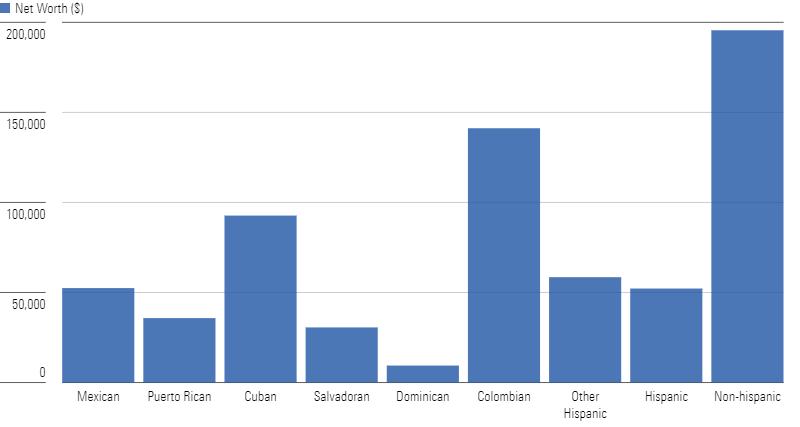
Some of our larger network clients who are of Hispanic backgrounds are not necessarily up there because of liquid net worth, but because of real estate. In the demographic of higher liquid-net-worth clients, there’s not a big presence of Hispanics. But they are there in terms of overall net worth, it’s just a different composition.
Median Household Net Worth by Origin: 2020
What also dovetails with that concern about trusting the system is that the stock market isn’t something you can touch and feel like you can with physical assets or tangible assets. That also amplifies the desire to seek out tangible investments. So business owners may not necessarily be looking to create a qualified retirement plan to save up liquid net worth, because the asset is the business, and everything goes into it to feed the family, feed the community, and so on. Instead of opening a retirement plan, it’s “Oh, let’s create a new store, or open another location” for whatever business that family may be developing.
There’s also the notion of community sharing. In some Hispanic cultures, there’s a community fund to which everyone’s chipping in when families need something. [In some Mexican communities, confianza, meaning “bond of mutual trust,” underlies informal loans and informal savings and credit associations.]
There’s a responsibility tax to people who are doing well financially, but also have part of their family that they need to look after and support. The responsibility tax falls on the family member who is the first in their family—the First Gen—who has the professional job and success but also the obligation to financially assist the family.
Money being taboo is a cultural norm. There is a machismo tilt to our culture, but that is fading. Gender roles are changing, and career and professional paths. So if you talk to a next gen and you talk to a boomer couple, you’re going to find stark differences about who controls the money.
Finally, a recent challenge is the whole issue of ICE deportations. I was at a conference recently where they showed a slide of native and nonnative employees in the workforce. There was this drop in nonnative statistics. That’s posing a strong headwind this year. For families that had a member come to the US to help provide financial support, that lifeline has been closed off. So for families that had a better life because a family member came to Central California to pick cantaloupe, like my grandfather did, that money isn’t getting sent back home. It’s probably financially choking quite a bit. For business owners that probably voted against immigration, but yet staff immigrant workers, you’re going into survival mode for the family that’s here.
Financial Misconceptions in the Hispanic Community
Angeles: Are there any financial misconceptions or myths within the Hispanic community?
Orozco: There are false and limiting beliefs including the ideas around cash, and saving, and having cash on hand versus investing. The security and the comfort of having the money in jars at home, or hidden in the house, or in pages in books, impact and impairs the community by having the security and safety of that cash be available and in their possession versus the institution’s possession.
As well, there’s the issue of taking advice from nonfinancial experts in the family. Everyone has a successful person in their life. They could be successful for a various view of reasons, perhaps they were the only one that went to college. That person is the beacon, and although it could be very well intended, they’re not necessarily professional financial advisors. This could impact the community negatively as well.
There’s only so much you can educate. My legacy is to bring more [Hispanic] people in the space, so that it becomes less of a learning curve, and there’s more access to education from advisors that clients can trust.
Challenges for Financial Advisors in the Hispanic Community
Angeles: What are challenges and opportunities for advisors?
Orozco: CFP is not the only classification for a financial professional, but based on the last September numbers of this year from the CFP board website, 2,900 of the 106,000 CFP professionals identify as Hispanic or Latino, so about 2.7%. There are many not identified. And it doesn’t necessarily designate who speaks Spanish and who does not. But all that to say is there’s a lot more room to go, and usually we’re the few in the room. What hurts our community is that not a lot of financial advisors speak Spanish and are Hispanic. It’s hard to build trust in a system that people aren’t used to, that they don’t feel confident understands them and their story. I can’t personally help with that, given my lack of Spanish, and my hope is to bring other people into [the] space. I can help with the second generation. A lot of it is just being patient, educating.
I want to commend Vanessa Martinez and Ana Trujillo-Limon for being the founders of SER, for Hispanics in financial services. Instead of being the few in the room, we are the room, and it’s a powerful place to be when you see the flags of all the different Latin American countries on the wall. A lot of experienced advisors are helping the next generation come on board. That is powerful and nourishing.
Angeles: What’s the one piece of advice you’d give this community?
Orozco: There is so much power in language. Our community has learned how to navigate multiple languages. The language of money is no different. Understanding the language of money no matter where you call home is a power that rewards you is so many ways.
Angeles: What are some financial tools you’d recommend?
Orozco: I talk about really understanding your income, your taxes, your expenses. Looking at the documents you get regularly could help educate and enlighten you. I use tools like eMoney and Holistiplan. Investopedia is an amazing website. The vast amount of education around investing and personal finance is a must tool. Also, know your credit score and how it works. Platforms like Credit Karma, which is free, or Experian, which costs money, are an insightful way to make sure you are fully aware of your credit report and what lenders will look at when it comes time to get financing. I also recommend reading The Latino Journey to Financial Greatness by Louis Barajas, and Cultura & Cash by Giovanna González.
The author or authors do not own shares in any securities mentioned in this article. Find out about Morningstar’s editorial policies.

 United States