
5 Undervalued Food-Related Stocks With Low ESG Risk
These stocks have low Sustainalytics ESG Risk Rating scores and are trading below their fair value.


As consumers, we carefully consider the food we eat, but as investors, how thoroughly do we think about the companies that produce it?
One way to do a deeper dive is to consider the Morningstar Global Food Innovation Index. This index targets the stocks of companies that are well positioned to benefit from innovations aimed at enhancing nutrition, improving food production practices, ensuring food safety, and promoting the sustainability of packaging. Comprising just 33 stocks, with no single stock weighted over 5%, the index is selective.
We looked for stocks from this index that are both undervalued and exhibit low environmental, social, and governance risk. Specifically, we chose stocks with a current price/fair value estimate below 0.80 and a Sustainalytics ESG Risk Rating score below 20.00. A low price/fair value indicates that these stocks are trading below their estimated fair value, according to Morningstar. Meanwhile, a low ESG Risk Rating score suggests that a company’s economic value is well protected from relevant ESG factors, reflecting its subindustry and risk-management approach.
Food and agriculture stocks have suffered amid rising ingredient and labor costs along with shifting consumer eating habits. In recent years, shoppers have seen the price of food skyrocket, but Morningstar equity strategist Kristoffer Inton says that “as the rapid price increases of the recent past slow, we think consumers will return to more normalized buying patterns.” That, in turn, will balance the demand and volume for food companies, lifting earnings. Food companies are also hurt by a decline in biodiversity, as agriculture depends on healthy crop genetic diversity, pest control, and pollination.
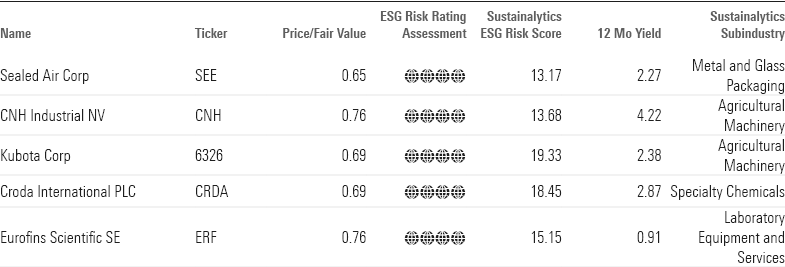
We’ve identified five undervalued, low-ESG-risk stocks from the Morningstar Global Food Innovation Index: Sealed Air SEE, CNH Industrial CNH, Kubota 6326, Croda International CRDA, and Eurofins Scientific ERF.
5 Undervalued Food-Related Stocks with Low ESG Risk
Sealed Air
- Price/Fair Value: 0.65
- ESG Risk Rating Assessment: Low
- Morningstar Rating: 4 stars
The packaging and containers industry constitutes 18.72% of the index, making it the largest equity industry within the index. Sealed Air primarily produces flexible resin packaging and protective shipping materials for food packaging and processing companies. In addition to packaging, Sealed Air supplies the equipment needed for its application, fostering brand loyalty and ensuring proper usage.
Food safety is a top priority in this industry, making Sealed Air’s specialized equipment invaluable. Currently, the stock is trading at a 35% discount to its fair value. Following a price surge between 2021 and 2022, the fair value increased, but recent price declines have left the stock undervalued.
With a score of 13.17, Sealed Air’s ESG Risk Rating is Low. While the company is exposed to inevitable risks, such as carbon emissions from its manufacturing facilities, Sealed Air does not face any ESG risks threatening its economic value. However, Morningstar assigned a High Uncertainty Rating to Sealed Air owing to potential reputational risks. Analyst Spencer Liberman noted, “If a consumer were to get sick due to faulty packaging from Sealed Air, customers could become concerned with Sealed Air’s quality and ultimately switch packaging providers.”
CNH Industrial
- Price/Fair Value: 0.76
- Sustainalytics ESG Risk Rating: Low
- Morningstar Rating: 4 stars
CNH Industrial is a leader in the agricultural sector, known for its reliable products and strong relationships with farmers. The company manufactures agriculture and construction equipment, and director of industrials equity research Brian Bernard says it is “well positioned to compete with peers.”
Currently, CNH is at a 24% discount to its fair value estimate of $14.70 per share, making it an attractive option with a high trailing yield. With a suite of brands that serve both large and small farmers, analysts don’t see this company going anywhere anytime soon. In his analysis, Bernard points out that rising crop prices increase farmers’ profitability, allowing them to purchase new agricultural equipment to boost production. Customers are brand-loyal, often purchasing repeat equipment, which is reliable and predictable. Despite the market being led by Deere DE, our analysts determine that farmers who are loyal to CNH are unlikely to “switch to a competitor based on individual product performance and features.”
CNH’s ESG Risk Rating score of 13.68 places it just behind Sealed Air in terms of risk. While the company is exposed to safety risks, carbon emissions, and environmental regulations, these are manageable. On carbon emissions, Bernard says, “We think CNH is already hedging against this risk through the development of next-generation products that reduce carbon emissions of its products, namely its electric drivetrains. These efforts range from commercializing biofuel-powered tractors to hybrid and full-electric tractors.” It will be interesting to see what space electric vehicles have within agriculture as technology advances and how companies use them to mitigate environmental risk and increase value.
Kubota
- Price/Fair Value: 0.69
- ESG Risk Rating Assessment: Low
- Morningstar Rating: 4 stars
Kubota, based in Japan, excels in high-end compact farm and construction equipment catering to the North American and Asian markets. Morningstar analyst Jason Kondo reports that the company plans to increase its overseas production to 50% from 35%, with acquisitions of agricultural equipment companies in Europe and India already underway. Kubota’s reputation for high-quality compact farming equipment positions it for long-term growth.
Currently, Kubota’s stock is selling at a 31% discount to its fair value estimate. Kubota has found a niche market of smaller farms with a need for compact machinery for tight spaces. Brand and reputation in this space contribute to a wide moat. Frequent maintenance and part repairs help the company create loyal relationships with its customers.
Like its competitors, Kubota faces challenges such as carbon emissions and regulatory pressures, but analysts consider these manageable. Kondo notes, “We expect Kubota to continue refining its battery/fuel-cell technologies and work on its target to reduce carbon emissions from its machinery by 30% between 2020 and 2030.”
While our analysts think this transition will be slower, Kondo adds that “Kubota has been investing in both battery- and fuel-cell agriculture technologies and also unveiled prototypes of its electric autonomous tractors and electric mini excavators, similar to other incumbent players, suggesting they will not fall behind competitors on the development.”
Croda International
- Price/Fair Value: 0.69
- ESG Risk Rating Assessment: Low
- Morningstar Rating: 4 stars
Croda, a UK-based chemical company, specializes in crop production and healthcare, with agriculture accounting for 40% of its revenue. The company focuses on developing pesticides, herbicides, and fungicides, formulating adjuvants and additives that improve coverage and efficacy.
Currently, Croda is undervalued, trading at a discount of 31%. Over the past two years, Morningstar analyst Diana Radu says that the company has faced challenges.
While its crop protection volume has yet to recover, “We expect a normalization going into 2025,” she says. “From then on, we project Croda to achieve a CAGR of 7% between 2025 and 2033, driven by secular growth trends in its high-potential market niches.”
Croda’s ESG Risk Rating score stands at 18.45, primarily owing to the risks associated with the production and transportation of hazardous chemicals.
“Regulatory changes could increase operating costs, require capital investments to meet new standards, increase liability risks, or outright ban certain process chemicals previously deemed acceptable that may not have an economical substitute,” Radu cautions.
Croda may struggle to adapt their business to new regulations, which limit the use of chemicals in food growth.
Eurofins Scientific
- Price/Fair Value: 0.76
- ESG Risk Rating Assessment: Low
- Morningstar Rating: 4 stars
Based in Luxembourg, Eurofins has a global presence in testing, inspection, and certification, particularly in the food, environmental, and pharmaceutical sectors. “We think Eurofins benefits from secular trends, such as the robust pace of biologics research, increasing recognition of the risks of microplastics, and new regulations like the Food Safety Modernization Act in the United States and the European Union’s Registration, Evaluation, Authorization, and Restriction of Chemicals regulation,” says Morningstar senior analyst Jay Lee.
The stock is currently undervalued by 24%, yet the company continues to grow, with recent expansions in Asia and Latin America. Eurofins is the largest food and environmental testing company, holding approximately 20% of the total market share. The “Life” segment, which includes food and environmental testing, constitutes 40% of the revenue.
With a low ESG Risk Rating score of 15.15, analysts do not identify material risks that threaten Eurofins’ value. However, Lee highlights that the Martin family controls 60% of voting shares, which could lead to conflicts of interest, though this concern is mitigated by the firm’s majority-independent board and history of solid shareholder returns.
The author or authors do not own shares in any securities mentioned in this article. Find out about Morningstar’s editorial policies.

 United States