
How ETF Diversifiers Performed During Market Turmoil
Diversifying stock portfolios can smooth out performance without giving up much in return.


This article mentions funds that have an issuer-initiated rating and/or track a Morningstar Index. For full disclosure information, please refer to the specific funds, which are demarcated with a * symbol, listed below.
Investors may have been caught off guard when global stocks took a nosedive earlier this month. Outside of a quick decline due to covid and an inflation-induced selloff in 2022, the stock market has chugged along since the global financial crisis. Risk can give way to comfort after 15 years of strong stock performance.
The growing popularity of speculative assets means some investors have lost respect for risk. At the extremes, investors seemingly taunt the market with their brazen speculation. More typically, investors have slowly added increments of risk to their portfolio over the past decade-plus, resulting in a riskier portfolio than they would choose if a major selloff was featured more prominently in their memory.
There’s no time like the present to pay risk its due respect by diversifying portfolios to handle whatever may come next, good or bad.
Why We Diversify
Diversification can enhance long-term returns by reducing exposure to any one risk, which smooths out returns and sidesteps the pitfalls of bad luck. Diversified portfolios may share similar expected returns to a riskier alternative but with less volatility, or risk, which is why diversification is coined as the only free lunch in investing.
Diversification starts at the fund level. Many of the equity strategies we rate highest, like Gold-rated Vanguard Total Stock Market ETF
VTI
Mixing asset classes also levels out performance when one goes out of favor. Combining stocks and bonds is a common example. Were stocks to tank during a recession, investors may benefit from owning safer US Treasuries, especially if the Federal Reserve ends up cutting interest rates to stimulate the economy. Gold has also proved to be a diversifier for stocks and bonds on occasion. The goal here is to mix asset classes that are exposed to different risks and, therefore, are unlikely to fall together.
More diversifiers are better than selecting just one. Each asset class has its own scenario where it drops alongside stocks. For example, stocks and bonds both dropped precipitously due to inflation in 2022.
Smoothing out performance is critical for investors who need to use the money they’re investing in the coming months or years. Pulling out money in a drawdown makes it much harder for investors to earn it back. On the flip side, markets could outperform long-term expectations in the short term, but investors in retirement, for example, shouldn’t rely on luck.
Most investors own stocks, and for good reason. Stocks have been reliable long-term performers. Conventional wisdom says investors with longer time horizons should hold a higher percentage of stocks to compound their money as much as possible before they need to use it.
Our goal is to keep that money compounding by diversifying risks inherent to stocks to reduce drawdowns and maximize long-term returns for a specific risk level. Investors of different ages and situations will need different allocations to achieve their goals. Since most people own stocks, this article addresses ways to optimize the long-term performance of stocks while cutting portfolio risk.
ETFs That Can Diversify Stock Portfolios
Traditional stock diversifiers fall into a few categories:
- Bonds
- Stores of value
- Liquid alternatives
Investors can also access low-volatility strategies and limit risk using derivatives, like by owning low-volatility stock exchange-traded funds and buffer ETFs.
Several iterations of each of these strategies exist.
Bonds
For bonds, US Treasuries and high-quality bonds best diversify stock exposures. From a risk perspective, bond investors carry credit risk and interest-rate risk. Credit risk describes the risk of default, while interest-rate risk quantifies how bond prices move in reaction to changing interest rates. Credit risk shares similar risk factors to stocks. During the global financial crisis in 2008, the economy faltered, stocks fell, and credit spreads widened out. High-yield bonds, some of the highest credit-risk bonds available in ETFs, lost value because investors required a greater premium in return for the heightened risk of default. For that reason, credit risk doesn’t diversify stock as well as low credit-risk options like Treasuries.
Interest-rate risk is relatively uncorrelated to stock returns, but it can come in handy when stocks are suffering their worst declines. During economic crises, the government typically cuts interest rates to stimulate the economy, which increases the value of fixed-rate bonds.
High-quality bond ETFs that hold a wide range of maturities are a great starting point for investors looking to diversify their portfolios using bonds. Two top options are Gold-rated iShares Core US Aggregate Bond ETF AGG and iShares US Treasury Bond ETF GOVT. The former takes a small increment of credit risk, which means it should outperform the latter when markets are strong, while iShares US Treasury Bond ETF should offer slightly better performance during market stress.
Stores of Value
Gold can shine during market stress when investors search for safe assets. Gold can often escape country-specific risks, and it doesn’t rely on generating profits. It’s a speculative asset class, although one with a history that extends thousands of years. Gold’s ability to hedge stocks is inconsistent because its returns aren’t very predictable. Still, gold’s uncorrelated returns can diversify stock exposure—just don’t count on it to offset losses whenever stocks drop.
The best option here is SPDR Gold MiniShares GLDM.
Bitcoin supporters have claimed it belongs in this category as a store of value, so it will be put to the test in the next section on how these ETFs performed. IShares Bitcoin Trust ETF IBIT is the leading bitcoin ETF for investors.
Liquid Alternatives
My colleague, Jason Kephart, performed a deep dive on the diversification benefits of liquid alternatives. For this article, I chose to focus on managed futures strategies because of their ability to go long or short asset classes and hedge against down-trending markets.
Managed futures strategies can follow several different playbooks, many of which operate as hedge funds known as commodity trading advisors and aren’t available to retail investors. Several ETFs have come to market in recent years, but none has supplanted the nearly six-year-old iMGP DBi Managed Futures Strategy ETF DBMF.
iMGP DBi Managed Futures Strategy ETF holds a range of long and short positions on various asset classes depending on their recent performance. For example, at the end of February 2025, it was long gold, short the euro, short Treasuries, and long developed-markets stocks. It flips positions as trends change: By April 15, iMGP DBi Managed Futures Strategy ETF had sold most of its gold position, stayed short the euro, went long on Treasuries, and is long MSCI EAFE and MSCI Emerging Markets index futures but short S&P 500 futures.
Reduce Risk Stock Exposures
Low-volatility stock ETFs hold companies whose prices moved less than the market’s, with the hopes that the ETF would outperform peers during market stress. Stacking stocks with muted recent performance can lead to concentrated sector bets, which was a problem for low-volatility ETFs when defensive sectors underperformed in 2020.
The silver-rated iShares MSCI USA Minimum Volatility Factor ETF USMV takes a more holistic approach to low volatility by considering the correlation between stocks in its portfolio. The result is a portfolio without sector biases or concentrated risk characteristics, making it a more durable ETF than low-volatility peers.
Defined outcome ETFs also cut risk by adding a “buffer” to a percentage of losses on the underlying index, like the S&P 500. For example, Innovator Laddered Allocation Buffer ETF BUFB doesn’t participate in the first 9% of index losses. It pays for this protection by selling a call option, effectively capping index upside beyond a certain point. The result is a lower-risk version of its underlying index.
How Diversifying ETFs Performed During Market Turmoil
Tariffs tested markets in early April, offering a glimpse at how effectively these ETFs hedged US stocks.
ETF Performance From April 3 to April 11

The good news is that all diversifiers outperformed the Morningstar US Market during this period. The bad news is only high-quality bonds lived up to their uncorrelated billing, with Treasuries even flashing negative correlation during the downturn. Gold outperformed all other asset classes and experienced a shallow drawdown and muted volatility relative to stocks. Bitcoin had a higher correlation to stocks and the highest volatility of diversifiers, a common issue for the nascent asset class. Managed futures signaled some diversifying ability via its low drawdown and volatility, but trend following is late to capture changing trends, making it suboptimal for hedging short-term drawdowns. In this case, the iMGP DBi Managed Futures Strategy ETF was caught long stocks and joined in the US market’s decline as shown in its correlation to Morningstar US Market Index, though its other positions offset the magnitude of losses. Finally, iShares MSCI USA Minimum Volatility Factor ETF and Innovator Laddered Allocation Buffer ETF mitigated losses and drawdowns to some extent.
A week of performance is hard to draw inference from. I compared the diversifying ETFs over the past three years for added context below.
ETF Performance Over the Past Three Years
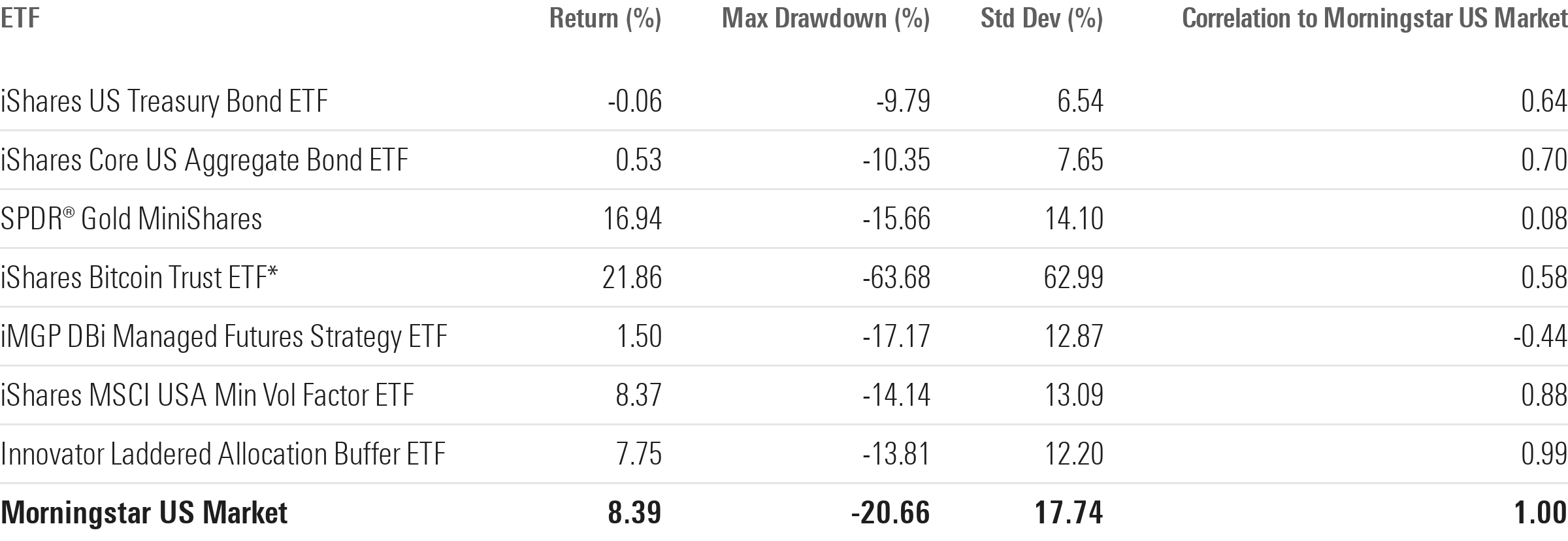
A couple of trends flipped when comparing diversifiers over the past three years. First, bonds appear to be less of a hedge than they demonstrated in early April 2025. This shines a spotlight on the hole in high-quality bonds’ ability to hedge stocks: Interest-rate risk can bite investors when inflation rears its ugly head. Investors learned this lesson all too well when stocks and bonds fell side by side in 2022. Traditional 60/40 portfolios should benefit from diversifying their diversifiers by combining different types of hedges on this list.
Gold shone again as a diversifier with its near-zero correlation. However, its speculative nature and moderate volatility seem best suited to a small slice of the portfolio.
Bitcoin isn’t much of a diversifier when added to stock portfolios. Volatile performance derails any benefit it may have as a hedge against stocks.
Managed futures earned their stripes as a diversifier during these past three years, thanks to its negative correlation to US stocks. Zigging when stocks zagged worked to its benefit in 2022 but also dragged on performance when stocks performed well in 2023 and 2024. Low expected returns in the long term make this a useful tool but one that should also represent a small portion of portfolios.
Minimum volatility and buffer strategies matched up well with one another. Both lowered volatility and drawdowns compared with US stocks without a major dip in performance. That won’t be true in every market, but iShares MSCI USA Minimum Volatility Factor ETF’s near-equal return and lower correlation to stocks seems best suited to fill out a portfolio’s stock sleeve alongside traditional broad market stock exposure.
Is It Too Late to Diversify?
John F. Kennedy once said, “The best time to repair the roof is when the sun is shining.” The sun is not currently shining on US stocks, but we’re not in a bad storm, either. Investors absolutely have an opportunity to set a strategic allocation that they can stick to for the long term, even if the timing isn’t perfect.
That said, it would have been better to own gold before now. Its 17% return over the past three years would have aided stock investors.
Managed futures may offer the best time to buy. Trends are changing, so it takes time for iMGP DBi Managed Futures Strategy ETF to reposition its portfolio. If stocks continue to fall, I expect iMGP DBi Managed Futures Strategy ETF’s correlation will drop, and it will outperform stocks.
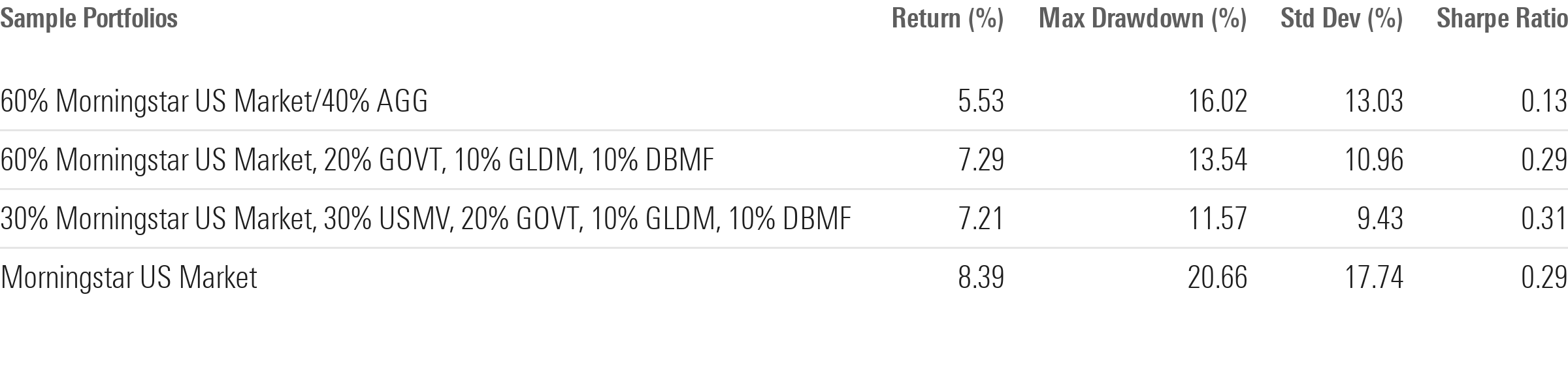
I leave you with one last illustration of alternatives to a traditional 60/40 portfolio. Each portfolio rebalances annually. The most diversified portfolio, which includes half of its stock portfolio in iShares MSCI USA Minimum Volatility Factor ETF, a slug of Treasuries, gold, and managed futures, seriously cuts down risk without a massive drop in return. Investors in this portfolio would have had the best risk-adjusted performance over the past three years, as measured by the Sharpe ratio.
Example ETF Portfolio Alternatives to 60/40
The author or authors own shares in one or more securities mentioned in this article. Find out about Morningstar’s editorial policies.

 United States