
These ‘Innovative’ ETFs Have Been Disastrous for Investors
The average leveraged and inverse single-stock ETF has proved costly, as regulators seek comment on new table games possibly coming to the ETF casino.


Single-stock exchange-traded funds are the hoverboards of finance. They provide no real utility and might catch fire and explode at any moment.
Leveraged and inverse single-stock ETFs were first approved for US trading in 2022, prompting a rare companion statement from former SEC Commissioner Caroline Crenshaw, saying, “… it would likely be challenging for an investment professional to recommend such a product to a retail investor while also honoring his or her fiduciary obligation or obligations under Regulation Best Interest.”
After four years on the ETF market, Crenshaw’s warning has proven prescient. Single-stock ETFs have mostly been as disastrous for investors as they have been lucrative for their asset managers: The median single-stock ETF has lost 38% while having paid over $500 million in management fees on them over the past four years ended July 2026.
One Stock, Fewer Use Cases
Leveraged single-stock ETFs theoretically replace a do-it-yourself leveraged stock position built with margin, as long as the ETF is held for a single day or less. The one-day limit applies because the DIY approach would buy twice as many stock shares, while a “2X” ETF resets its leverage each day to ensure it provides roughly 2 times the stock’s return the next day, adding convexity to long-term outcomes.
In practice, investors don’t limit themselves to single-day periods, which comes as no surprise. The median single-stock ETF traded 22% of its net assets on average over the 30 days through Aug. 17, making it impossible that investors adhered to the regulatory-advised limit of daily exposure. Likewise, net assets and flows tend to be stable day to day, suggesting investors don’t use single-stock ETFs for “daily” tactical use cases.
Regulators require disclosure language to include the “daily” intention of these ETFs because longer-term returns won’t reflect, for example, the 2-times exposure promised on the tin. Instead, high costs and volatility decay eat away at returns over time.
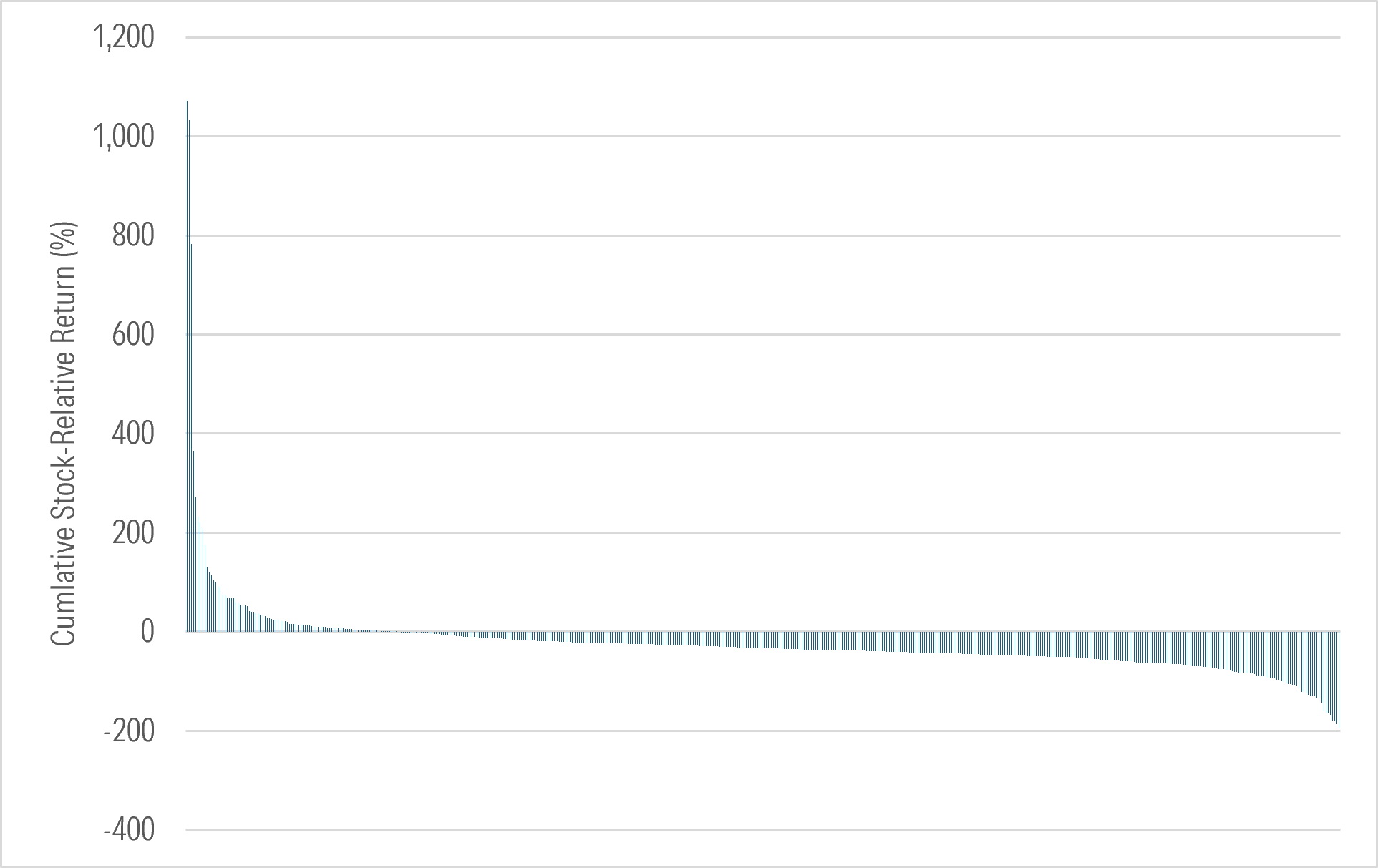
Indeed, single-stock investors have thus far been more likely to lose over 75% of their investment than outperform just buying the stock outright. Despite their short history, 19% of single-stock ETFs have lost over 75% since inception while just 18% have outperformed the stock they track. The chart below shows the distribution of cumulative returns by single-stock ETFs relative to buying and holding the underlying stock over the same period.
Distribution of Stock-Relative Cumulative Returns
The ETF Spaghetti Cannon
Single-stock ETF issuers are happy to launch dozens of ETFs tracking a variety of stocks because of the potentially huge asset growth an ETF can experience when a stock takes off—hence the proverbial spaghetti cannon, firing wildly at the wall to see what sticks.
The spaghetti cannon approach works much better for ETF issuers than investors. Issuers seek out the most volatile stocks—like red-hot companies tied to artificial intelligence—because of their lottery-ticket potential. Investor money chases top performers, incentivizing ETF issuers to launch ETFs tracking the riskiest stocks in case the risk pays off. If the gambit fails, they can close the ETF with little cost to them. The same can’t be said about the ETF investors, though.
Indeed, 13% of the 518 single-stock ETFs in my study have already closed. Of these 65 ETFs, the median lost 25% and lasted just 206 days on the market.
The greater the volatility of the underlying security, the faster the ETF performance decays. It’s partly why 24% of all leveraged ETFs—not just single-stock ETFs—that launched over three years ago have lost over 90% of their value.
Casino-like products don’t seek to outperform the market. They charge a toll for folks seeking to gamble for entertainment, rather than offer a positive expected return like investors should require. The following table compares the median cumulative return, the median cumulative return relative to buying and holding the underlying stock, and the management fees collected by each firm that issues single-stock ETFs.
Single-Stock ETF League Table
It’s worth noting that Corgi launched its first-ever ETF in December 2025, so its time in the market has been shorter than peers.
Buy the Stock, Skip the Wrapper
The top-performing single-stock ETFs since 2022 tracked stocks like Nvidia NVDA, Micron MU, and Advanced Micro Devices AMD. Had investors bought those stocks the day the ETFs launched, they would have returned at least 300% and up to 1,227% (had they bought Nvidia on Dec. 12, 2022). Picking the stock alone would’ve provided a haul. Yet the risk of picking a losing lottery ticket would result in a 38% loss.
There’s no reason to buy ETFs that the SEC themselves say are unsuitable for investors.
Correction: This article has been updated to fix a calculation error about management fees.
The author or authors do not own shares in any securities mentioned in this article. Find out about Morningstar’s editorial policies.

 United States