
Memecoin ETFs and Other Crypto News: What Investors Should Know
Issuers’ crypto ETF filings hope to cash in on a new era of deregulation.


The more speculative, casino-like corner of the exchange-traded funds market could get more crowded.
RexShares and its partner, Osprey Funds, among others, have asked the SEC for permission to launch ETFs that track the values of various cryptocurrencies.
RexShares and Osprey plan ETFs tied to three popular cryptocurrencies—solana, XRP, and litecoin—and three “memecoins,” or cryptocurrencies that piggyback on memes from popular culture, including doge, Trump, and bonk coins, according to regulatory filings.
If I lost you with references to memecoins and doge, you’re better off. There is a lot of noise around these potential ETFs, though. Last week, crypto ETF provider Bitwise registered for its own dogecoin trust, which improves the prospects of a dogecoin ETF becoming a reality. On Monday, Tuttle Capital Management filed for the first leveraged memecoin ETFs, and it won’t stop there.
Let’s start with some important context for the three memecoins:
- Doge is an old internet meme consisting of a picture of a Shiba Inu dog with some random words scrawled on it, unrelated to crypto. Dogecoin emerged as a joke, satirizing cryptocurrencies. But the joke turned serious: these coins are now collectively worth around $50 billion.
- President Trump’s memecoin launched three days before he took office to much fanfare, exploding in value to $15 billion when announced. As of Monday, it had fallen 65% off its highs. The Trump coin website includes a disclaimer that says it’s “not intended to be, or the subject of” an investment or security. Yet a Trump coin ETF was filed for within days of its inception.
- Bonkcoin plays off the doge meme by also featuring a Shiba Inu dog. It launched in 2022 and built a following by distributing trillions of coins for free to the solana community. Its popularity on TikTok has been a driving force behind its growth in value to nearly $3 billion.
The combined market value of these three cryptocurrencies is about $60 billion—equivalent to Target TGT or General Motors GM—but they have no underlying business or intrinsic value. Bitcoin ETFs already stretched the definition of capital markets, but memecoins stretch the definition of investment to the snapping point. Memecoins may well be this generation’s Beanie Babies, destined for a figurative box in holders’ attics.
Bitcoin ETFs had a successful launch because they gave institutions and advisors that wanted bitcoin but couldn’t hold it direct access to the cryptocurrency. I don’t expect institutions or advisors to have much interest in memecoins.
Solana, XRP, and Litecoin ETFs
Given Trump’s pro-crypto and deregulation campaign promises, several issuers filed for ETFs that would hold other popular cryptocurrencies, like solana, XRP, and litecoin, shortly after his inauguration. Trump’s appointment of crypto-friendly Mark Uyeda as acting chairman of the SEC was a major contributor to these filings. Issuers expect the SEC under Uyeda to adopt a softer stance on crypto-related ETFs, increasing their odds of approval. That doesn’t necessarily mean new cryptocurrency ETFs will be approved in short order, though.
Under former chairman Gary Gensler, the SEC was reluctant to approve any spot crypto ETFs. They decided to allow futures-based bitcoin ETFs because the Chicago Mercantile Exchange ran a substantial and, importantly, regulated bitcoin futures market. Courts ultimately ruled that a futures ETF and a spot ETF shared roughly the same risk, so the SEC was forced to approve a spot bitcoin ETF. Spot ethereum ETFs followed the same pattern.
This is important because the SEC’s approval of the futures ETFs led to the spot ETFs, and those futures ETFs relied on existing regulated CME futures markets. The SEC has few ways to monitor the underlying trading of cryptocurrencies, making it nearly impossible to prevent manipulation of the ETF via crypto exchanges. Instead, the SEC was able to rely on the Commodity Futures Trading Commission’s regulation of the futures market.
Today, no futures markets exist for solana, XRP, or litecoin. The SEC can’t approve a futures ETF without a futures market, and it can’t lean on a regulated futures market to police manipulation. Without that, I struggle to see how a new acting chair of the SEC could upend this precedent and approve new spot crypto ETFs.
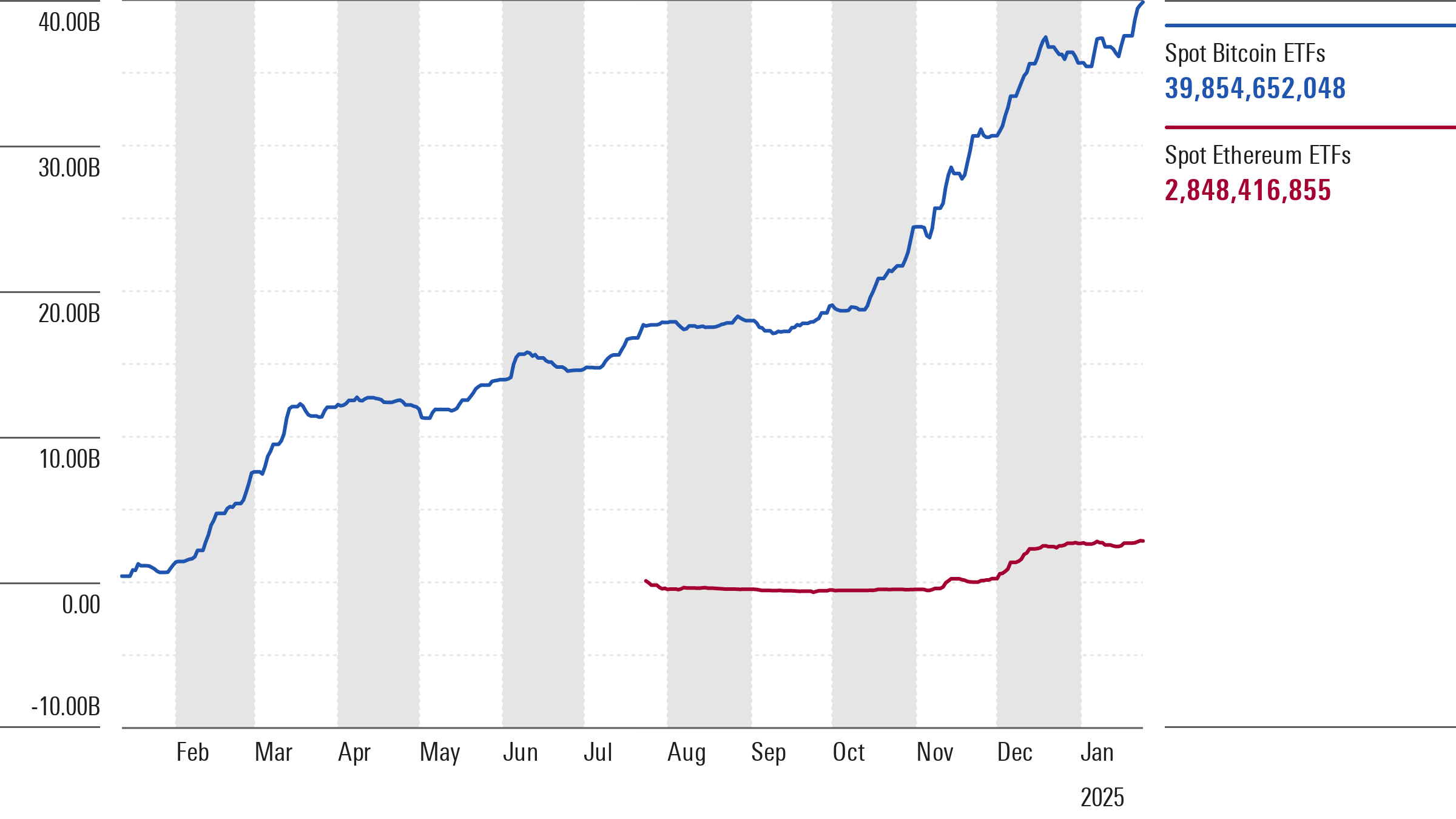
Even without approval, new crypto ETFs face an uphill battle. Spot ethereum ETFs saw significantly less investor interest than spot bitcoin ETFs, and I would expect a similar drop in interest with each new series of crypto ETFs.
Sluggish Inflows for Ethereum Suggest Crypto ETF Fatigue
Regulatory Clarity for Crypto
Last summer, I sat down with a group of advisors who were trying to understand what to make of spot bitcoin ETFs. They all wanted to do right by their clients and the law, but they didn’t know how. There was little to no guidance for what was allowed, and at the time the SEC was suing several crypto actors, including the custodian and surveillance-sharing partner of several bitcoin ETFs. It was unclear whether recommending a bitcoin ETF would run afoul of regulations. The only advice I could give on crypto compliance was, “I don’t know.”
On Jan. 23, President Trump issued an executive order to “strengthen American leadership in digital financial technology.” One of the order’s measures was for the SEC and other agencies to provide much-needed regulatory clarity on crypto. The order’s timelines are short, but the result should be clearer guidance for how advisors and institutions can comply with regulations while investing in crypto.
The author or authors do not own shares in any securities mentioned in this article. Find out about Morningstar’s editorial policies.

 United States