
13 Charts on Q4’s Big Postelection Rally—and Late Stumble
Despite ending on a weak note, stocks set record after record in 2024.


Stocks closed out 2024 with a strong fourth quarter, as the broader market set one record high after another thanks to healthy economic growth, widening earnings, and the Federal Reserve cutting interest rates. That’s not to mention the ongoing momentum from the artificial intelligence trade, which continued to captivate investors.
The results of the US election sent stocks soaring in November. But the party ended abruptly in December, when the Fed reduced its forecasts for more cuts amid slower progress on inflation and an uncertain policy outlook. Bonds had a tougher quarter, with yields steadily climbing throughout October and again after the election.
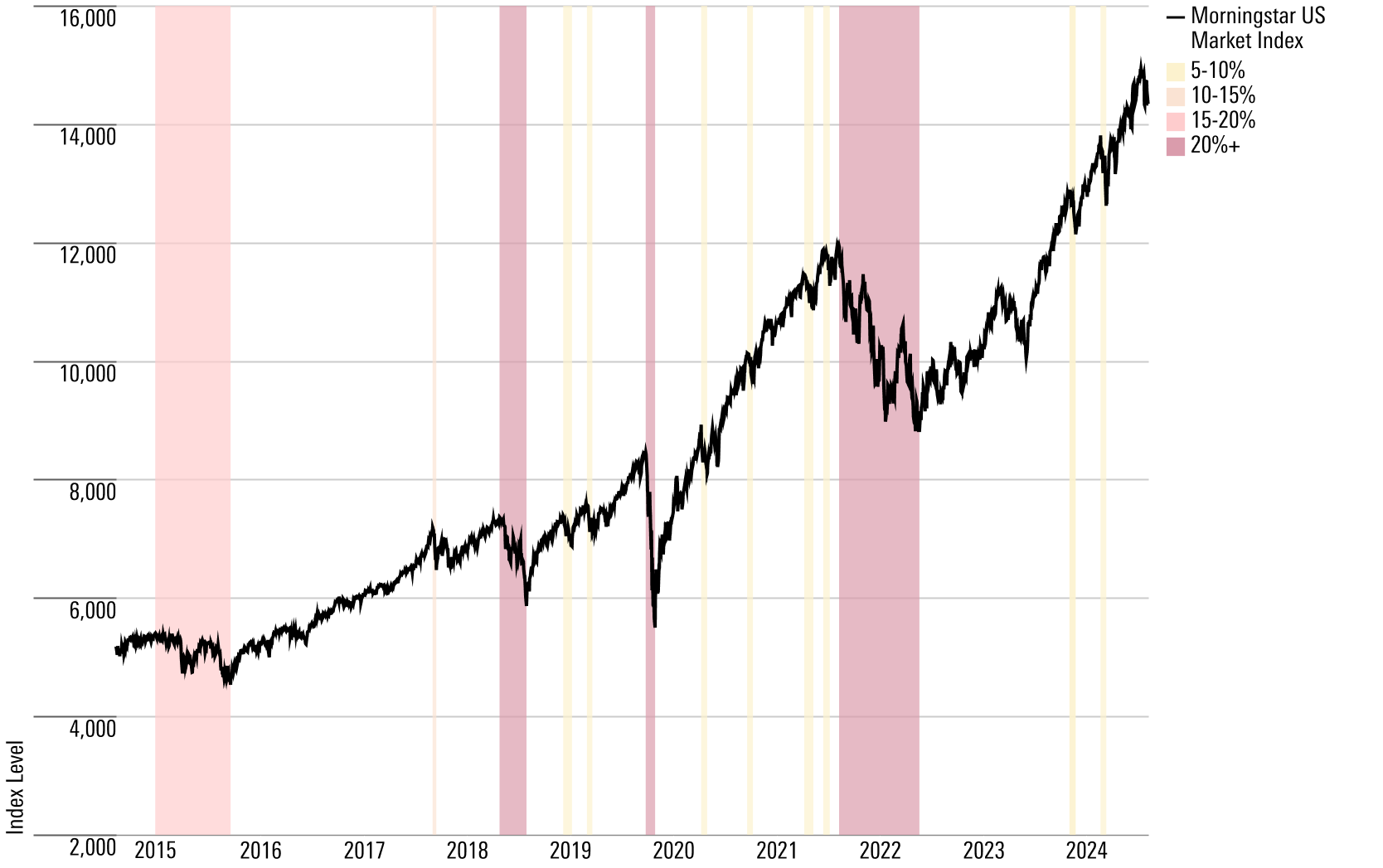
Despite the volatility in the quarter, it was a banner year for stock investors. The Morningstar US Market Index finished 2024 up more than 24%, hot on the heels of the 26.44% gain posted for 2023. Growth stocks continued building on a year of gains—they’re up 6.32% for the fourth quarter and 23.42% for 2024.
Across sectors and segments of the Morningstar Style Box that struggled late in the year, fourth-quarter losses weren’t enough to offset gains for 2024. Value stocks, for instance, were down 2.23% in the quarter but rose 13.77% over the last 12 months. Dividend stocks struggled in the quarter, but the Morningstar Dividend Composite Index gained 15.72% for the year.
Among the major segments of financial markets, only longer-term Treasury bond investors ended the year in the red, with the Morningstar US 10+ Yr Treasury Bond Index down 6.19%.
Key Stats: Q4 2024 Stock and Bond Market Performance
- The US Market Index recovered from an October rout to spend much of the quarter in the green as tech stocks came roaring back to life. Stocks tumbled at the end of December but finished up 2.57% for the quarter and 24.09% over the past year.
- Growth stocks regained ground after trailing value stocks in the third quarter. The Morningstar US Growth Index returned 6.32%, while the Morningstar US Value Index fell 2.23%.
- Bonds struggled as progress on inflation slowed and the results of the presidential election pointed to the possibility of more persistent price pressures down the road. The Morningstar US Core Bond Index fell 3.04% while yields on the 10-year Treasury note climbed 0.76% between October and December.
- Dividend stocks underperformed the broader market, ending the quarter with losses of 1.75%.
- The Fed cut interest rates twice in the quarter, at its November and December meetings. The target federal-funds rate range ended 2024 at 4.25%-4.50%.
- After un-inverting in the third quarter, the yield curve steepened slightly in the fourth as short-term interest rates fell while longer-term rates rose.
- Oil prices fell as global demand weakened, while gold prices slipped as the US dollar strengthened.
- Bitcoin prices soared after the election, with the most popular cryptocurrency reaching the $100,000 milestone in early December.
Q4 Stock Market Performance
The outcome of the November election sent stocks soaring, as investors cheered the likely boost to the markets from Republican policies like deregulation, tax cuts, and tariffs. Financial and energy stocks surged during election week, as did small caps.
More broadly, the fourth-quarter rally was dominated by the same technology stocks that have driven the market higher for the better part of the last two years. AI darling Nvidia NVDA gained more than 10% over the quarter after ending the previous quarter in the red. The Morningstar Wide Moat Composite Index, comprising stocks our analysts believe have the largest and most durable competitive advantages over their peers, was up 3.69%.
Under the hood, earnings continued to grow across sectors, and many analysts have confidence that the bull market will continue to broaden in its third year. Some of the biggest losses came in developed markets outside the United States and longer-term Treasury bonds, both of which saw declines of more than 7%.
Stock Market Pullbacks
Value vs. Growth Performance
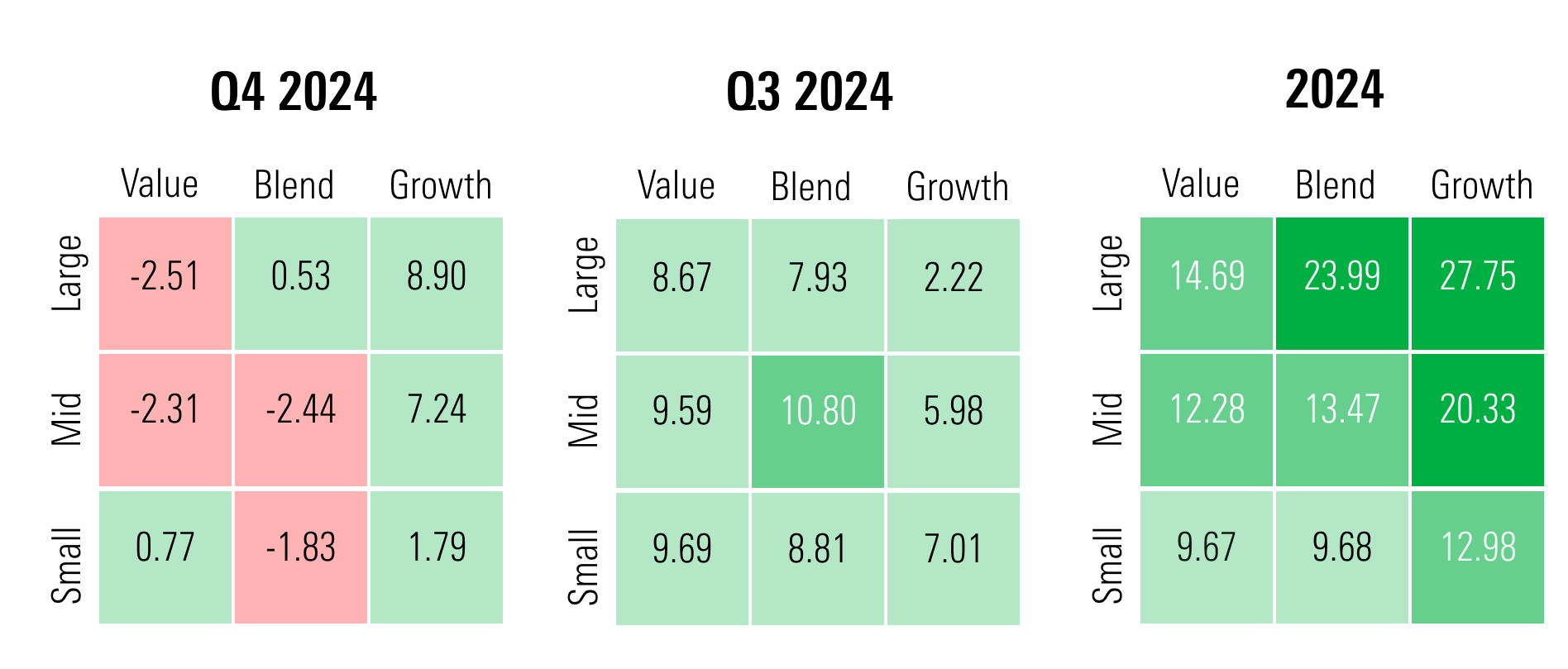
As tech roared back to life, growth stocks took the lead, while value stocks took a back seat. The US Value Index lost 2.23% for the fourth quarter, while the US Growth Index surged 6.32%—more than twice the broader market’s return.
Within the style box, large-cap growth stocks returned 8.9%, the most of any category. That’s a major change from the third quarter, when they lagged with returns of just 2.22%. Value lost ground across the capitalization spectrum, with large-cap value stocks seeing the biggest losses of 2.51%. Every category ended the year in the green, with the biggest gains again coming from large-cap growth.
US Equity Style Box Performance
Stock Sector Performance
Of the 11 major stock sectors, the biggest gains came from consumer cyclicals, with returns of 10.47%. Communication services (which includes Alphabet GOOGL/GOOG and Meta Platforms META) were next, with returns of 9.07%. Financial services stocks saw a major boost after the election and ended the fourth quarter with gains of 7.79%. Technology stocks were close behind, with returns of 5.61%.
Basic materials, healthcare, and real estate stocks ended the quarter deep in the red, each with losses of 7% or more. The turnaround was especially sharp for real estate, which returned nearly 17% in the third quarter. Every sector except basic materials ended the year in the green.
Q4 Dividend Stock Performance
Dividend stocks lagged the broader market in the quarter, with the Morningstar Dividend Composite Index down 1.8%. Investors like dividend stocks because they tend to generate steady, reliable returns and regularly pay cash back to shareholders. They usually align more with value stocks than growth, though a number of Big Tech growth companies have initiated dividends in recent years.
The Morningstar Dividend Leaders Index, which is made up of the 100 stocks from the Composite Index with the highest yields, lost 2.9%, while the Morningstar US Dividend Growth Index lost 1.6%.
Interest-Rate Whiplash
The Fed cut interest rates by 0.25% at its November and December meetings but shocked markets in December with a major change to its projections for 2025.
The target range for the federal-funds rate is now 4.25%-4.50%, a full percentage point lower than before the central bank began its policy easing cycle in September. The Fed’s most recent projections suggest just two more 0.25% cuts in 2025, down from four in its projections from the third quarter.
Central bankers have made clear that with price pressures remaining sticky, they are in no hurry to cut interest rates too quickly or deeply. Strategists say investors should be prepared for an environment in which rates remain significantly higher than their prepandemic lows.
Treasury Yield and Federal-Funds Rate
Q4 Bond Market Performance
Bond markets saw a major selloff in the fourth quarter, sparked by the outcome of the US presidential election and the potential for stronger economic growth, inflationary policies, and more deficit spending in the years ahead. Yields on the 10-year Treasury note rose from 3.78% at the beginning of the quarter to 4.54% at the end of the year.
As yields rose, bond investors saw losses. The US Core Bond Index was down 3.04% for the quarter, though it’s still up 1.36% for the year. The biggest losses came from long-term Treasury bonds, which fell more than 8%. Investors in short-term core bonds escaped that kind of damage, with that category down less than 1% for the quarter.
Overall, analysts expect the bond market to remain volatile in 2025, but they don’t anticipate another dramatic runup in yields.
Treasury Yield Curve Steepens Slightly
After normalizing in the third quarter, the Treasury yield curve steepened slightly over the past three months. The curve is a graphical representation of government bond yields across different maturities, most commonly two-year and 10-year Treasury notes.
In general, investors expect bonds with longer maturities to pay higher yields to compensate for the extra risk (especially from inflation) involved with leaving their money locked up with the government for longer. However, for about a two-year period ending in September, two-year note yields were higher than 10-year note yields—a dynamic known as an inverted yield curve. As the Fed cut interest rates in the fourth quarter, the front end of the curve, which tracks bonds with shorter maturities, moved lower. As longer-term yields rose because of higher inflation expectations and uncertainty about the future, the back end moved higher. The result was a steeper curve: a spread of 0.33 percentage points at the end of the fourth quarter versus 0.15 points at the end of the third.
US Treasury Yield Curves
Stock and Bond Market Volatility
Through October’s surge, December’s selloff, and volatility in the US stock market, developed and emerging markets fell in the fourth quarter compared with the third but remained well below their five-year averages. Volatility in the US bond market remained in line with the last two quarters and the five-year average.
Global Market Performance
The US market led its global counterparts by a significant margin in the quarter, thanks to strong performance from large- and mid-cap stocks. European stocks saw the greatest losses and were down 9.04% over the quarter. Chinese markets didn’t fare much better, with losses of 8.34%.
Commodity Market Performance
West Texas Intermediate crude prices—a benchmark for American oil prices—fell 3.58% in the quarter. This was an improvement over the third quarter’s losses of more than 18%, spurred by an uptick in production and flagging demand from China. More stable oil prices meant gasoline prices didn’t fall as dramatically over the past three months, which helped keep inflation relatively sticky.
Gold prices also fell in the fourth quarter, with losses of 0.63%. A stronger dollar on the back of the US election was one factor that pushed gold prices lower, along with the prospect of a stronger economy in the year ahead. Investors generally buy gold as a hedge against uncertainty or losses in other financial markets.
Copper prices, which are widely seen as a proxy for demand for industrial activity, fell 11.86%.
Commodity Futures Performance
Cryptocurrency Performance
Cryptocurrencies surged across the board in the fourth quarter after the November election, as advocates cheered what they expect to be a crypto-friendly presidential administration. Investors had even more reason to celebrate, as bitcoin cleared a price of $100,000 in early December. Over the fourth quarter, bitcoin gained 52.12%, while ether, the second-largest cryptocurrency, returned 38.87%.
Cryptocurrency Performance
The author or authors do not own shares in any securities mentioned in this article. Find out about Morningstar’s editorial policies.

 United States