
The Biggest ESG Risk You May Not Know About
Only 34 funds target biodiversity. The single US fund closed down.



The loss of biodiversity—which means the decline in the richness and variety of plants and animals in the natural ecosystem—has emerged as a severe new risk for investors. The World Economic Forum’s latest Global Risks Report identifies biodiversity loss and ecosystem collapse as the third most severe risk over the next 10 years. More than 50% of global gross domestic product is moderately or highly dependent on natural ecosystems.
Businesses have been major contributors to the decline of biodiversity—for example, through land use changes owing to agricultural expansion, climate change caused by greenhouse gas emissions, the overexploitation of natural resources, and pollution.
As a result, businesses also play a central role in halting and reversing biodiversity loss.
Since 2022, various regulations, frameworks, and coalitions have emerged to help investors assess biodiversity-related risks and impacts for businesses. One high-profile framework is the Taskforce on Nature-related Financial Disclosures. Over 400 companies intend to adopt the TNFD recommendations.
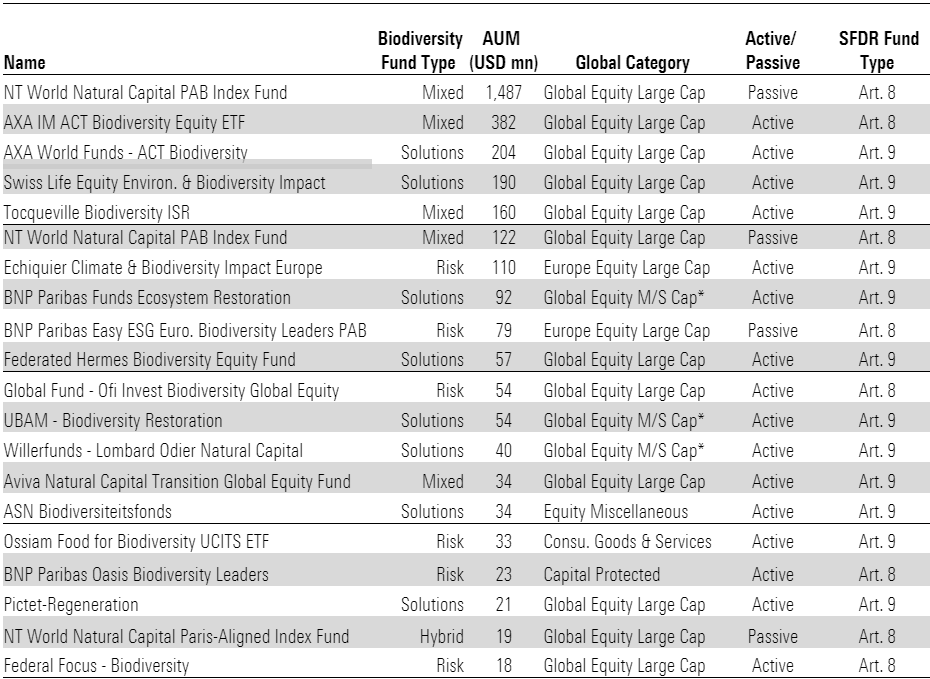
Progress in considering biodiversity in investment decisions remains slow. Equally, it is rare to find investment strategies that specifically focus on biodiversity. We identified only 34 open-end funds and exchange-traded funds in the Morningstar Direct database that specifically target biodiversity and natural capital as an investment theme, and all targeted European investors. The single product available in the US, the Karner Blue Biodiversity Impact fund, closed in February 2024.
In a report published this week, we explore the growing landscape of biodiversity funds, which currently account for $3.7 billion of assets. We subdivide them into three categories: risk-oriented, mixed, and solutions-focused.
Three Types of Biodiversity Funds
Three Types of Biodiversity Funds
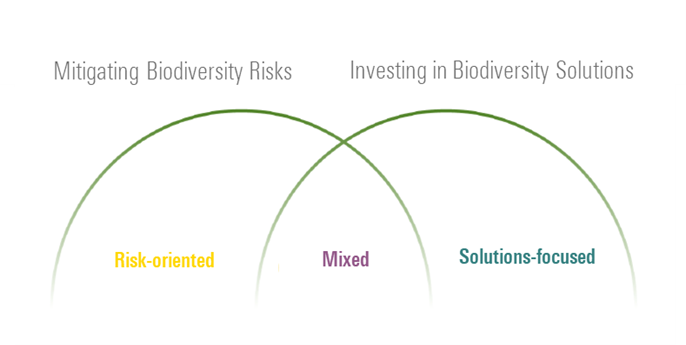
Biodiversity risk-oriented funds typically invest only in companies that aim to reduce their negative impact on biodiversity. For example, they consider water efficiency, waste reduction, and biodiversity protection, especially in sectors that are either highly dependent on nature and its services, such as agriculture, food and beverage, and construction. Risk-oriented funds also typically exclude companies involved in activities that harm ecosystems.
Examples of popular stocks held by biodiversity risk-oriented funds include Compass Group CMPGY, a leading global provider of contract food services and support services. Compass Group integrates biodiversity into its sustainability strategy by focusing on responsible sourcing and reducing its environmental footprint.
Meanwhile, solutions-focused funds target companies that help to protect and restore biodiversity through their products or services. For example, Xylem XYL, held by 11 solutions-focused funds, is a global water technology company that develops solutions for water and wastewater management. Also featured among the most popular holdings is Deere DE, a leading manufacturer of agricultural, construction, and forestry machinery.
The third group of biodiversity funds, the mixed one, aims to do both.
Each of the three distinct strategy types plays a different role in an investment portfolio, ranging from reducing risks in a portfolio to investing in alpha-generating opportunities.
Global assets held in biodiversity open-end funds and ETFs more than doubled over the past three years, boosted by product development. Over $800 million is invested in solutions-oriented funds.
Assets More Than Doubled
Assets in Biodiversity Open-End Funds and ETFs More Than Doubled in Three Years
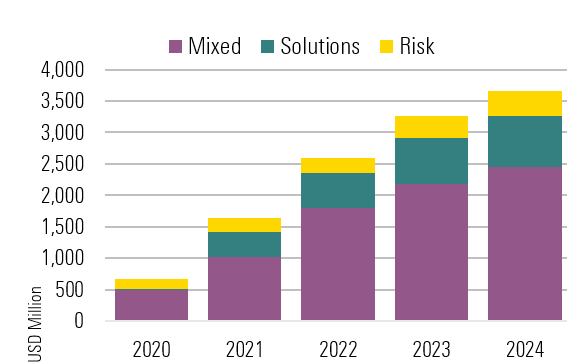
Biodiversity has a long way to go as an investment theme. Despite the rapid growth, the biodiversity fund universe is dwarfed by the $530 billion climate fund market.
As with other funds focused on environmental, social, and governance issues, 2024 has been tough for biodiversity funds. They have experienced negative flows of $70 million in the first eight months of the year, compared with net inflows of $1.22 billion last year and $1.53 billion in 2022.
What About Flows?
Flows Into Biodiversity Funds
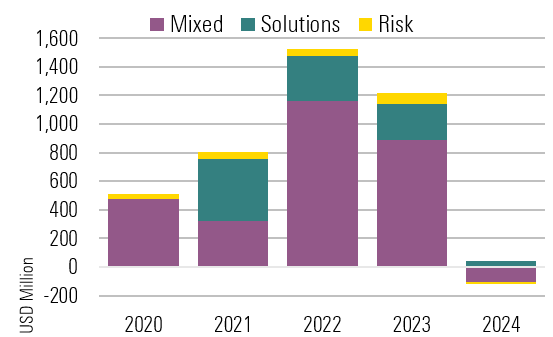
The biggest outflows were registered by biodiversity mixed funds, including one with a dual mandate, NT World Natural Capital PAB Index Fund. This fund tracks a Paris-aligned benchmark that increases exposure to companies that are associated with positive contribution to the environment through their products or services, or through their management of natural-capital-related risk.
Among the largest outflows, we also found Federated Hermes Biodiversity Equity Fund, which bled $40 million for the year to date. Other funds registered smaller outflows.
But some funds garnered positive flows, mostly on the solutions side. Pictet-Regeneration Solutions pulled $62 million and AXA World Funds-ACT Biodiversity Solutions attracted $19 million.
That said, the overall trend for biodiversity-solutions funds remains positive. Investor surveys show that there is still an appetite for investments that seek positive environmental outcomes and have the potential to deliver alpha at the same time. Companies offering products and services that contribute positively to the protection and restoration of natural ecosystems will benefit from the growing need to address the biodiversity crisis in years to come.
Top 20 Biodiversity Open-End Funds and ETFs
US and European Companies Dominate Biodiversity Portfolios
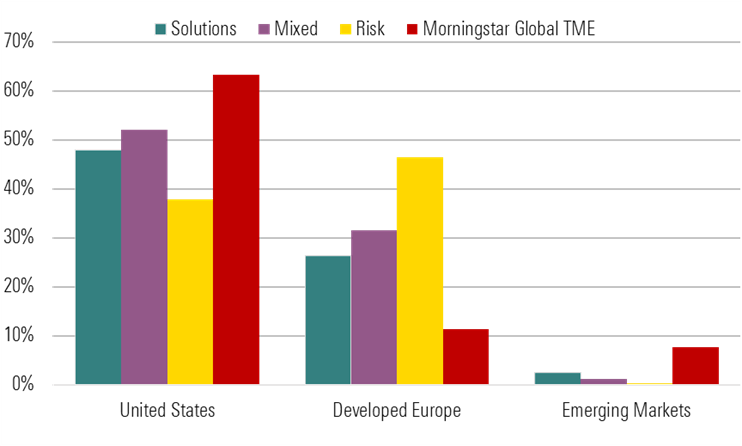
US and European firms dominate biodiversity fund holdings, with virtually no exposure to emerging markets. This is partly because the former have lower ESG risks compared with the latter, and they have more policies to address biodiversity loss. Moreover, the former have more resources to innovate and develop biodiversity-related solutions that will help the rest of the economy, including emerging markets, reduce their biodiversity footprint.
On average, the funds are underweight US companies and overweight developed European companies.
Geographic Exposure
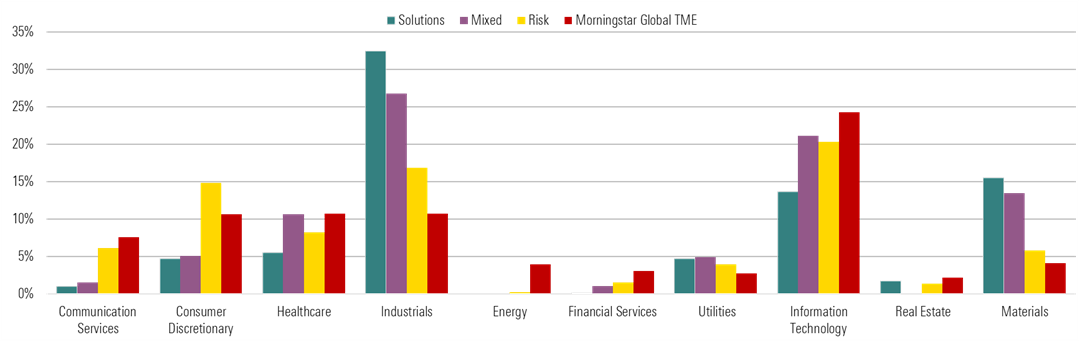
Biodiversity Funds Overweight in Industrials and Materials
The average solutions-focused fund is 3 times more exposed to industrials than the global market benchmark, making them much more sensitive to economic cycles.
Biodiversity funds underweight information technology, but that sector represents the second-largest sector exposure, followed by materials. Biodiversity funds have virtually no exposure to the energy sector.
Average Sector Exposure of Biodiversity Funds by Strategy Type
To read the full paper, click here.
The author or authors do not own shares in any securities mentioned in this article. Find out about Morningstar’s editorial policies.

 United States