
Key Statistics About Income and Wealth for the US Hispanic Population
Some facts and figures for National Hispanic Heritage Month.


Every year since 1968, the US has celebrated the cultures and histories that originated from Spain, Mexico, the Caribbean, and Central and South America. National Hispanic Heritage Month is observed from Sept. 15 to Oct. 15.
In the spirit of Hispanic Heritage month and to illuminate the financial challenges that some individuals in the Hispanic community face, we’ve compiled statistics about Hispanic income, wealth, and financial wellness.
You’ll notice some differences in the terminology used. The terms Hispanic and Latino are often used interchangeably, even though they mean different things. Morningstar uses Hispanic or Latino because the surveys cited use these terms and respondents self-select into this category.
The Hispanic Population Is Large … and Growing
Some 17.8% of the US population older than 16 identifies as Hispanic or Latino, according to a 2023 survey conducted by the Bureau of Labor Statistics. The entire group expanded population by 23.8% between the third quarter of 2014 and the third quarter of 2023.
Longer term, the group is growing far more swiftly than the rest of the population. According to the US Census Bureau, the Hispanic or Latino population was 62.1 million in 2020. That was up 23% since the 2010 census. By comparison, the population that was not of Hispanic or Latino origin grew 4.3%.
America’s Hardworking Hispanic Population
Labor force participation among Hispanics is higher than the national average, according to a BLS study. For Hispanics, the labor force participation rate for individuals 16 and older was 67.2%. By comparison, the standard labor force participation rate was 62.9%.
Indeed, nearly one in five workers (19.0%) in the labor force are Hispanic. The Bureau of Labor Statistics forecasts that the Hispanic labor force will account for 21.9% of the overall labor force in 2032. Latinas are now the second-largest group of female workers in the US.
US Labor Force Participation
Hispanic Income, Poverty, and Financial Stress
Wealth varies widely among Hispanic groups, as does each group’s ability to accumulate wealth, according to US Census Bureau’s 2021 Survey of Income and Program Participation.
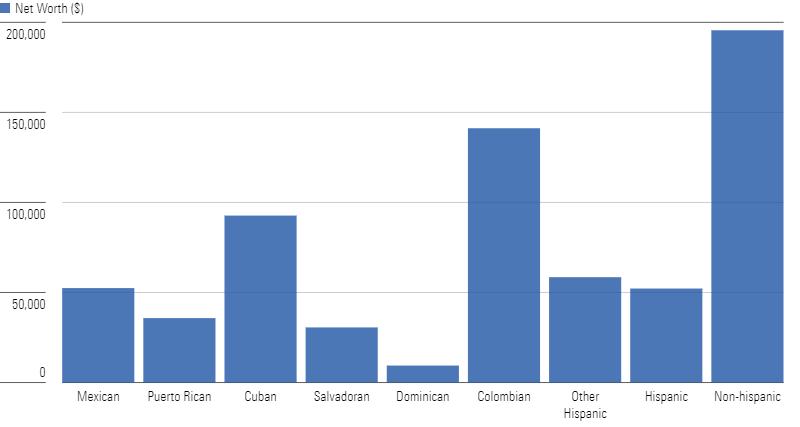
The median net worth for all Hispanic households in the US was $52,190 in 2020. That means that half lived in a household with a net worth at or below, and half with a net worth at or above that amount. The median household net worth for non-Hispanic individuals was nearly quadruple that number: $195,600.
Median Household Net Worth by Origin: 2020
Poverty is high. The poverty rate for Hispanics of any race was 16.9% in 2022, higher than the overall poverty rate of 11.5%, according to the US Census Bureau. This was exacerbated by the pandemic, when Latinos suffered more employment-related hardships than the general population. Of those Latinos, 17.7% temporarily lost jobs, while 9.6% permanently lost their job or had to close their business.
But while the wealth gap for Hispanics is large—it is narrowing. In 2022, the general population had more than twice the wealth of Hispanic households, according to the Board of Governors of the Federal Reserve System and Polygon Research. In 2022, non-Hispanic white households held on average $4.47 for every $1 held by Latino households. That has narrowed from $8.87 in 2013.
Business ownership is also growing. According to the Board of Governors of the Federal Reserve System and Polygon Research, between 2019 and 2022, the number of self-employed Hispanic households rose by 64.6% to 1 million. During the same period, median business equity held by self-employed Hispanic households grew 37.6%, from $114,822 to $158,000.
Hispanic Housing and Homeownership
Much of the progress in household wealth comes from homeownership. In 2023, the Hispanic homeownership rate was 49.9%, according to the US Census Bureau.
A third of Hispanic household wealth came from home equity in a primary residence in 2022. That compares with 26.7% in 2013. Real estate accounts for 45.5% of Hispanic household wealth, according to the Board of Governors of the Federal Reserve System and Polygon Research.
Financial and Retirement Preparedness for the Hispanic Population
Eleven percent of Hispanic adults were “unbanked” in 2023, meaning that neither they nor their spouse or partner had a checking, savings, or money market account. This rate is higher than the average 6% unbanked rate for all adults. Unbanked rates were also higher among younger adults, Black and Hispanic adults, and adults with a disability, according to the Federal Reserve Board Publication.
Hispanic workers also lag in retirement plan participation. Some 33.1% of 21-to-64-year-old Hispanic salaried workers participate in retirement plans, substantially lower than the 52.1% of salaried workers who do so overall, according to T. Rowe Price.
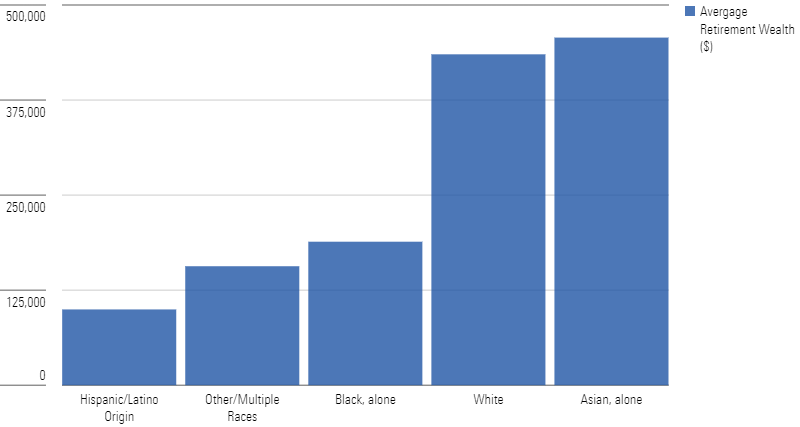
The mean retirement wealth of Hispanic/Latino households was 22.9% of that of white households in 2022, according to the SOA Research Institute.
2022 Household Retirement Wealth
Growth Is Promising for the Hispanic Community
Latinos play a vital role in driving entrepreneurship. According to the Census Bureau and US Department of Commerce, in 2021, US Latinos owned 5.1 million of the 34.4 total employer and nonemployer businesses in the United States. US Latino-owned businesses were also innovating by using cutting-edge technologies, such as artificial intelligence—in fact, they implemented AI technologies at twice the rate of Caucasian-owned businesses, considering employer firms with at least $10,000 in revenue.
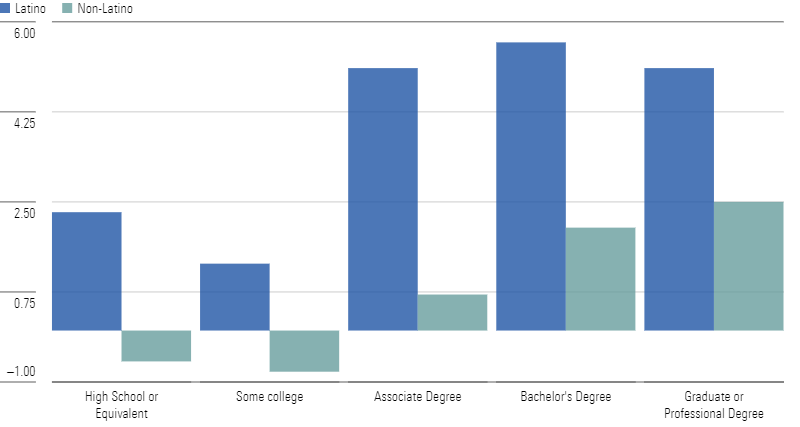
Education attainment is also encouraging for Latinos. Between 2010 and 2022, the percentage of US Latinos holding at least a bachelor’s degree increased to 13.6% from 8.9%, while those with a graduate or professional degree increased to 6.8% from 4.1%. The number of US Latinos leaving high school without a diploma also declined. On a year over-year basis, the growth rate for Latinos with bachelor’s and graduate degrees in 2022 was 2.8 times and 2.0 times faster, respectively, than it was for non-Latinos, according to the US Department of Commerce.
Education Attainment Changes for Latinos from 2021-22
The author or authors do not own shares in any securities mentioned in this article. Find out about Morningstar’s editorial policies.

 United States